


Shares in Nvidia Corp’s Taiwanese suppliers mostly closed higher yesterday on hopes that the US artificial intelligence (AI) chip designer would showcase next-generation technologies at its annual AI conference slated to open later in the day.
The GPU Technology Conference (GTC) in California is to feature developers, engineers, researchers, inventors and information technology professionals, and would focus on AI, computer graphics, data science, machine learning and autonomous machines.
The event comes at a make-or-break moment for the firm, as it heads into the next few quarters, with Nvidia CEO Jensen Huang’s (黃仁勳) keynote speech today seen as having the ability to stave off fears that the chipmaker’s sales boom is peaking.
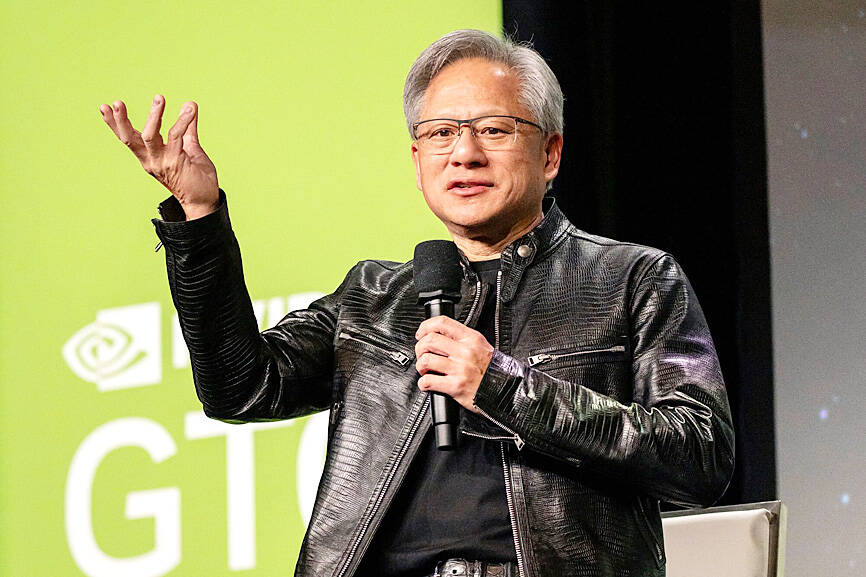
Photo: David Paul Morris, Bloomberg
Top of mind for investors would be updates on the company’s Blackwell product line, and commentary on gross margins, China, competitors and growth. Huang is also slated to appear with a group of industry executives on a panel on Thursday about the future of quantum computing.
More than 20 Taiwanese companies would be joining the five-day conference this week through Friday, either as exhibitors or sponsors. They include Taiwan Semiconductor Manufacturing Co (TSMC, 台積電), Asustek Computer Inc (華碩), Lite-On Technology Corp (光寶), Hon Hai Precision Industry Co (鴻海), Quanta Cloud Technology Inc (雲達), Delta Electronics Inc (台達電) and Advantech Co (研華).
Following Nvidia shares’ 5.3 percent increase on Friday amid a rebound on Wall Street, TSMC gained 1.15 percent, Asustek rose 2.63 percent, Delta increased 4.1 percent, Advantech climbed 0.39 percent and Lite-On moved up 1.42 percent yesterday in Taipei trading. However, iPhone assembler and AI server maker Hon Hai lost 1.18 percent.
The TAIEX closed up 150.58 points, or 0.69 percent, at 22,118.63.
“The local main board rode the wave of expectations about Nvidia’s conference, as many investors have high hopes the AI giant will unveil the next generation AI server GB300, which is likely to benefit its Taiwanese suppliers,” Hua Nan Securities Co (華南永昌證券) analyst Kevin Su (蘇俊宏) said.
Nvidia shares remain down more than 9 percent this year, despite a recent rebound from a March trough. Investors are hoping Huang’s speech can deliver enough optimism to help sustain the stock’s recent rebound.
“The fear of Nvidia is we are at peak earnings right now and that the second half of the year isn’t going to be nearly as good as they outlined,” Wayve Capital Management chief strategist Rhys Williams said. “When he [Huang] goes onstage he may be able to give people some comfort that things are going well and that the wheels aren’t falling off.”
Additional reporting by Bloomberg
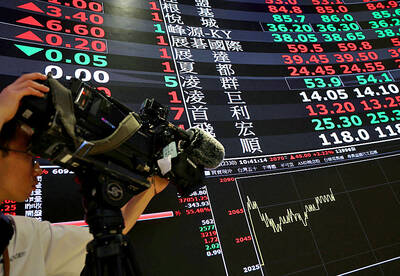
After several years flying high as Asia’s best Nvidia Corp proxy, Taiwan Semiconductor Manufacturing Co (TSMC, 台積電) is increasingly vying with other artificial intelligence (AI) stocks for investor attention. Stock traders are chasing a wider array of beneficiaries as mainstream usage of AI creates demand for hardware beyond the most-advanced chips TSMC makes for Nvidia. Subthemes from the deepening memory crunch to advances in robotics are also luring bids. At the same time, investment caps on single stocks are pushing funds to diversify, while retail investors long familiar with TSMC through its US depositary receipts are being offered a broader set of
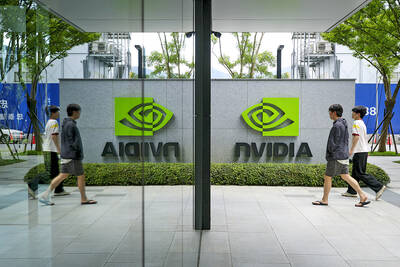
UNDER MICROSCOPE: Taiwan detained three people who allegedly conspired to buy servers in Taiwan and export them using fraudulent documentation, prosecutors said Nvidia Corp chief executive officer Jensen Huang (黃仁勳) on Saturday urged Super Micro Computer Inc to tighten up on compliance after Taiwan detained three people this week for allegedly making fraudulent declarations about artificial intelligence (AI) servers made by its US partner. The development marked the nation’s first crackdown on semiconductor smuggling, which grew after the US slapped restrictions on exports of high-end chips such as Nvidia AI accelerators to China. Nvidia is “rigorous” in explaining regulations to all of its partners, Huang told reporters after arriving in Taipei. “Ultimately Super Micro has to run their own company,” he said in response to
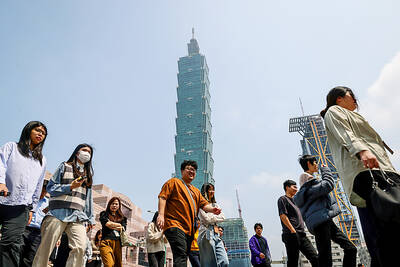
TECH RELIANCE: Growth is increasingly reflecting an unequal K-shaped distribution, where technology sectors outperform and other industries struggle, an expert said Standard Chartered Bank has significantly raised its forecast for Taiwan’s economic growth to 9.5 percent this year, up from 7.6 percent previously, citing surging artificial intelligence (AI) demand driving exports, semiconductor production and investment. The upgrade reflects a sustained AI supercycle that continues to fuel demand for advanced chips and technology infrastructure, which form the backbone of Taiwan’s exports, the bank said in a report this week. “We raise our 2026 growth forecast to reflect a much stronger-than-expected first-quarter GDP figure,” Standard Chartered senior economist for greater China and Asia Tommy Wu (胡東安) said in the report. Driven largely by a 35.3 percent
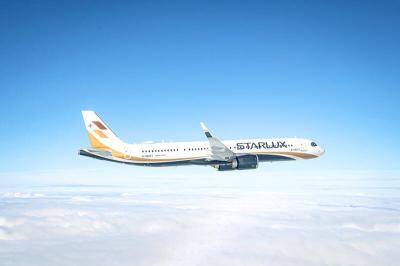
Two of Taiwan’s international carriers, Starlux Airlines Co (星宇航空) and EVA Airways Corp (長榮航空), have retained the five-star airline rating awarded by international airline review organization Skytrax. Starlux was awarded the distinction for a second consecutive year, while EVA Air received it for the 11th straight year, Skytrax said in statements released yesterday and on Thursday last week, respectively. The five-star rating is considered one of the airline industry's highest honors and is awarded following professional audits of airline product and frontline service standards, Skytrax said. The ratings are based on in-depth assessments using unified global quality standards rather than customer review scores


 RSS
RSS