


Australian Minister for Industry and Science Ed Husic yesterday raised privacy concerns over China’s breakout artificial intelligence (AI) chatbot DeepSeek (深度求索), urging users to think carefully before downloading it.
Developed by a China-based technology start-up, the DeepSeek chatbot has astounded industry insiders and upended financial markets since it was released last week.
Praised for its ability to match Western competitors at a fraction of the cost, DeepSeek has surged to the top of app download charts, displacing market leader ChatGPT. The start-up said on Monday it was limiting the registration of new users due to large-scale cyberattacks on its services.
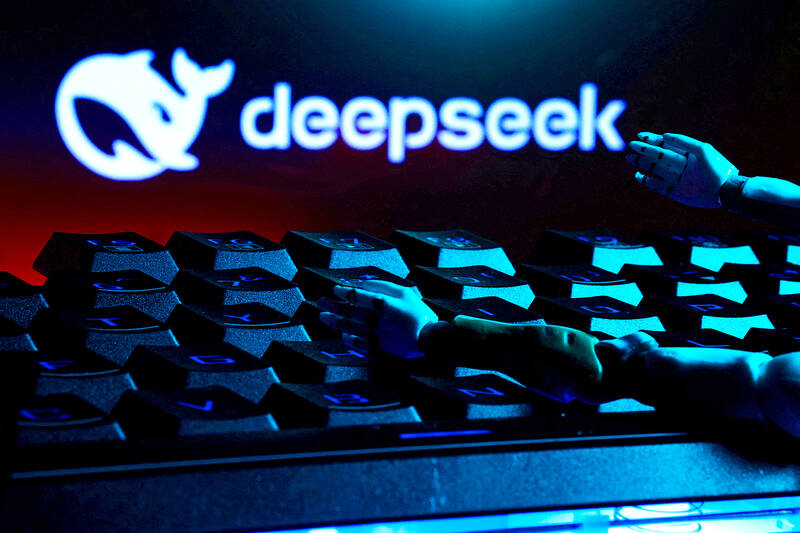
Photo: Reuters
While DeepSeek has shown the ability to match the capacity of AI pace-setters such as Nvidia Corp, Husic urged caution.
“There are a lot of questions that will need to be answered in time on quality, consumer preferences, data and privacy management,” Husic told national broadcaster ABC. “I would be very careful about that. These types of issues need to be weighed up carefully.”
Husic said Chinese companies sometimes differed from Western rivals when it came to user privacy and data management.
“The Chinese are very good at developing products that work very well. That market is accustomed to their approaches on data and privacy,” he said.
“The minute you export it to markets where consumers have different expectations around privacy and data management, the question is whether those products will be embraced in the same way. I think you have to be careful, I’m just being completely frank and direct on that,” Husic said.
Australia in 2018 banned Chinese telecommunications giant Huawei Technologies Co (華為) from its national 5G network, citing national security concerns.

Cairo’s new monorail slices across the city skyline, running above the familiar chaos of blaring horns and aging buses’ exhaust fumes that mark rush hour below. The US$4.5 billion monorail, opened this month, is among Egypt’s most prominent new transport projects, part of a debt-funded infrastructure drive criticized for sapping state finances while bringing limited benefits to most of the country’s 109 million people. “It feels like you’re in a different country,” said Ramy Sayed, a restaurant manager, aboard a driverless Innovia 300 train. “No noise, no traffic, we’re not used to this.” The eastern line runs 56km from the bustling middle-class
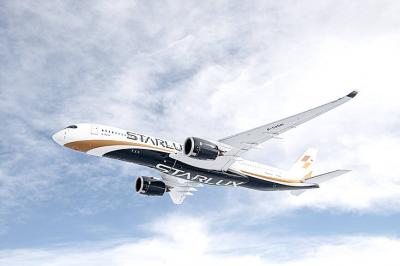
Starlux Airlines Co (星宇航空) today unveiled a long-haul network expansion plan at a shareholders’ meeting in Taipei, including direct flights to Barcelona, Spain, and Zurich, Switzerland, as well as a service connecting Taipei, Sydney and New Zealand. Starlux is to become the first Taiwanese carrier to offer non-stop services to the two European cities, while the inaugural oceanic route is expected to expand transit opportunities within the Australia-New Zealand market, Starlux said. Flight services to Chicago, Dallas, Washington and New York are under evaluation, the airline added. Prior to the shareholders’ meeting, the airline earlier this year announced that it would be

Taiwanese prosecutors suspect that three people successfully smuggled at least one shipment of Nvidia Corp artificial intelligence (AI) chips to China after first exporting them to Japan, people familiar with the matter said. The trio was detained last week by the Keelung District Prosecutors’ Office for allegedly falsifying documents related to exports of Super Micro Computer Inc servers containing advanced Nvidia chips, which the US has barred from sale to China without a license from Washington. The move marked Taiwan’s first public crackdown on AI chip diversion after years of pressure from the US to take a more active role in curtailing

Taiwan Semiconductor Manufacturing Co (TSMC, 台積電) employee bonuses are likely to grow more than 30 percent this year, in line with the past few years as the company’s profits continue to set new records, an anonymous source cited TSMC chairman C.C. Wei (魏哲家) as saying yesterday. TSMC, the world’s largest contract chipmaker, is committed to taking care of its workers, the source said, citing Wei’s meeting with employees yesterday morning. Wei also expressed gratitude to employees for their contribution to the company’s improving bottom line, the source added. Since 2023, TSMC’s employee bonuses have grown at an annual rate of


 RSS
RSS