


The nation’s eight major state-run banks extended NT$35.56 billion (US$1.08 billion) in preferential housing loans for first-home buyers last month, up 5.23 percent from NT$33.79 billion the previous month and ending six consecutive months of declines, Ministry of Finance data showed yesterday.
The eight banks approved 4,571 preferential loan applications last month, up 5.49 percent from 4,333 the previous month and also the first increase in six months, the data showed.
The eight banks are Bank of Taiwan (臺灣銀行), Land Bank of Taiwan (土地銀行), Hua Nan Commercial Bank (華南銀行), Taiwan Cooperative Bank (合作金庫銀行), First Commercial Bank (第一銀行), Chang Hwa Commercial Bank (彰化銀行), Mega International Commercial Bank (兆豐銀行) and Taiwan Business Bank (臺灣企銀).
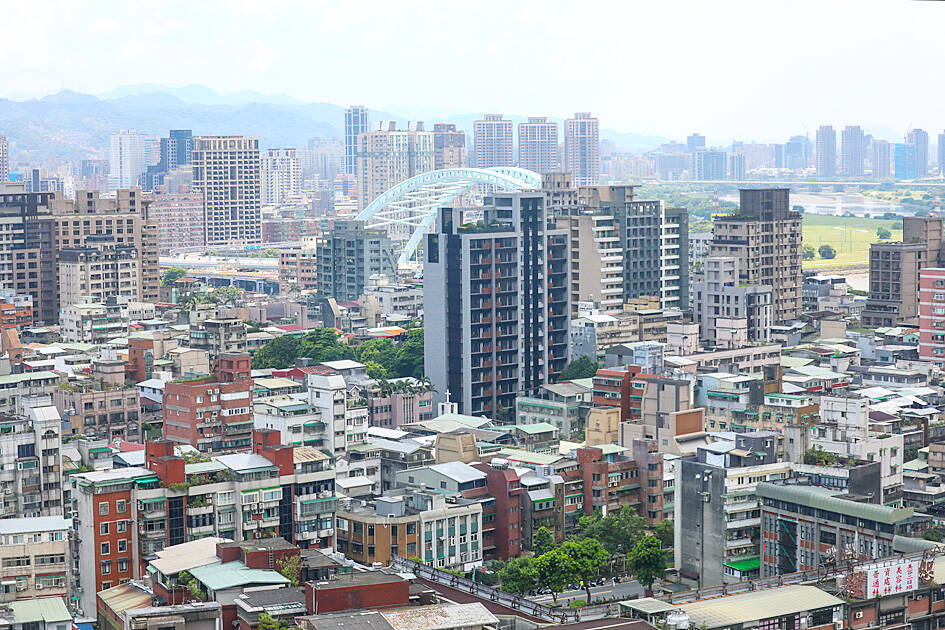
Photo: CNA
The ministry said the increases in the size of loans extended and the number of applications accepted last month was due to the traditional high season for new property deliveries before the end of the year.
Approved, but not-yet funded loans in accordance with related regulations under the Banking Act (銀行法) also helped free up some space for the banks to take on new preferential loan cases, it said.
Under the ministry’s instruction, the eight banks in August 2023 began to provide additional support to first-home buyers through a new mortgage initiative after the banking sector’s average mortgage rate exceeded the 2 percent mark.
The program offers more flexible conditions for loan applications than a previous similar scheme, such as increasing the maximum loan amount from NT$8 million to NT$10 million, extending the loan period from 30 to 40 years, and expanding the grace period for repayment from three years to five years.
Together, the government and the banks subsidize 0.375 percent of the interest rate, allowing people to buy their first home at a favorable interest rate as low as 1.775 percent, with the interest subsidy lasting until July 31 next year.
However, it has also drawn criticism for rekindling a hot housing market, prompting the central bank to introduce new credit control measures and forcing the ministry to crack down on abuses of the favorable loans since July last year.
For the whole of last year, the program approved about 74,000 preferential loan applications totaling NT$575.37 billion, accounting for more than 40 percent of the total new mortgages in the year, ministry data showed.

The EU and US are nearing an agreement to coordinate on producing and securing critical minerals, part of a push to break reliance on Chinese supplies. The potential deal would create incentives, such as minimum prices, that could advantage non-Chinese suppliers, according to a draft of an “action plan” seen by Bloomberg. The EU and US would also cooperate on standards, investments and joint projects, as well as coordinate on any supply disruptions by countries like China. The two sides are additionally seeking other “like-minded partners” to join a multicountry accord to help create these new critical mineral supply chains, which feed into

For weeks now, the global tech industry has been waiting for a major artificial intelligence (AI) launch from DeepSeek (深度求索), seen as a benchmark for China’s progress in the fast-moving field. More than a year has passed since the start-up put Chinese AI on the map in early last year with a low-cost chatbot that performed at a similar level to US rivals. However, despite reports and rumors about its imminent release, DeepSeek’s next-generation “V4” model is nowhere in sight. Speculation is also swirling over the geopolitical implications of which computer chips were chosen to train and power the new

Elon Musk’s lieutenants have reached out to chip industry suppliers, including Applied Materials Inc, Tokyo Electron Ltd and Lam Research Corp, for his envisioned Terafab, early steps in an audacious and likely arduous attempt to break into the production of cutting-edge chips. Staff working for the joint venture between Tesla Inc and Space Exploration Technologies Corp (SpaceX) have sought price quotes and delivery times for an array of chipmaking gear, people familiar with the matter said. In past weeks, they’ve contacted makers of photomasks, substrates, etchers, depositors, cleaning devices, testers and other tools, according to the people, who asked not to

Japan approved ¥631.5 billion (US$3.97 billion) in additional subsidies to hasten Rapidus Corp’s entry into the high-stakes artificial intelligence (AI) chipmaking arena, ramping up support for a project widely regarded as a long shot. The capital is intended to bankroll Rapidus’ work for information technology firm Fujitsu Ltd, one of the initial customers that Tokyo hopes would get the signature endeavor off the ground. The new money raises the fees and investments that the government is injecting into the start-up to ¥2.6 trillion by the end of the current fiscal year to March next year, the Japanese Ministry of Economy, Trade and


 RSS
RSS