

Sales in the retail sector last month increased 1.8 percent from a year earlier to NT$438.1 billion (US$13.41 billion), a record high, reversing an annual decrease of 0.5 percent in the previous month, the Ministry of Economic Affairs said on Monday.
The ministry attributed the improvement in retail sales to the effects of anniversary sale events, the Double 11 Singles’ Day online shopping festival, store expansions, new product launches and special promotions associated with Taiwan’s victory in the World Baseball Softball Confederation’s Premier12 tournament.
They collectively led to annual increases of 6 percent in sales at convenience stores, 9.4 percent at supermarkets, 7.4 percent at hypermarkets, 3.1 percent at department stores, 5.2 percent at cosmetics outlets, 3.3 percent at household appliance stores and 2.1 percent at apparel shops, it said.
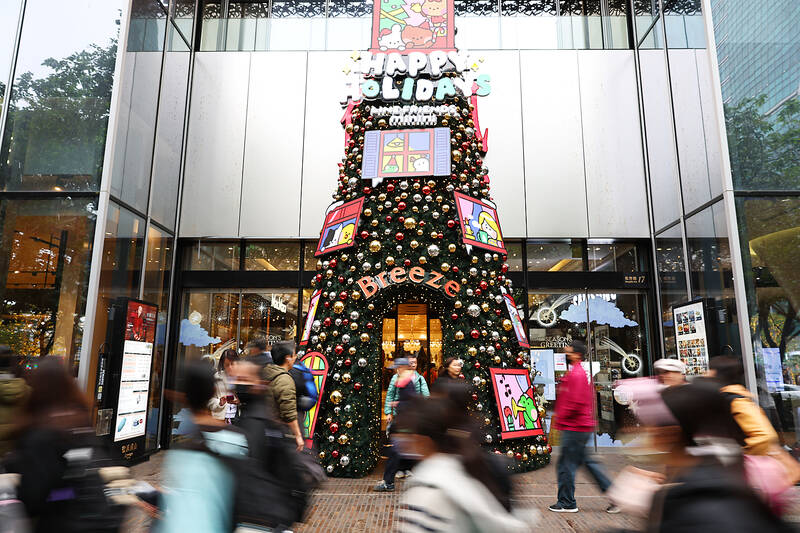
Photo: CNA
That helped offset a drop in sales at auto dealers, the ministry said, adding that sales of cars, motorcycles, auto parts and accessories decreased 4.1 percent last month.
Cumulative sales in the first 11 months of the year totaled NT$4.42 trillion, up 2.5 percent from a year earlier, marking the highest level for the same period on record, it said.
For this month, the ministry forecast retail sales to be NT$433.1 billion to NT$445.8 billion, representing growth of 2.9 percent to 5.9 percent on an annual basis.
It also forecast that retail sales for the whole of this year would increase by 2.6 percent to 2.8 percent to between NT$4.85 trillion and NT$4.86 trillion.
Meanwhile, sales in the food and beverage sector rose 7.2 percent year-on-year to NT$85.4 billion last month, compared with the 1.8 percent decline seen in the previous month, the ministry said.
The strong showing came as restaurants reported sales increased 7.6 percent and beverage stores’ sales grow 3.6 percent from a year earlier, after store operators launched special meals and promotions in conjunction with baseball games, while a drop in temperatures drove demand for warm food and beverages, the ministry said.
Steady demand for in-flight and group meals that resulted in a 9.7 percent sales increase in the catering business was also a factor behind the annual growth in food and beverage sales last month, it added.
In the first 11 months of the year, food and beverage sales rose 3.4 percent year-on-year to NT$941.2 billion, the highest ever for the same period, it said.
Sales this month are projected to climb 1 percent to 4 percent year-on-year to NT$92.8 billion to NT$95.6 billion, while the full-year sales are estimated to increase 3.2 percent to 3.5 percent to between NT$1.03 trillion and NT$1.04 trillion, it said.

INFRINGEMENT: The investigation comes after a complaint from Vicor Corp, with the company seeking a limited exclusion order as well as cease-and-desist orders, the ITA said The US International Trade Commission (USITC) has launched a Section 337 investigation naming Taiwanese technology companies, including Hon Hai Precision Industry Co (鴻海), Delta Electronics Inc (台達電) and Quanta Computer Inc (廣達), as respondents. The Ministry of Economic Affairs (MOEA) pledged assistance if needed. The USITC said on Friday in a statement that it had voted to institute an investigation under Section 337 of the US Tariff Act of 1930 into certain vertical power delivery systems, related components and computing devices incorporating such systems. The investigation covers 20 companies from Taiwan, China, Germany and the US, the commission said, adding that it

IN GOOD FAITH: Lai said he appreciates Micron’s commitment to Taiwan and that it would continue expanding its investment in the country, while also working with labor President William Lai (賴清德) yesterday called for US memory maker Micron Technology Inc and its workers to negotiate “sincerely” ahead of a possible strike by the company’s union in Taiwan. Last week, a Taiwanese union representing workers at Micron said it had secured authorization from its members to strike over a dispute concerning the company’s bonus scheme, escalating a labor conflict at the chipmaker’s largest manufacturing hub. Micron employs about 15,000 people in Taiwan and has said it invested more than NT$1.6 trillion (US$49.6 billion) in the country. Speaking in Taichung at the opening of a new Micron advanced assembly and testing facility,
A man charged along with Super Micro Computer Inc co-founder Yih-Shyan “Wally” Liaw (廖益賢) of conspiring to send cutting-edge chips to China in violation of US export controls pleaded guilty, court documents said. Ting-Wei “Willy” Sun (孫廷瑋), a former outside contractor described by US authorities as a “fixer” who allegedly aided in the sales, pleaded guilty on Thursday at a hearing in federal court in New York as part of an agreement with prosecutors, court filings showed. Prosecutors claimed the men were part of a scheme to send Nvidia Corp-powered servers to an unnamed Southeast Asian company and then divert them to
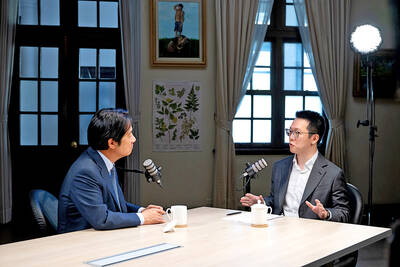
Taiwan should not rule out any energy source or abandon environmental sustainability in favor of ideology and short-term benefits, President William Lai (賴清德) said in an interview, calling for a “professional assessment” of whether nuclear power should be reintroduced into Taiwan’s energy mix. In an online interview with influencer Yu Ting-hao (游庭皓) that aired yesterday, Lai reiterated his position on nuclear power. SHIFT Lai’s remarks marked a shift from the Democratic Progressive Party’s (DPP’s) longstanding opposition to nuclear power. As premier from 2017 to 2019, Lai pushed for more gas-fired power capacity while sticking to the DPP’s nuclear free homeland ideology and rejected the


 RSS
RSS