


Fueled by pricier used cars, hotel rooms and auto insurance, inflation in the United States moved slightly higher last month while remaining far below its peak of two years ago.
Consumer prices rose 2.7 percent last month from a year earlier, up from a yearly figure of 2.6 percent in October. Excluding volatile food and energy costs, so-called core prices increased 3.3 percent, the same as in the previous month.
From October to last month, consumer prices climbed 0.3 percent, the biggest monthly increase since April. Core prices also rose 0.3 percent for a fourth straight month.
Photo: Will Oliver, EPA-EFE
Yesterday’s inflation figures from the US Labor Department are the final major piece of data that US Federal Reserve officials will consider before they meet next week to decide on interest rates.
The relatively mild increase won’t likely be enough to discourage the officials from cutting their key rate by a quarter-point, as most economists and Wall Street traders expect.
The Fed slashed its benchmark rate by a sizable half-point in September and by a quarter-point last month. Those cuts lowered the central bank’s key rate to 4.6 percent, down from a four-decade high of 5.3 percent.
Though inflation is now way below its peak of 9.1 percent in June 2022, average prices are still about 20 percent higher than they were three years ago — a major source of public discontent that helped drive president-elect Donald Trump’s victory over Vice President Kamala Harris last month. Still, most economists expect inflation to decline further next year toward the Fed’s 2 percent target.
Fed officials have made clear that they expect inflation to fluctuate along a bumpy path even as it gradually cools toward their target level. In speeches last week, several of the central bank’s policymakers stressed their belief that with inflation having already fallen so far, it was no longer necessary to keep their benchmark rate quite as high.
Fed Chair Jerome Powell has said that the central bank is seeking to “recalibrate” its rate to a lower setting, one more in line with tamer inflation. In addition, hiring has slowed a bit in recent months, raising the risk that the economy could weaken in the coming months. Additional rate cuts by the Fed could offset that risk.
One possible threat to the Fed’s efforts to keep inflation down is Trump’s threat to impose widespread tariffs on US imports — a move that economists say would likely send inflation higher.
Trump has said he could impose tariffs of 10 percent on all imports and 60 percent on goods from China. As a consequence, economists at Goldman Sachs Group Inc have forecast that core inflation would amount to 2.7 percent by the end of next year. Without tariffs, they estimate it would drop to 2.4 percent.

STRONG INTEREST: Analysts have pointed to optimism in TSMC’s growth prospects in the artificial intelligence era as the cause of the rising number of shareholders The number of people holding shares of chipmaker Taiwan Semiconductor Manufacturing Co (TSMC, 台積電) hit a new high last week despite a decline in its stock price, the Taiwan Depository and Clearing Corp (TDCC, 台灣集保) said. The number of TSMC shareholders rose to 2.46 million as of Friday, up 75,536 from a week earlier, TDCC data showed. The stock price fell 1.34 percent during the same week to close at NT$1,840 (US$57.55). The decline in TSMC’s share price resulted from volatility in global tech stocks, driven by rising international crude oil prices as the war against Iran continues. Dealers said
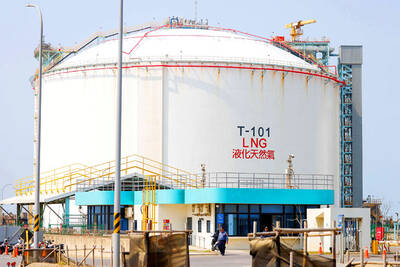
Taiwan’s natural gas supply remains stable through the end of May, despite rising concerns about potential disruptions to Qatari liquefied natural gas (LNG) supplies due to escalating conflicts in the Middle East, the Ministry of Economic Affairs said yesterday. The ministry in a statement said that Taiwan has completed preparations for natural gas supply and shipping schedules through the end of May. It has also made plans to increase natural gas imports from regions outside the Middle East in June to ensure a stable supply, it added. Taiwan sources natural gas from 14 countries and is not solely dependent on the Middle East,

China is clamping down on fertilizer exports to protect its domestic market, industry sources said, putting an additional strain on global markets that were already grappling with shortages caused by the US-Israeli war on Iran. China is among the largest fertilizer exporters — shipping more than US$13 billion of it last year — and it has a history of controlling exports to keep prices low for farmers. Shipments through the war-blocked Strait of Hormuz account for about one-third of the sea-borne supply. This month, Beijing banned exports of nitrogen-potassium fertilizer blends and certain phosphate varieties, sources said. The ban, which has not

Grab Holdings Ltd agreed to buy Delivery Hero SE’s Foodpanda operations in Taiwan for US$600 million, a deal that marks its first foray outside of its Southeast Asian base. The cash acquisition will allow Grab to expand into 21 cities across Taiwan, the Singapore-based ride-hailing and delivery company said in a statement yesterday. Grab expects the transaction to be completed in the second half, subject to regulatory approvals. The purchase will give Grab a presence on the island of about 23 million people, helping it to expand beyond its intensely competitive home market. Grab has seen growth slow dramatically as it takes


 RSS
RSS