


Chinese President Xi Jinping (習近平) and other top leaders yesterday said they would adopt a more “relaxed” approach to monetary policy as they hashed out plans to boost the economy next year.
The world’s second-largest economy is battling sluggish domestic consumption, a persistent crisis in the property sector and soaring government debt — all of which threaten Beijing’s official growth target for this year.
Leaders are also eyeing the second term of US president-elect Donald Trump, who has indicated he would reignite his hardball trade policies.
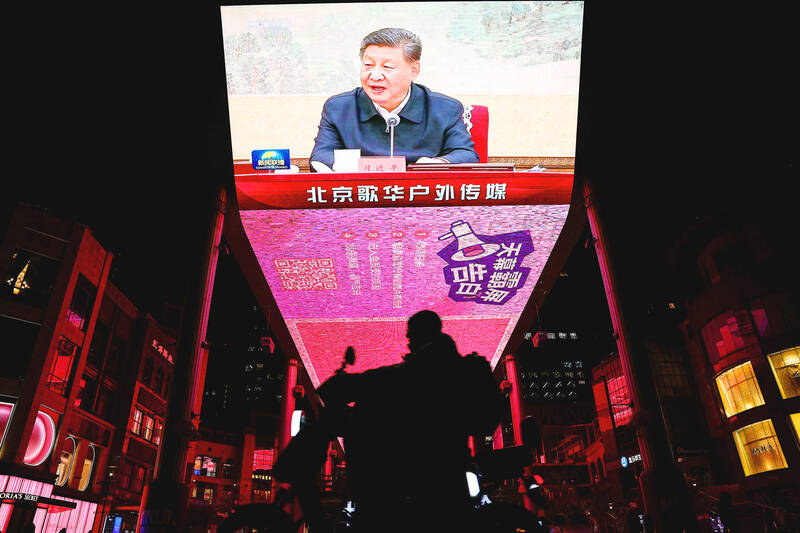
Photo: Reuters
Yesterday, the Politburo Standing Committee of the Chinese Communist Party, the country’s top decision-making body, “held a meeting to analyze and study the economic work of 2025,” state news agency Xinhua said.
“We must vigorously boost consumption, improve investment efficiency, and comprehensively expand domestic demand,” Xinhua quoted officials as having said.
“Next year we should… implement a more active fiscal policy and an appropriately relaxed monetary policy,” they added.
The new wording for the monetary policy marks the first easing of the stance since late 2010, official announcements at the Politburo meetings showed.
China’s central bank has outlined five policy stances — “loose,” “appropriately loose,” “prudent,” “appropriately tight” and “tight” — with flexibility on either side of each.
China adopted an “appropriately loose” monetary policy after the 2008 global financial crisis, before switching to “prudent” in late 2010.
Beijing has unveiled a string of measures since September aimed at bolstering growth, including cutting interest rates, canceling restrictions on homebuying and easing the debt burden on local governments.
However, economists have warned that more direct fiscal stimulus aimed at shoring up domestic consumption is needed to restore full health in China’s economy as fears of a renewed trade dispute with the US mount.
The consumer price index, a key measure of inflation, came in at 0.2 percent, down from 0.3 percent in October, the Chinese National Bureau of Statistics said.
Fitch Ratings has slashed its economic growth forecasts for China next year and in 2026.
China’s GDP growth forecast for next year has been revised to 4.3 percent from 4.5 percent and the 2026 GDP growth has been revised to 4.0 percent from 4.3 percent, while the effective tariff rate on US imports from China is assumed to increase from about 10 percent to about 35 percent, Fitch said yesterday.
Beijing’s leadership also said it would intensify an anti-corruption drive, calling for a “high-pressure posture in punishing” graft.
Officials yesterday pledged to “strengthen the mechanism for investigating and addressing unhealthy practices and corruption.”
Additional reporting by Reuters


Taiwanese firms have increased investment in the Philippines in recent years as Manila’s ties with Washington deepen and global supply chains continue to shift away from China, an expert at the Chung-Hua Institution for Economic Research (CIER, 中華經濟研究院) said yesterday. The Philippines had not been among Taiwanese investors’ top choices in Southeast Asia, CIER Taiwan ASEAN Studies Center director Kristy Hsu (徐遵慈) said at a seminar in Taipei. However, Taiwan’s investment in the country has grown significantly since the COVID-19 pandemic, reaching US $257 million last year, a high in recent years, she said. Although Taiwan’s total investment in the Philippines still lags

Intel Corp regards Taiwan Semiconductor Manufacturing Co (TSMC, 台積電) as a longstanding partner, as the US chipmaker would continue outsourcing production of advanced chips to TSMC, Intel chief executive officer Lip-Bu Tan (陳立武) said yesterday. “I don’t look at people as competitors. I look at the collaboration... Nvidia is also, you know, a good friend,” Tan told a news conference following his keynote speech at the Computex trade show in Taipei. “It’s a very trusted partnership for us... We are a big, top customer for them, and we’re going to continue doing that,” he said, referring to TSMC, the world’s largest foundry

Hon Hai Precision Industry Co (鴻海精密) yesterday said it would work with US chipmaker Intel Corp to jointly develop and deploy next-generation artificial intelligence (AI) infrastructure and intelligent computing platforms in a move to capture booming demand for AI computing systems. Hon Hai, also known as Foxconn Technology Group (富士康), said in a statement that the partnership would combine its global manufacturing scale, system integration expertise and AI data center deployment capabilities with Intel’s strengths in processor architecture, silicon technologies and software ecosystem. The companies said they plan to work on equipment used in AI data centers, including server racks powered by

Artificial intelligence (AI) agents would supplant smartphones as the center of people’s digital lives, fundamentally reshaping personal devices and driving a major computing upgrade cycle, Qualcomm Inc CEO Cristiano Amon said yesterday. In his keynote speech for this year’s Computex trade show in Taipei, Amon said that the rise of "agentic AI" — AI systems capable of reasoning, planning and carrying out tasks autonomously — would transform how people interact with technology across phones, PCs, vehicles and wearable devices. Describing the technology as the next major evolution in computing, Amon said that "2026 is the year of agents.” For decades, smartphones have sat


 RSS
RSS