


Argentine biochemist Alejandro Nadra worries that Argentine President Javier Milei’s budget cuts would undo his scientific quest to unravel the cause of genetic diseases that disable and kill millions.
Since taking office in December last year, budget-slashing Milei has frozen public university and research budgets even as annual inflation stands at 236 percent.
This meant real spending on science and technology fell 33 percent year-on-year in August, the CIICTI research center said.
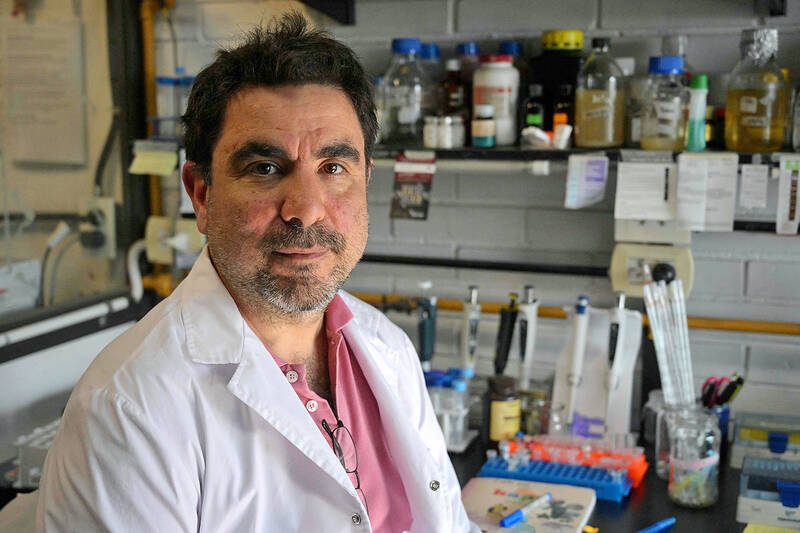
Photo: AFP
Nadra said he has already had to stop some of his experiments with the proteins responsible for gene mutations that cause diseases.
“We are on the verge of collapse,” Nadra said from his laboratory at the University of Buenos Aires, home to three Nobel Prize laureates in science.
Along with artists, teachers, pilots, social workers and countless other professionals affected by Milei’s drive to curb flyaway inflation and public debt, scientists fear for their future in Argentina.
“People are leaving, and they aren’t applying for scholarships or teaching positions anymore, because they can’t make a living,” Nadra said.
Those who do often end up working in labs without the necessary equipment or supplies.
“If things don’t change, the time is near when everything disintegrates,” said Nadra.
Nadra said he has not been able to buy anything he needs for his research since November last year.
“So, if I run out of supplies, I either borrow from someone who still has some, or I stop doing those experiments,” Nadra said.
The gross monthly salary of a research assistant today at the Argentine National Council for Scientific and Technical Research of Argentina (CONICET) is about 30 percent less, about US$1,180, than a year ago, the RAICYT network of science institutes said.
Official figures released last week showed that 52.9 percent of people live in poverty in Milei’s Argentina.
Biologist Edith Kordon works at the Institute for Physiology, Molecular Biology and Neurosciences, where she investigates breast cancer.
“This is the first time this has happened to me. I mean, it has always been very hard to get funding, it has always been very hard to get scholarships, but now there is this practical certainty that we have nothing... I’ve never had so little money to do anything,” she said.
Former Argentine minister of science, technology and innovation Lino Baranao recently highlighted that even before Milei’s cuts, Argentina spent about 0.31 percent of GDP on science compared with 1.21 percent in Brazil, 3.45 percent in the US and 4.9 percent in South Korea.
Today, it is even less, at about 0.2 percent.
“Never in the recent history of Argentina has there been such a drastic reduction in the [scientific] budget,” Baranao told La Nacion newspaper.
In a more prosperous past, state funding of research had made possible the development of a transgenic wheat strain resistant to drought by a CONICET research team, among other life-changing breakthroughs.
Last week, Milei’s government adjusted CONICET’s working budget upward to just more than US$100,000 for this year, a figure which physicist Jorge Aliaga considers “irrelevant” in its inadequacy.
“It doesn’t change anything,” Aliaga said.
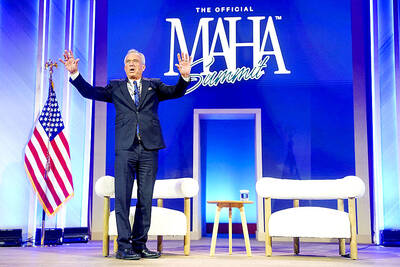
Sweeping policy changes under US Secretary of Health and Human Services Robert F. Kennedy Jr are having a chilling effect on vaccine makers as anti-vaccine rhetoric has turned into concrete changes in inoculation schedules and recommendations, investors and executives said. The administration of US President Donald Trump has in the past year upended vaccine recommendations, with the country last month ending its longstanding guidance that all children receive inoculations against flu, hepatitis A and other diseases. The unprecedented changes have led to diminished vaccine usage, hurt the investment case for some biotechs, and created a drag that would likely dent revenues and
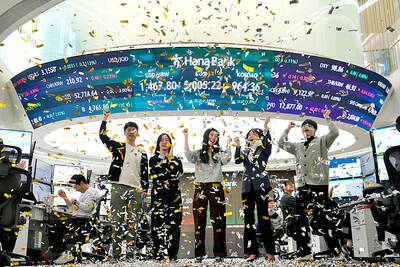
Global semiconductor stocks advanced yesterday, as comments by Nvidia Corp chief executive officer Jensen Huang (黃仁勳) at Davos, Switzerland, helped reinforce investor enthusiasm for artificial intelligence (AI). Samsung Electronics Co gained as much as 5 percent to an all-time high, helping drive South Korea’s benchmark KOSPI above 5,000 for the first time. That came after the Philadelphia Semiconductor Index rose more than 3 percent to a fresh record on Wednesday, with a boost from Nvidia. The gains came amid broad risk-on trade after US President Donald Trump withdrew his threat of tariffs on some European nations over backing for Greenland. Huang further

CULPRITS: Factors that affected the slip included falling global crude oil prices, wait-and-see consumer attitudes due to US tariffs and a different Lunar New Year holiday schedule Taiwan’s retail sales ended a nine-year growth streak last year, slipping 0.2 percent from a year earlier as uncertainty over US tariff policies affected demand for durable goods, data released on Friday by the Ministry of Economic Affairs showed. Last year’s retail sales totaled NT$4.84 trillion (US$153.27 billion), down about NT$9.5 billion, or 0.2 percent, from 2024. Despite the decline, the figure was still the second-highest annual sales total on record. Ministry statistics department deputy head Chen Yu-fang (陳玉芳) said sales of cars, motorcycles and related products, which accounted for 17.4 percent of total retail rales last year, fell NT$68.1 billion, or
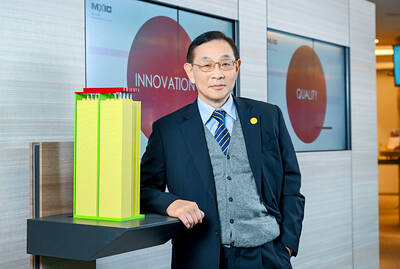
Macronix International Co (旺宏), the world’s biggest NOR flash memory supplier, yesterday said it would spend NT$22 billion (US$699.1 million) on capacity expansion this year to increase its production of mid-to-low-density memory chips as the world’s major memorychip suppliers are phasing out the market. The company said its planned capital expenditures are about 11 times higher than the NT$1.8 billion it spent on new facilities and equipment last year. A majority of this year’s outlay would be allocated to step up capacity of multi-level cell (MLC) NAND flash memory chips, which are used in embedded multimedia cards (eMMC), a managed


 RSS
RSS