


The nation’s five major state-run banks extended NT$96.741 billion (US$3.02 billion) in new mortgages last month, down NT$24.998 billion from the previous month and falling below the NT$100 billion mark for the first time in four months, central bank data released on Thursday showed.
The monthly decrease in new mortgages by the Bank of Taiwan (臺灣銀行), Land Bank of Taiwan (土地銀行), Taiwan Cooperative Bank (合作金庫銀行), Hua Nan Commercial Bank (華南銀行) and First Commercial Bank (第一銀行) came with the arrival of Ghost Month, which affected property transactions, the central bank said.
Taiwanese avoid business transactions during Ghost Month, which falls on the seventh month of the lunar calendar. It began on Aug. 4 and ended on Sept. 2 this year.
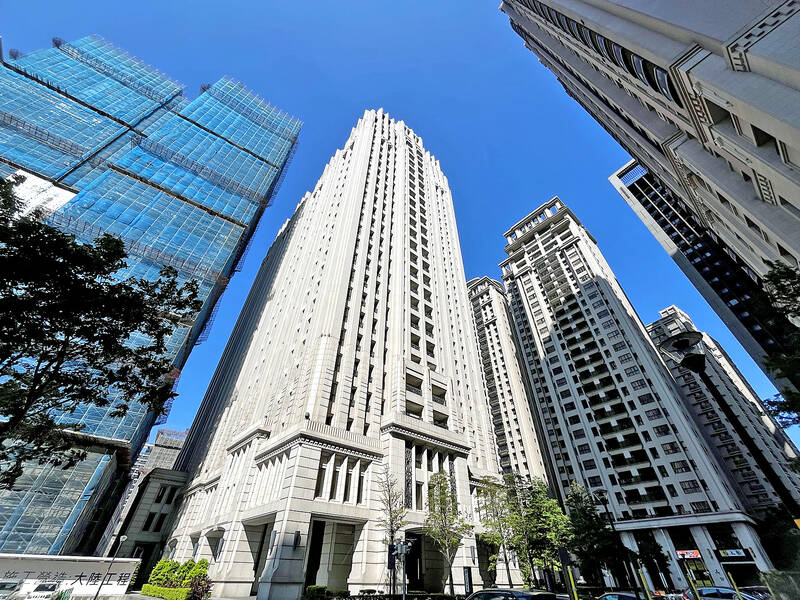
Photo: Hsu Yi-ping, Taipei Times
Some local lenders might have also become conservative in extending new mortgages as their real-estate lending approaches the financial regulator’s property loan quota for banks, the central bank said.
Loans extended for residential and commercial properties may not exceed 30 percent of the aggregate of a bank’s deposits and financial debentures — or its available funds on hand, Article 72-2 of the Banking Act (銀行法) says.
Despite the decrease in new mortgages, the average mortgage rate charged by the five state-run banks rose 0.007 basis points from 2.187 percent the previous month to 2.194 percent last month, setting a new high in more than 15-and-a-half years, central bank data showed.
The rise in mortgage rates indicated that some banks were tight on funds and faced higher costs in cash flow management, forcing them to raise rates for those who were not first-home buyers, the central bank said.
It also reflected a declining proportion of the government’s preferential loans for first-home buyers in the total new mortgages, which fell from 38.23 percent in July to 35.73 percent last month, the central bank said.
Since the government’s preferential loan program carries relatively lower interest rates, a lower proportion of such loans affected the average mortgage rate less than expected, it said.
During the first eight months of this year, the five state-run banks extended NT$769.731 billion of new mortgages, a record for the period and up 79.73 percent from NT$428.281 billion a year earlier, the data showed.
The latest data came as the central bank continued its efforts to cool the domestic housing market, and contain real-estate speculation and property hoarding. At its quarterly board meeting on Thursday last week, it introduced a new round of selective credit control measures, which took effect the next day, and increased the required reserve ratio for lenders by 25 basis points, which takes effect on Tuesday next week.

Netherlands-based semiconductor equipment supplier ASML Holding NV yesterday said that it is planning to hire an additional 1,000 people in Taiwan this year in response to growing demand from clients. ASML had previously planned to recruit 600 people this year, but that the plan has been adjusted upward, ASML vice president and ASML Taiwan general manager Grace Wang (汪佳慧) told reporters. ASML has a workforce of more than 4,500 in Taiwan, accounting for about 10 percent of its global total, Wang said. This year’s recruitment campaign would focus on adding people in the customer support, manufacturing and supply chain domains to assist ASML

UNDER MICROSCOPE: Taiwan detained three people who allegedly conspired to buy servers in Taiwan and export them using fraudulent documentation, prosecutors said Nvidia Corp chief executive officer Jensen Huang (黃仁勳) on Saturday urged Super Micro Computer Inc to tighten up on compliance after Taiwan detained three people this week for allegedly making fraudulent declarations about artificial intelligence (AI) servers made by its US partner. The development marked the nation’s first crackdown on semiconductor smuggling, which grew after the US slapped restrictions on exports of high-end chips such as Nvidia AI accelerators to China. Nvidia is “rigorous” in explaining regulations to all of its partners, Huang told reporters after arriving in Taipei. “Ultimately Super Micro has to run their own company,” he said in response to

Nvidia Corp yesterday announced that CEO Jensen Huang (黃仁勳) would attend an employee meeting in Taipei tomorrow to celebrate the launch of the company’s Taiwan headquarters project. Huang would attend a gathering at the site of Nvidia’s planned headquarters in Beitou Shilin Technology Park (北投士林科技園區), the company said in a statement. After arriving in Taiwan on Saturday last week, Huang told reporters that he plans to meet with Quanta Computer Inc (廣達) chairman Barry Lam (林百里) and Taiwan Semiconductor Manufacturing Co (TSMC, 台積電) chairman C.C. Wei (魏哲家), and would attend the groundbreaking ceremony for Nvidia’s Taiwan headquarters tomorrow. Nvidia has not yet applied

Huawei Technologies Co (華為) said it has come up with a new pathway to shorten its gap with industry leader Taiwan Semiconductor Manufacturing Co (TSMC, 台積電), potentially achieving a breakthrough in making advanced semiconductors without cutting-edge equipment. Right now there is about a five-year gap between what TSMC is capable of and what Huawei, together with its manufacturing partner Semiconductor Manufacturing International Corp (中芯), can produce. Huawei is to start making 1.4-nanometer chips by 2031 with its own “LogicFolding” technology, Huawei semiconductor chief He Tingbo (何庭波) said in a rare public appearance during a chip conference yesterday, while TSMC has


 RSS
RSS