


Advanced Micro Devices Inc (AMD) on Tuesday gave an upbeat revenue forecast, underscoring that its new artificial intelligence (AI) processors are boosting growth.
Revenue will be roughly US$6.7 billion in the third quarter, the company said. Analysts estimated US$6.62 billion on average. Second-quarter results also topped projections, and the company raised its forecast for so-called AI accelerators — chips used to develop AI models.
The outlook suggests that AMD is making headway in its pursuit of Nvidia Corp, which dominates the accelerator market.
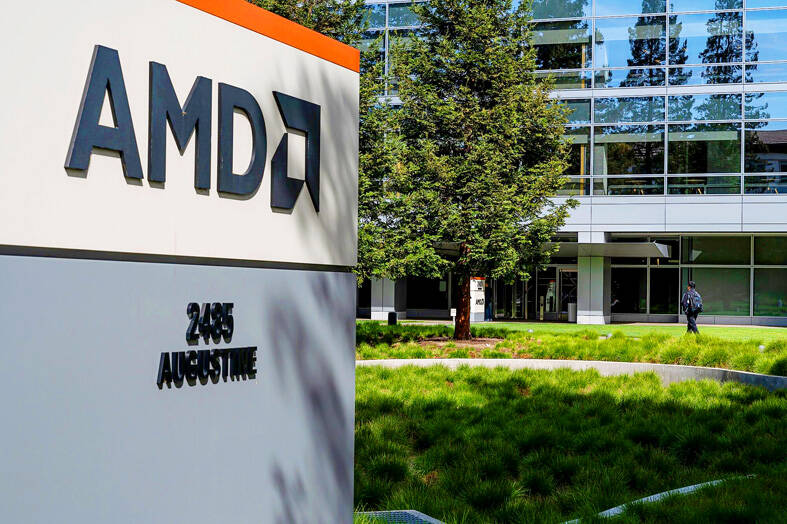
Photo: David Paul Morris, Bloomberg
Chief executive officer Lisa Su (蘇姿丰) said that AMD expects to generate more than US$4.5 billion in sales from its MI300 products this year. That’s up from an earlier target of US$4 billion, though analysts’ estimates have ranged closer to US$5 billion. The growth reflects an effort to ramp up production, but supplies continue to be tight, she said.
Su downplayed concerns that the race to add AI infrastructure is slowing down, saying that customers are still eager to chase the opportunity.
“The overall view on AI investment is: We have to invest — the potential of AI is so large,” she said on a conference call with analysts. “The investment cycle will continue to be strong.”
MI300 revenue topped US$1 billion in the second quarter, and the company committed to rolling out new AI processors once a year — a key milestone.
“We continued accelerating our AI traction,” Su said. Cloud computing and enterprise customers are embracing AMD’s Instinct MI300X products, she said. And demand is picking up for its traditional personal-computing and server businesses.
AMD’s second-quarter revenue rose 8.9 percent to US$5.84 billion, beating an estimate of US$5.72 billion. Earnings increased to US$0.69 a share, compared with a projection of US$0.68.
Though demand for AI accelerators has been strong, the appetite for some other AMD products has slowed. Embedded chips and semiconductors for gaming consoles have struggled recently.
Like Intel Corp, AMD still gets most of its revenue from PC and server microprocessors. Santa Clara, California-based AMD also competes with Nvidia in the market for graphics processors that improve the images in video games.
Separately, Intel plans to eliminate thousands of jobs to reduce costs and fund an ambitious effort to rebound from an earnings slump and market share losses.
The workforce reduction may be announced as early as this week, according to people familiar with the company’s plans. Intel, which is scheduled to report second-quarter earnings today, has about 110,000 employees, excluding workers at units that are being spun out.
Intel’s once-dominant position eroded under chief executive officer Pat Gelsinger’s predecessors as rivals, such as AMD, have caught up and taken market share.
Other chipmakers led by Nvidia have sprinted ahead in the development of lucrative semiconductors tailored for demanding AI-related tasks. Intel is also coming to grips with uneven demand for chips that run laptops and desktop computers, its main business.
The company reduced its workforce about 5 percent last year to 124,800 after announcing job cuts beginning in October 2022. It also has slowed spending in other areas. The company expected those cost reductions would save as much as US$10 billion by next year.
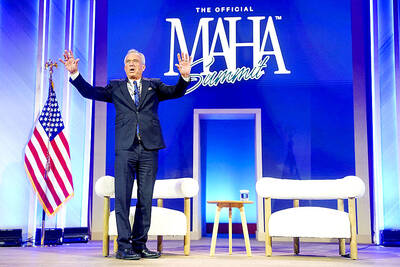
Sweeping policy changes under US Secretary of Health and Human Services Robert F. Kennedy Jr are having a chilling effect on vaccine makers as anti-vaccine rhetoric has turned into concrete changes in inoculation schedules and recommendations, investors and executives said. The administration of US President Donald Trump has in the past year upended vaccine recommendations, with the country last month ending its longstanding guidance that all children receive inoculations against flu, hepatitis A and other diseases. The unprecedented changes have led to diminished vaccine usage, hurt the investment case for some biotechs, and created a drag that would likely dent revenues and
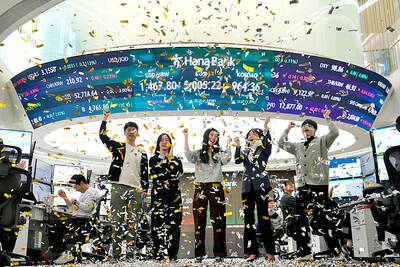
Global semiconductor stocks advanced yesterday, as comments by Nvidia Corp chief executive officer Jensen Huang (黃仁勳) at Davos, Switzerland, helped reinforce investor enthusiasm for artificial intelligence (AI). Samsung Electronics Co gained as much as 5 percent to an all-time high, helping drive South Korea’s benchmark KOSPI above 5,000 for the first time. That came after the Philadelphia Semiconductor Index rose more than 3 percent to a fresh record on Wednesday, with a boost from Nvidia. The gains came amid broad risk-on trade after US President Donald Trump withdrew his threat of tariffs on some European nations over backing for Greenland. Huang further

CULPRITS: Factors that affected the slip included falling global crude oil prices, wait-and-see consumer attitudes due to US tariffs and a different Lunar New Year holiday schedule Taiwan’s retail sales ended a nine-year growth streak last year, slipping 0.2 percent from a year earlier as uncertainty over US tariff policies affected demand for durable goods, data released on Friday by the Ministry of Economic Affairs showed. Last year’s retail sales totaled NT$4.84 trillion (US$153.27 billion), down about NT$9.5 billion, or 0.2 percent, from 2024. Despite the decline, the figure was still the second-highest annual sales total on record. Ministry statistics department deputy head Chen Yu-fang (陳玉芳) said sales of cars, motorcycles and related products, which accounted for 17.4 percent of total retail rales last year, fell NT$68.1 billion, or
MediaTek Inc (聯發科) shares yesterday notched their best two-day rally on record, as investors flock to the Taiwanese chip designer on excitement over its tie-up with Google. The Taipei-listed stock jumped 8.59 percent, capping a two-session surge of 19 percent and closing at a fresh all-time high of NT$1,770. That extended a two-month rally on growing awareness of MediaTek’s work on Google’s tensor processing units (TPUs), which are chips used in artificial intelligence (AI) applications. It also highlights how fund managers faced with single-stock limits on their holding of market titan Taiwan Semiconductor Manufacturing Co (TSMC, 台積電) are diversifying into other AI-related firms.


 RSS
RSS