


The consumer price index (CPI) climbed at the fastest rate in four months to 2.42 percent last month, as a result of higher food prices along with increasing medical, rental and dining out costs, the Directorate-General of Budget, Accounting and Statistics (DGBAS) said yesterday.
The inflationary gauge again rose above the central bank’s 2 percent target and outpaced May’s 2.23 percent increase after briefly returning to the bank’s comfort zone in April. During the second quarter, CPI increased 2.2 percent, slightly lower than the 2.25 percent estimated by the DGBAS.
Core CPI, excluding volatile items such as food and energy prices, rose 1.83 percent last month from a year earlier.
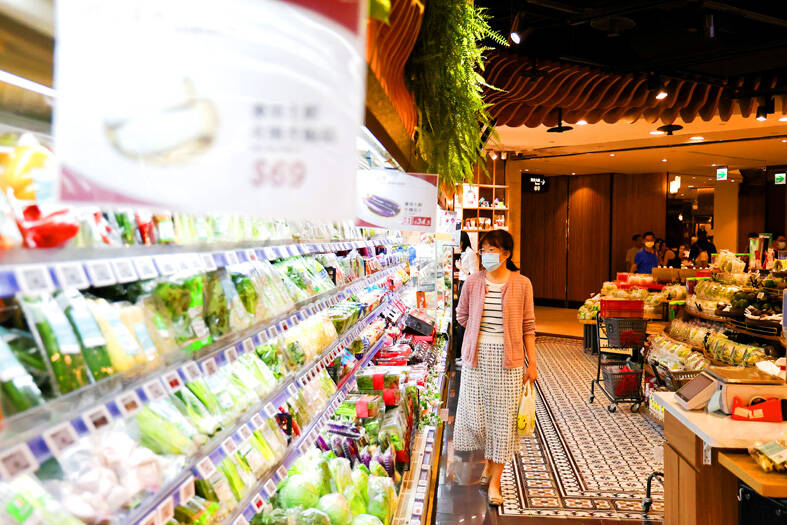
Photo: CNA
“A total of 273 among 368 items monitored by the agency showed year-over-year upticks last month, with some having significant price hikes, such as lychees rising 57 percent. Breakfasts, Chinese medicinal materials and accommodation costs also showed an increase. This is why consumers have felt deeply higher living costs lately,” DGBAS official Tsao Chih-hung (曹志弘) told a news conference in Taipei.
Rent costs rose 2.59 percent last month from a year earlier, the steepest increase in about 28 years, Tsao said.
Accommodation costs, including rent, home repair costs and electricity charges, increased 2.27 percent from a year earlier, the DGBAS said.
Dining out costs jumped 2.78 percent year-over-year, although they retreated slightly from the historical high of 2.81 percent in May.
The cost of dining out is increasing more slowly, Tsao said.
Last quarter, dining out costs rose 2.85 percent year-over-year, coming down from their peak in the second quarter of last year, when they soared 4.48 percent, Tsao said.
Food costs surged 4.16 percent year-on-year last month, with fruit prices increasing most, by 22.6 percent, as heavy rain reduced harvests of lychees and mangoes, the agency said.
An annual decline of 15.52 percent in egg prices last month helped slow down the increase of food prices, the agency said.
Healthcare was another major factor on the CPI reading, rising 3.78 percent from a year earlier, as hospitals and clinics hiked registration fees, and health insurance authorities increased copayment and emergency treatment charges, it said.
Costs for entertainment and education increased 1.67 percent last month, affected by strong demand for overseas travel, and fee increases at cram schools and other education providers, the DGBAS said.
In the first half of the year, the CPI increased 2.27 percent from a year ago, with core CPI rising 2.02 percent. However, the prices of 17 major living items tracked by the Cabinet showed a decline of 0.14 percent from a year ago. Among measured items, egg prices dropped most, at an annual rate of 18.17 percent, due to an oversupply, the agency said.
Milk and tissue paper prices also dropped by 1.99 percent and 2.45 percent respectively.
The producer price index (PPI), which measures the price movements of goods from a seller’s perspective, rose 3.54 percent year-on-year last month, as raw materials and personal computers became more expensive, the agency said.
In the first half of the year, the PPI climbed 1.37 percent from a year earlier, DGBAS data showed.

Taichung reported the steepest fall in completed home prices among the six special municipalities in the first quarter of this year, data compiled by Taiwan Realty Co (台灣房屋) showed yesterday. From January through last month, the average transaction price for completed homes in Taichung fell 8 percent from a year earlier to NT$299,000 (US$9,483) per ping (3.3m²), said Taiwan Realty, which compiled the data based on the government’s price registration platform. The decline could be attributed to many home buyers choosing relatively affordable used homes to live in themselves, instead of newly built homes in the city’s prime property market, Taiwan Realty
The government yesterday approved applications by Alphabet Inc’s Google to invest NT$27.08 billion (US$859.98 million) in Taiwan, the Ministry of Economic Affairs said in a statement. The Department of Investment Review approved two investments proposed by Google, with much of the funds to be used for data processing and electronic information supply services, as well as inventory procurement businesses in the semiconductor field, the ministry said. It marks the second consecutive year that Google has applied to increase its investment in Taiwan. Google plans to infuse NT$25.34 billion into Charter Investments Ltd (特許投資顧問) through its Singapore-based subsidiary Fructan Holdings Singapore Pte Ltd, and

JET JUICE: The war on Iran’s secondary effects have seen fuel prices skyrocket, knocking flight schedules down to earth in return as airlines struggle with costs Airline passengers should brace for more irritation in the next few months as carriers worldwide cancel flights and ground planes to cope with stratospheric increases in jet-fuel prices. Dutch flag carrier KLM is the latest company to cut its schedule, saying on Thursday that it would scrap 80 return flights at Amsterdam’s Schiphol Airport in the coming month. That puts it in the same league as United Airlines Holdings Inc, Deutsche Lufthansa AG and Cathay Pacific Airways Ltd, which have all pruned itineraries to mitigate costs. Global capacity for next month has been reduced by about 3 percentage points, with all

FORESEEABLE CONSEQUENCES: New technology always comes with new innovations by the iniquitous in exploiting users for financial gain or more nefarious ends Artificial intelligence (AI) “agents” say they can save users time and energy by automating tasks, but the growing power of systems such as OpenClaw is putting cybersecurity experts on edge. Powered by a wave of hype, OpenClaw today says it has more than three million users worldwide. The system allows users to create so-called agents, tools based on a large language model (LLM) such as OpenAI’s ChatGPT or Anthropic PBC’s Claude, that can carry out online tasks. “We’ve moved from an AI you could talk with via a chatbot to an agentic AI, which can take action... the threat and the risks are


 RSS
RSS