


With statues of the Buddha and local gods, candles and incense sticks, Lee Kyoung-hyun’s shrine looks similar to those of Korean shamans from centuries past.
However, the 29-year-old shaman — also known as Aegi Seonnyeo, or “Baby Angel” — reaches her clients in a thoroughly modern way: through social media accounts with hundreds of thousands of followers.
“Shamanism ... was believed to be an invisible, mysterious and spiritual world,” Lee said, adding that she had noticed more South Korean shamans posting videos about the spiritual practice since she started her own YouTube channel in 2019.
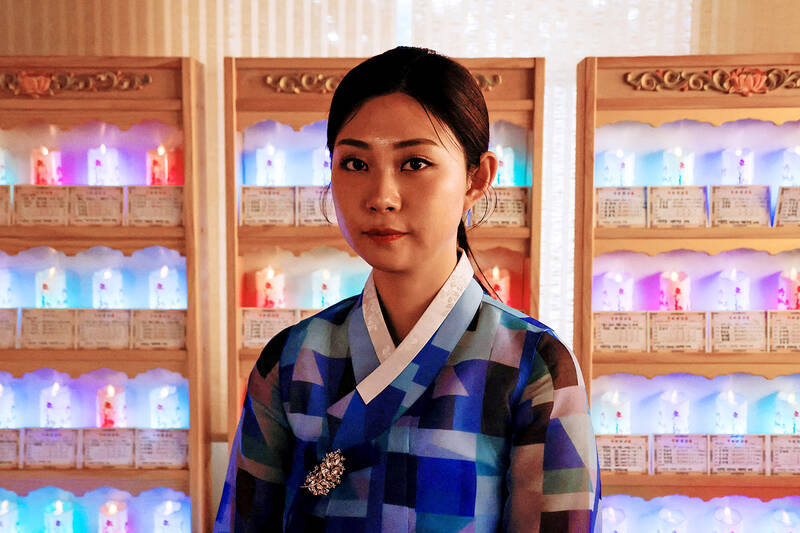
Photo: Reuters
South Korea is among the world’s most modern and high-tech economies. More than half its population of 51 million is not religiously affiliated, polls show.
Nevertheless, the appeal of shamanism has stood the test of time.
Kim Dong-kyu — a researcher at the Academic Center for K-Religions at Sogang University, a private research university in Seoul — said that shamans used to promote themselves in newspapers.
It was a “natural phenomenon” to turn to social media, he said.
Google Trends shows that searches on YouTube for “shaman” and “fortune-telling” in Korean have nearly doubled over the past five years.
The spiritual tradition was central to the plot of a blockbuster South Korean film this year, Exhuma, in which shamans are tasked with lifting a curse on a family.
The movie depicts well-dressed shamans in their 20s and 30s, and director Jang Jae-hyun said he discovered many young shamans while researching for the project.
The movie has grossed at least 132 billion won (US$95.65 million) internationally, raising interest in the religious tradition.
About one in five South Koreans has seen Exhuma, Korean Film Council data showed.
“People used to hide that they live as a [shaman]. There was a lot of stigma,” said 51-year-old Eunmi Pang, who has been a practitioner for almost 20 years.
She said that shamans today were more willing to express and promote themselves.
Shamans — who are believed to have divination abilities — typically charge about 100,000 won for a consultation of between 30 and 60 minutes, according to Pang and online pricing lists.
They offer relationship advice, guidance on job searches and predictions about the future, Lee said.
Shamans typically answer queries after conducting rituals that might involve ringing bells and tossing grains of rice.
They also sing, dance and walk on the edge of a knife to call on divine intervention. While practices vary, many Korean shamans worship local deities such as the Mountain God, Great Spirit Grandmother and Dragon King.
Park Chea-bin, a 33-year-old Buddhist, visited Lee when she was struggling to find a job in 2020.
She said she felt “peace of mind” after consulting the practitioner.
“I was very anxious at the time, but I became a little relaxed after deciding to let things go and focus on what I need to do,” said Park, who found employment at about the same time. “I’m a Buddhist, but I know Christians around me who come for their niggles.”
Lee said she has felt physical pain and experienced psychosis since she was a teenager — symptoms that some believe are signs of a deity possessing a budding shaman.
She decided to embrace her calling in 2018 and soon started a YouTube channel that now has more than 300,000 subscribers. She posts videos on topics such as the items she carries in her bag and the country’s fate this year — she is not optimistic.
“The current state of South Korean society is a factor that can’t be ignored,” she said, adding that many of her millennial and Gen Z clients come to her with concerns about affordable housing and the cost of raising children.
In Seoul, where Lee is based, the price of a home was more than 15 times the median salary in 2022, up from 8.8 in in 2017, a government report showed.
The country also has high inflation and interest rates.
The younger generation of shamans who live in the city can connect well with younger clients facing economic challenges that they cannot find an answer for, said Han Seung-hoon, an assistant professor at the Academy of Korean Studies, a research and education institute that operates under the South Korean Ministry of Education.
An agency under the South Korean Ministry of Culture, Sports and Tourism in 2022 estimated that the country has 300,000 to 400,000 shamans and fortune-tellers.
Shamanism is an “important and powerful part of the Korean character,” the agency wrote on its Web site.
The roots of shamanism on the Korean Peninsula go back at least 2,000 years, Han said.
The Japanese colonial administration of the early 20th century and the military dictatorship of the 1970s attempted to suppress shamanism, which they saw as an obstacle to modernization.
Politically powerful Christians — who make up about one-quarter of the population — have also criticized shamans and their followers.
Larger religions such as Christianity and Buddhism — which about 40 percent of South Koreans say they are followers of — are more influential in society, yet do not draw similar levels of criticism, Han said.
Christians also visit shamans in South Korea, Lee said.
“Even ... churchgoers want to have their bad dreams read,” she said.
More recently, some practitioners have found themselves in legal trouble.
A 66-year-old shaman in Seoul was sentenced to four years’ imprisonment in February after being convicted of defrauding a client of more than US$200,000, local media reports said.
The court ruled that the shaman had been pretending to speak to the client’s dead mother.
Lee said it is wrong for shamans to make decisions for clients.
Instead, shamans should serve as guides — like friends and family offering advice — rather than decisionmakers, she said.
Some in South Korea’s elite have links to shamans.
Min Hee-jin, a top entertainment executive embroiled in a business dispute with a major K-pop label, defended herself in an April news conference against allegations that she consulted a shaman for business purposes.
Min said that she had a conversation with a shaman in hope that talking would make her feel better.
“Don’t you guys all do that too?” she said.
A 2022 study in the journal BMC Psychiatry said there was a “huge” gap between South Koreans needing mental health treatment and getting it, which it partly attributed to stigma.
“Shamans have been playing the role of counselors,” Kim said.
“People have stigmatized shamanism as something dirty, suspicious, and scary,” Han said, adding that people were sometimes accused of visiting shamans in attempts to hurt their reputation.
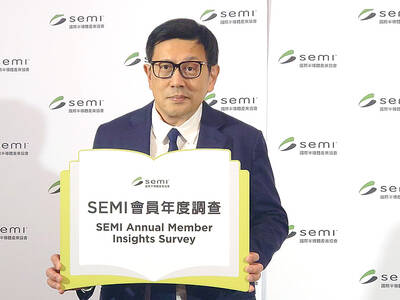
PRICE HIKES: The war in the Middle East would not significantly disrupt supply in the short term, but semiconductor companies are facing price surges for materials Taiwan’s semiconductor companies are not facing imminent supply disruptions of essential chemicals or raw materials due to the war in the Middle East, but surges in material costs loom large, industry association SEMI Taiwan said yesterday. The association’s comments came amid growing concerns that supplies of helium and other key raw materials used in semiconductor production could become a choke point after Qatar shut down its liquefied natural gas (LNG) production and helium output earlier this month due to the conflict. Qatar is the second-largest LNG supplier in the world and accounts for about 33 percent of global helium output. Helium is
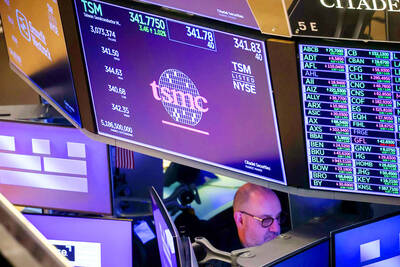
STRONG INTEREST: Analysts have pointed to optimism in TSMC’s growth prospects in the artificial intelligence era as the cause of the rising number of shareholders The number of people holding shares of chipmaker Taiwan Semiconductor Manufacturing Co (TSMC, 台積電) hit a new high last week despite a decline in its stock price, the Taiwan Depository and Clearing Corp (TDCC, 台灣集保) said. The number of TSMC shareholders rose to 2.46 million as of Friday, up 75,536 from a week earlier, TDCC data showed. The stock price fell 1.34 percent during the same week to close at NT$1,840 (US$57.55). The decline in TSMC’s share price resulted from volatility in global tech stocks, driven by rising international crude oil prices as the war against Iran continues. Dealers said
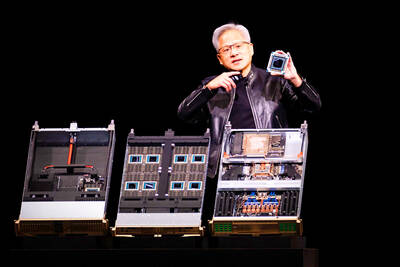
DOMESTIC COMPONENT: Huang identified several Taiwanese partners to be a key part of Nvidia’s Vera Rubin supply chain, including Asustek, Hon Hai and Wistron Nvidia Corp chief executive officer Jensen Huang (黃仁勳), addressing crowds at the company’s biggest annual event, unveiled a variety of new products while predicting that its flagship artificial intelligence (AI) processors would help generate US$1 trillion in sales through next year. During a two-and-a-half-hour keynote address, Huang announced plans to push deeper into central processing units (CPUs) — Intel Corp’s home turf — and introduced semiconductors made with technology acquired from start-up Groq Inc. The company even said it was developing chips for data centers in outer space. At the heart of Huang’s speech was the message that demand for computing power
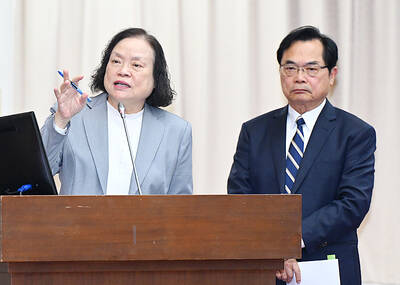
OPTIMISTIC: Inflation still has a chance of remaining below the central bank’s 2 percent alert level, as Taiwan’s economy is resilient with healthy exports, the NDC minister said Taiwan’s inflation could exceed 2 percent this year if oil prices continue to surge amid escalating tensions in the Middle East, prompting the government to reassess its economic outlook, the Directorate-General of Budget, Accounting and Statistics (DGBAS) said yesterday. DGBAS Minister Chen Shu-tzu (陳淑姿) told lawmakers at a meeting of the legislature’s Finance Committee that the agency’s earlier growth forecast of 1.68 percent in the consumer price index (CPI) and 7.71 percent for GDP this year did not account for the ongoing Middle East conflict and would need revision, if tensions persist. The previous forecast assumed an average international crude price of


 RSS
RSS