


The Taipei International Auto Parts and Accessories Show (Taipei AMPA), the Taipei International Automobile Electronics Show (Autotronics Taipei) and the 2035 E-Mobility Taiwan exhibition jointly opened yesterday at the Taipei Nangang Exhibition Center’s Hall 1, featuring electric vehicles along with components and assemblies.
The three trade shows have drawn about 1,000 domestic and foreign exhibitors from 19 countries, the Taiwan External Trade Development Council (TAITRA, 外貿協會) said in a statement.
Themed “360° Mobility,” the exhibitions are aimed at highlighting the automobile, motorcycle and smart mobility ecosystem, and offering a platform for potential buyers and exhibitors to connect, event organizers said in the statement.
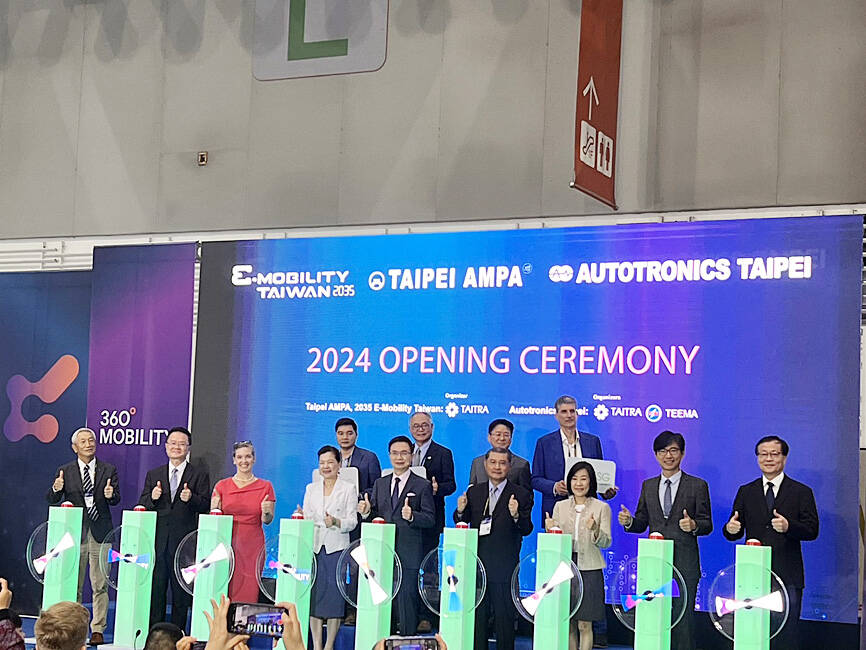
Photo: Lin Jin-hua, Taipei Times
One of the featured exhibitors is Hon Hai Precision Industry Co (鴻海精密), which is showcasing its new Model N electric cargo van prototype and the Model B personalized urban car, as well as components and parts used in the power systems of its Model T commercial bus model.
Shihlin Electric & Engineering Corp (士林電機), Pacific Electric Wire and Cable Co (太平洋電線電纜) and Texas Instruments Inc are featuring their power systems for electric vehicles.
Shihlin Electric is displaying two powertrain systems for electric vehicles for commercial logistics use and a four-in-one e-bike system.
One of the powertrains is a two-in-one system that has maximum power of 150 kilowatts (kW), enough for 5 tonne logistics vehicles, while the other is a new 13kW powertrain system used for three-wheel logistics vehicles, the company said.
Also at the event, Master Transportation Bus Manufacturing (成運汽車) is unveiling its self-developed direct-drive central motor, which can achieve peak power of 450kW, and an electric bus equipped with 218 kilowatt hours of battery capacity.
Master Transportation chairman Wu Ding-fa (吳定發) said the motor would be available from the second half of this year.
Other companies displaying their products at the shows, which run until Saturday, include aftermarket lighting supplier Coplus Inc (巨鎧精密), and vehicle parts and accessories suppliers Tong Yang Group (東陽集團), Depo Auto Parts Industrial Co (帝寶工業) and TW Racing Parts Inc (琦玉國際).

Taiwan’s foreign exchange reserves fell below the US$600 billion mark at the end of last month, with the central bank reporting a total of US$596.89 billion — a decline of US$8.6 billion from February — ending a three-month streak of increases. The central bank attributed the drop to a combination of factors such as outflows by foreign institutional investors, currency fluctuations and its own market interventions. “The large-scale outflows disrupted the balance of supply and demand in the foreign exchange market, prompting the central bank to intervene repeatedly by selling US dollars to stabilize the local currency,” Department of Foreign

ENERGY ISSUES: The TSIA urged the government to increase natural gas and helium reserves to reduce the impact of the Middle East war on semiconductor supply stability Chip testing and packaging service provider ASE Technology Holding Co (日月光投控) yesterday said it planned to invest more than NT$100 billion (US$3.15 billion) in building a new advanced chip testing facility in Kaohsiung to keep up with customer demand driven by the artificial intelligence (AI) boom. That would be included in the company’s capital expenditure budget next year, ASE said. There is also room to raise this year’s capital spending budget from a record-high US$7 billion estimated three months ago, it added. ASE would have six factories under construction this year, another record-breaking number, ASE chief operating officer Tien Wu

Intel Corp is joining Elon Musk’s long-shot effort to develop semiconductors for Tesla Inc, Space Exploration Technologies Corp and xAI, marking a surprising twist in the chipmaker’s comeback bid. Intel would help the Terafab project “refactor” the technology in a chip factory, the company said on Tuesday in a post on X, Musk’s social media platform. That is a stage in the development process that typically helps make chips more powerful or reliable. The chipmaker’s shares jumped 4.2 percent to US$52.91 in New York trading on Tuesday. The Terafab project is a grand plan by Musk to eventually manufacture his own chips for

For weeks now, the global tech industry has been waiting for a major artificial intelligence (AI) launch from DeepSeek (深度求索), seen as a benchmark for China’s progress in the fast-moving field. More than a year has passed since the start-up put Chinese AI on the map in early last year with a low-cost chatbot that performed at a similar level to US rivals. However, despite reports and rumors about its imminent release, DeepSeek’s next-generation “V4” model is nowhere in sight. Speculation is also swirling over the geopolitical implications of which computer chips were chosen to train and power the new


 RSS
RSS