


For 30 years, the Brussels nightclub Fuse has stood as a temple to Europe’s legions of electro-techno fans, a venue where the likes of Daft Punk and Aphex Twin set the concrete-walled dance floor thumping.
However, those thumps are increasingly the source of tensions with neighbors who want more restful nights. It is a tussle — between youthful cultural exuberance and city-center gentrification, a clash of generations and lifestyles — seen in many of the world’s capitals. It is one that hangs heavy over Fuse as it celebrates its three decades of existence.
Throughout this year, the nightclub is emphasizing its cultural status by bringing out a memorial book and a vinyl compilation by top artists. It is also launching a global club tour of 10 cities that is to include Amsterdam, Berlin, Barcelona and London, all under the banner “30 years of making noise.”

Photo: AFP
The celebration is backed by big-name sponsors — international soft drink brands and Belgian beer brewers — and Brussels city politicians who hold Fuse up as a world-class “monument.”
Yet some residents in Fuse’s Marolles district — a formerly working-class neighborhood gone hipster — would be happier to see all that as a crescendo before a definitive fade to silence.
“It’s tougher and tougher for clubs to exist in city centers,” said DJ Pierre — real name Pierre Noisiez — who is one of a roster filling Fuse with sound since it started in 1994.
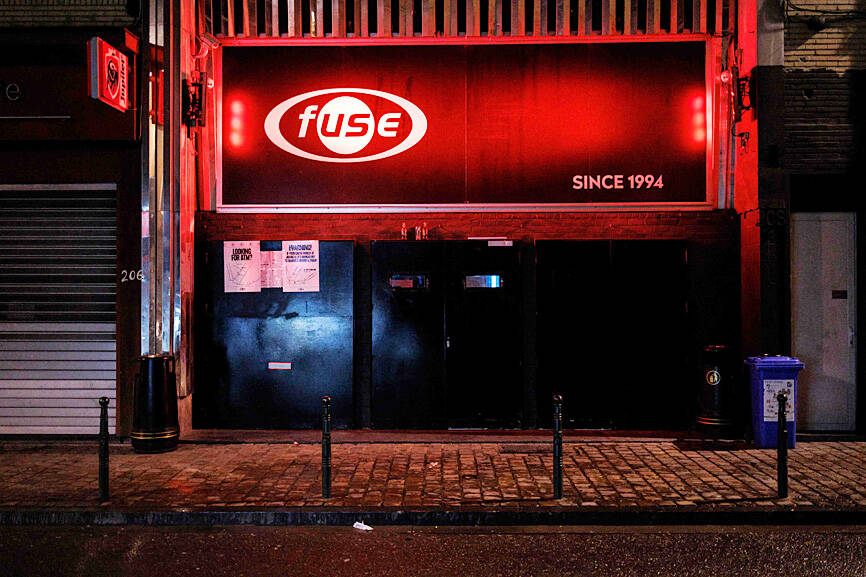
Photo: AFP
“If you get rid of them, you end up with a city center that is dead, which no one wants,” he said.
The club’s management has lashed out at noise complaints being made that threaten “the oldest techno club in Belgium.”
Fuse was forced to close for three weeks in January last year after complaints from one neighbor prompted authorities to swoop in with noise restrictions.
“It really breaks my heart,” DJ Charlotte de Witte, a Belgian who is one of the global stars of the techno scene, said of the order.
Since then, there have been “two new complaints from neighbors,” said the club’s artistic director, Steven Van Belle, who added that the problem was not going away.
“It’s still a hot topic, but the authorities are working on more protections for us,” he said.
Last year’s January closure triggered a spectacular backlash uniting artists, nightclub-goers and politicians.
Several months later, in July, “clubbing” culture was added to the list of intangible heritage for the Brussels region — alongside beer and Belgium’s fritkot stands that sell French fries. The symbolic move was a direct consequence of Fuse’s dilemma.
Closing Fuse would have “imperiled all nightlife” in Brussels, said an aide to the official, Ans Persoons, in charge of the city’s heritage.
With the listing, “the neighbors also have to adapt to what is considered part of the heritage.”
The classification — which is distinct from the internationally recognized UNESCO heritage list — applies to “at least 100 places” in the Brussels region, according to the nightlife federation that lobbied for it.
Twenty Belgian nightclubs, late-hour bars, concert venues and open-air dance festivals round out the list.
To balance their activity — which often spurs the local economy in the areas they are located in — against living standards other residents are entitled to, Brussels regional authorities have drawn up new urban rules to be followed.
They cover planning permits and sound isolation requirements, as well as obligations for the venue’s users — and for direct neighbors.
Van Belle said he was awaiting formalization of those rules, to see them become law once they are voted on by the regional parliament.
Taiwan’s exports soared 56 percent year-on-year to an all-time high of US$64.05 billion last month, propelled by surging global demand for artificial intelligence (AI), high-performance computing and cloud service infrastructure, the Ministry of Finance said yesterday. Department of Statistics Director-General Beatrice Tsai (蔡美娜) called the figure an unexpected upside surprise, citing a wave of technology orders from overseas customers alongside the usual year-end shopping season for technology products. Growth is likely to remain strong this month, she said, projecting a 40 percent to 45 percent expansion on an annual basis. The outperformance could prompt the Directorate-General of Budget, Accounting and

Two Chinese chipmakers are attracting strong retail investor demand, buoyed by industry peer Moore Threads Technology Co’s (摩爾線程) stellar debut. The retail portion of MetaX Integrated Circuits (Shanghai) Co’s (上海沐曦) upcoming initial public offering (IPO) was 2,986 times oversubscribed on Friday, according to a filing. Meanwhile, Beijing Onmicro Electronics Co (北京昂瑞微), which makes radio frequency chips, was 2,899 times oversubscribed on Friday, its filing showed. The bids coincided with Moore Threads’ trading debut, which surged 425 percent on Friday after raising 8 billion yuan (US$1.13 billion) on bets that the company could emerge as a viable local competitor to Nvidia

BARRIERS: Gudeng’s chairman said it was unlikely that the US could replicate Taiwan’s science parks in Arizona, given its strict immigration policies and cultural differences Gudeng Precision Industrial Co (家登), which supplies wafer pods to the world’s major semiconductor firms, yesterday said it is in no rush to set up production in the US due to high costs. The company supplies its customers through a warehouse in Arizona jointly operated by TSS Holdings Ltd (德鑫控股), a joint holding of Gudeng and 17 Taiwanese firms in the semiconductor supply chain, including specialty plastic compounds producer Nytex Composites Co (耐特) and automated material handling system supplier Symtek Automation Asia Co (迅得). While the company has long been exploring the feasibility of setting up production in the US to address

OPTION: Uber said it could provide higher pay for batch trips, if incentives for batching is not removed entirely, as the latter would force it to pass on the costs to consumers Uber Technologies Inc yesterday warned that proposed restrictions on batching orders and minimum wages could prompt a NT$20 delivery fee increase in Taiwan, as lower efficiency would drive up costs. Uber CEO Dara Khosrowshahi made the remarks yesterday during his visit to Taiwan. He is on a multileg trip to the region, which includes stops in South Korea and Japan. His visit coincided the release last month of the Ministry of Labor’s draft bill on the delivery sector, which aims to safeguard delivery workers’ rights and improve their welfare. The ministry set the minimum pay for local food delivery drivers at


 RSS
RSS