


Sales in the retail sector in the first two months of the year rose 4.3 percent year-on-year to NT$769.3 billion (US$24.14 billion), the highest for the same period on record, the Ministry of Economic Affairs said yesterday.
Sales for the first two months are reported together to factor out the effects of the week-long Lunar New Year holiday, when many businesses are closed. The holiday was in January last year, but in February this year.
Rising sales of vehicles and general merchandise due to a series of promotional campaigns before the Lunar New Year holiday, as well as higher revenue generated by convenience stores, were the main drivers, the ministry said in a report.
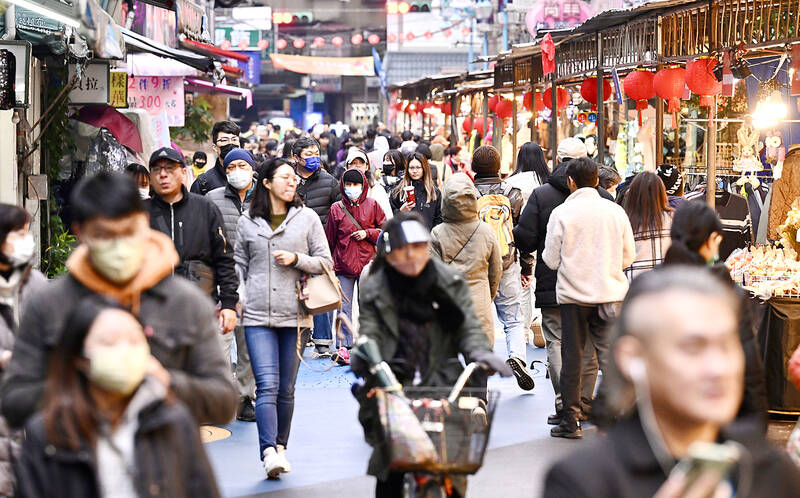
Photo: Peter Lo, Taipei Times
An increase in e-commerce and catalog sales as firms launched marketing campaigns before the holiday also contributed to the growth, it added.
For this month, the ministry forecast that the retail sector’s growth momentum would continue thanks to seasonal demand for clothing and related products and special sales promotions related to International Women’s Day and White Valentine’s Day.
Retail sales are to grow between 0.3 and 3.3 percent annually to between NT$371.6 billion and NT$382.7 billion this month, it said.
The food and beverage sector also posted record-high sales of NT$188.4 billion for the first two months, representing an annual increase of 5.7 percent, as holiday consumption benefited restaurants, while travel demand boosted catering services for international flights, the report said.
The sector’s sales this month are expected to fall from last month due to fewer holidays, but sales are likely to grow from a year earlier, up 8.8 to 11.8 percent to between NT$83.9 billion and NT$86.2 billion, as firms remain active in brand development and store expansion, it added.
Meanwhile, the wholesale sector witnessed a 9.1 percent annual rise in sales to NT$1.94 trillion during the first two months, mainly driven by demand for machinery equipment used to develop emerging artificial intelligence (AI) and high-performance computing (HPC) applications, the report said.
Higher steel prices and kitchenware shipments also boosted the wholesale revenue of building materials, while channel distributors and restaurants’ piling up inventory contributed to revenue growth in wholesale food, beverage and tobacco products, it added.
This month, the wholesale sector would see sales grow from a year earlier, up 5.8 to 8.8 percent to between NT$1.08 trillion and NT$1.11 trillion, due to stable domestic consumption and steady demand for new technology applications such as AI, the ministry said.

Among the rows of vibrators, rubber torsos and leather harnesses at a Chinese sex toys exhibition in Shanghai this weekend, the beginnings of an artificial intelligence (AI)-driven shift in the industry quietly pulsed. China manufactures about 70 percent of the world’s sex toys, most of it the “hardware” on display at the fair — whether that be technicolor tentacled dildos or hyper-realistic personalized silicone dolls. Yet smart toys have been rising in popularity for some time. Many major European and US brands already offer tech-enhanced products that can enable long-distance love, monitor well-being and even bring people one step closer to

MAJOR BENEFICIARY: The company benefits from TSMC’s advanced packaging scarcity, given robust demand for Nvidia AI chips, analysts said ASE Technology Holding Co (ASE, 日月光投控), the world’s biggest chip packaging and testing service provider, yesterday said it is raising its equipment capital expenditure budget by 10 percent this year to expand leading-edge and advanced packing and testing capacity amid strong artificial intelligence (AI) and high-performance computing chip demand. This is on top of the 40 to 50 percent annual increase in its capital spending budget to more than the US$1.7 billion to announced in February. About half of the equipment capital expenditure would be spent on leading-edge and advanced packaging and testing technology, the company said. ASE is considered by analysts

TRANSFORMATION: Taiwan is now home to the largest Google hardware research and development center outside of the US, thanks to the nation’s economic policies President Tsai Ing-wen (蔡英文) yesterday attended an event marking the opening of Google’s second hardware research and development (R&D) office in Taiwan, which was held at New Taipei City’s Banciao District (板橋). This signals Taiwan’s transformation into the world’s largest Google hardware research and development center outside of the US, validating the nation’s economic policy in the past eight years, she said. The “five plus two” innovative industries policy, “six core strategic industries” initiative and infrastructure projects have grown the national industry and established resilient supply chains that withstood the COVID-19 pandemic, Tsai said. Taiwan has improved investment conditions of the domestic economy

Malaysia’s leader yesterday announced plans to build a massive semiconductor design park, aiming to boost the Southeast Asian nation’s role in the global chip industry. A prominent player in the semiconductor industry for decades, Malaysia accounts for an estimated 13 percent of global back-end manufacturing, according to German tech giant Bosch. Now it wants to go beyond production and emerge as a chip design powerhouse too, Malaysian Prime Minister Anwar Ibrahim said. “I am pleased to announce the largest IC (integrated circuit) Design Park in Southeast Asia, that will house world-class anchor tenants and collaborate with global companies such as Arm [Holdings PLC],”


 RSS
RSS