


Taiwan Semiconductor Manufacturing Co (TSMC, 台積電) has left its long-term gross margin target unchanged despite the government deciding on Friday to raise electricity rates.
One of the heaviest power consuming manufacturers in Taiwan, TSMC said it always respects the government’s energy policy and would continue to operate its fabs by making efforts in energy conservation.
The chipmaker said it has left a long-term goal of more than 53 percent in gross margin unchanged.
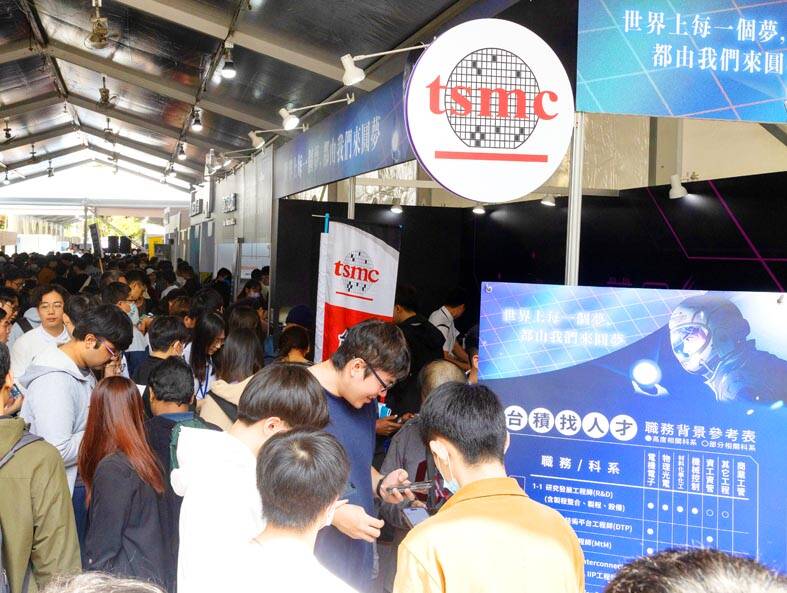
Photo: CNA
The Ministry of Economic Affairs concluded a power rate evaluation meeting on Friday, announcing electricity tariffs would go up by 11 percent on average to about NT$3.4518 per kilowatt-hour (kWh) for household and industrial users to stem massive losses for the state-owned Taiwan Power Co (台電).
For industrial users, the increases range from 7 percent to 25 percent depending on how much electricity certain industries use.
The average rise in industrial rates is 12.7 percent, pushing the average price from NT$3.38 per kWh up to about NT$3.81 per kWh, the ministry said.
TSMC is said to belong to the ultra-high voltage power user group which would see electricity bills rising 25 percent due to their consumption of more than 500 gigawatt-hours per year.
The electricity rate hike is expected to add about NT$4 billion (US$125.2 million) to TSMC’s electricity bill a year and cut its annual earnings per share by about NT$0.154, local media forecasts showed.
The chipmaker recorded a gross margin of 53 percent in the fourth quarter of last year, close to the higher end of its forecast of 51.5 to 53.5 percent, but down 1.3 percentage points from a quarter earlier because its 3-nanometer chips had not yet reached economies of scale.
The 3-nanometer process is the latest technology of which TSMC began commercial production at the end of 2022.
TSMC said it has five energy conservation task forces in place to facilitate power savings across its operations such as advanced process research and development, 12-inch and 8-inch wafer production, back-end packaging and testing services, and extreme ultraviolet (EUV) lithography equipment, which is used to produce high-end chips.
TSMC implemented massive power conservation measures in 2022 to cut power usage by 700 gigawatt-hours a year, which was equivalent to a reduction of about 360,000 tonnes in carbon dioxide emissions.
Among these measures, TSMC has optimized 12-inch wafer production equipment, which has helped the company cut electricity consumption by about 112 gigawatt-hours a year.
In addition, it has worked with its EUV supplier to cut power consumption by 22 percent from the production of each wafer made by EUV machines.
TSMC said the company is determined to fulfill its social responsibility.
The company’s operations in Taiwan account for more than 90 percent of its total revenue.

Cairo’s new monorail slices across the city skyline, running above the familiar chaos of blaring horns and aging buses’ exhaust fumes that mark rush hour below. The US$4.5 billion monorail, opened this month, is among Egypt’s most prominent new transport projects, part of a debt-funded infrastructure drive criticized for sapping state finances while bringing limited benefits to most of the country’s 109 million people. “It feels like you’re in a different country,” said Ramy Sayed, a restaurant manager, aboard a driverless Innovia 300 train. “No noise, no traffic, we’re not used to this.” The eastern line runs 56km from the bustling middle-class

Taiwanese firms have increased investment in the Philippines in recent years as Manila’s ties with Washington deepen and global supply chains continue to shift away from China, an expert at the Chung-Hua Institution for Economic Research (CIER, 中華經濟研究院) said yesterday. The Philippines had not been among Taiwanese investors’ top choices in Southeast Asia, CIER Taiwan ASEAN Studies Center director Kristy Hsu (徐遵慈) said at a seminar in Taipei. However, Taiwan’s investment in the country has grown significantly since the COVID-19 pandemic, reaching US $257 million last year, a high in recent years, she said. Although Taiwan’s total investment in the Philippines still lags

Intel Corp regards Taiwan Semiconductor Manufacturing Co (TSMC, 台積電) as a longstanding partner, as the US chipmaker would continue outsourcing production of advanced chips to TSMC, Intel chief executive officer Lip-Bu Tan (陳立武) said yesterday. “I don’t look at people as competitors. I look at the collaboration... Nvidia is also, you know, a good friend,” Tan told a news conference following his keynote speech at the Computex trade show in Taipei. “It’s a very trusted partnership for us... We are a big, top customer for them, and we’re going to continue doing that,” he said, referring to TSMC, the world’s largest foundry

Artificial intelligence (AI) agents would supplant smartphones as the center of people’s digital lives, fundamentally reshaping personal devices and driving a major computing upgrade cycle, Qualcomm Inc CEO Cristiano Amon said yesterday. In his keynote speech for this year’s Computex trade show in Taipei, Amon said that the rise of "agentic AI" — AI systems capable of reasoning, planning and carrying out tasks autonomously — would transform how people interact with technology across phones, PCs, vehicles and wearable devices. Describing the technology as the next major evolution in computing, Amon said that "2026 is the year of agents.” For decades, smartphones have sat


 RSS
RSS