


European companies in China are facing “less predictable” business conditions in the world’s second-largest economy, a report said yesterday, forcing them to allocate more resources to risk management.
The study, published by the EU Chamber of Commerce in China, sheds light on the increasing challenges for foreign firms with operations in the country.
More than half of those polled — 55 percent — reported a business climate that is “more political over the past year,” according to a recent survey conducted by the chamber, which represents more than 1,700 companies in China.
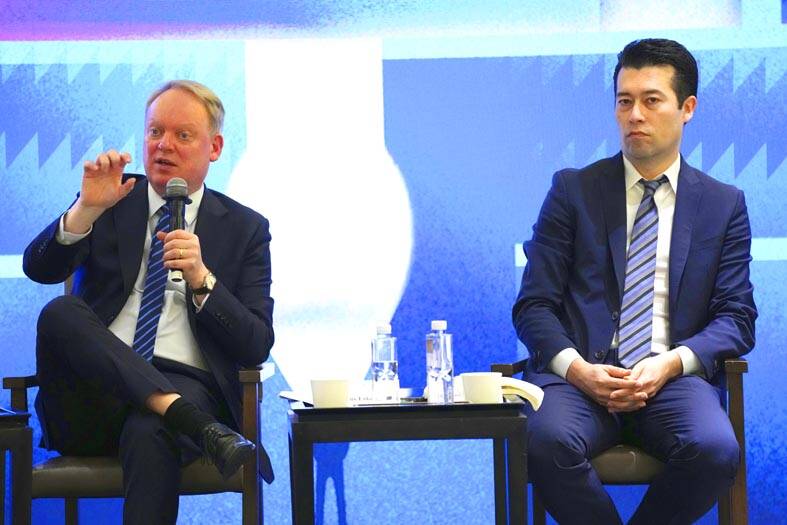
Photo: AP
This “general sentiment of uncertainty” has pushed three-quarters of European companies to review their exposure to China and diversify supply chains over the past two years, the survey found.
However, only 12 percent have decided to establish completely new supply chains outside China, while just 1 percent are severing all links with the country.
The report’s highlighting of uncertainty echoes sentiments expressed in an American Chamber of Commerce (AmCham) report last month, which noted an uptick in its members’ optimism about the Chinese market, but added that US-China tensions and regulatory inconsistency were among the main challenges reported.
Most of AmCham’s members planned limited or no new investments in China this year, it said.
“Despite significant improvement compared to last year, a majority (57 percent) of companies lack confidence that China will further open its markets to foreign firms,” it said.
“With the complexity and severity of the risks that businesses face having grown exponentially in recent years, companies are now having to allocate more resources to risk management and compliance activities than ever before,” the EU report said.
To navigate those risks, investing in due diligence services and detailed supplied chain reviews could become a competitive advantage, the chamber said.
However, a recent crackdown on consulting firms operating in China has spooked foreign investors, and recent changes to an anti-espionage law give Beijing more power than ever to determine what information falls under the national security umbrella.
“Derisking” has emerged as a core pillar of the EU’s economic policy toward China, after the COVID-19 pandemic and Russia’s invasion of Ukraine, the report said.
The term contrasts with the more drastic approach known as “decoupling,” pursued by some policymakers in the US who aim to isolate China or cut all commercial ties with the country.
The EU views China as a “partner,” but also as “an economic competitor and systemic rival,” the report said.
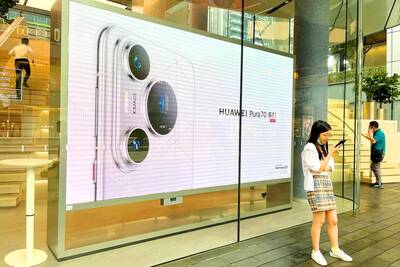
Huawei Technologies Co’s (華為) latest smartphones carry a version of the advanced made-in-China processor it revealed last year, results from an independent analysis showed. This underscored the Chinese company’s ability to sustain production of the controversial chip. The Pura 70 series unveiled last week sports the Kirin 9010 processor, research firm TechInsights found during a teardown of the device. This is a newer version of the Kirin 9000s, made by Semiconductor Manufacturing International Corp (SMIC, 中芯) for the Mate 60 Pro, which had alarmed officials in Washington who thought a 7-nanometer chip was beyond China’s capabilities. Huawei has enjoyed a resurgence since
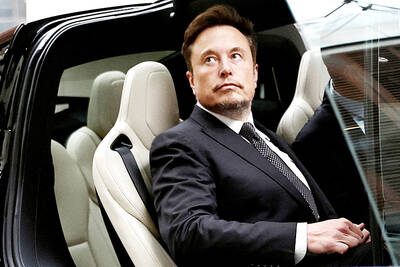
purpose: Tesla’s CEO sought to meet senior Chinese officials to discuss the rollout of its ‘full self-driving’ software in China and approval to transfer data they had collected Tesla Inc CEO Elon Musk arrived in Beijing yesterday on an unannounced visit, where he is expected to meet senior officials to discuss the rollout of "full self-driving" (FSD) software and permission to transfer data overseas, according to a person with knowledge of the matter. Chinese state media reported that he met Premier Li Qiang (李強) in Beijing, during which Li told Musk that Tesla's development in China could be regarded as a successful example of US-China economic and trade cooperation. Musk confirmed his meeting with the premier yesterday with a post on social media platform X. "Honored to meet with Premier Li
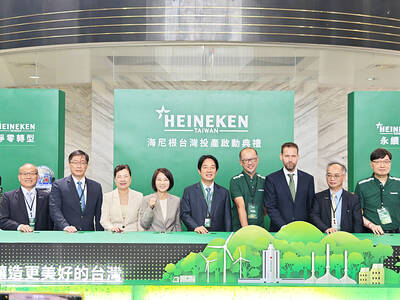
Dutch brewing company Heineken NV on Friday announced an investment of NT$13.5 billion (US$414.62 million) over the next five years in Taiwan. The first multinational brewing company to operate in Taiwan, Heineken made the statement at a ceremony held at its brewery in Pingtung County. It also outlined its efforts to make the brewery “net zero” by 2030. Heineken has been in the Taiwanese market for 20 years, Heineken Taiwan managing director Jeff Wu (吳建甫) said. With strong support from local consumers, the Dutch brewery decided to transition from sales to manufacturing in the country, Wu said. Heineken assumed majority ownership and management rights
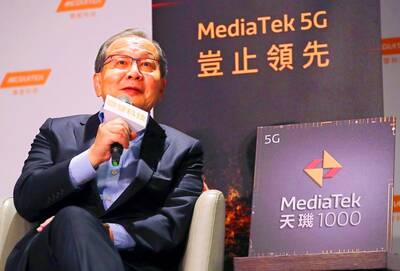
GROWTH DRIVERS: The firm expects to benefit from generative AI applications for smartphones, higher average selling price of flagship chips and market share gains Smartphone chip designer MediaTek Inc (聯發科) yesterday said it estimates that revenue would expand at an annual rate of about 15 percent this year, as a proliferation of generative artificial intelligence (AI) applications for premium smartphones are fueling demand for its flagship smartphone chips. It expects its smartphone chip revenue to outgrow the company’s average growth rate this year, benefiting primarily from the higher average selling price of its flagship smartphone chips and market share gains. The flagship chip revenue is to soar 50 percent year-on-year this year, MediaTek told an investor conference yesterday. As a whole, this year’s gross margin is


 RSS
RSS