


PC vendor Asustek Computer Inc (華碩電腦) yesterday said it expects server revenue growth this year to exceed the annual growth rate of 50 percent last year, ahead of the company’s five-year target to increase the new business revenue by five times.
While generative artificial intelligence (AI) applications grow rapidly, government agencies and large-scale private businesses worldwide are keen to build AI-enabled data centers, the Beitou District (北投), Taipei-based company said.
AI servers are expected to make up 70 percent of the company’s total server offerings this year, doubling from last year’s 35 percent, Asustek said.
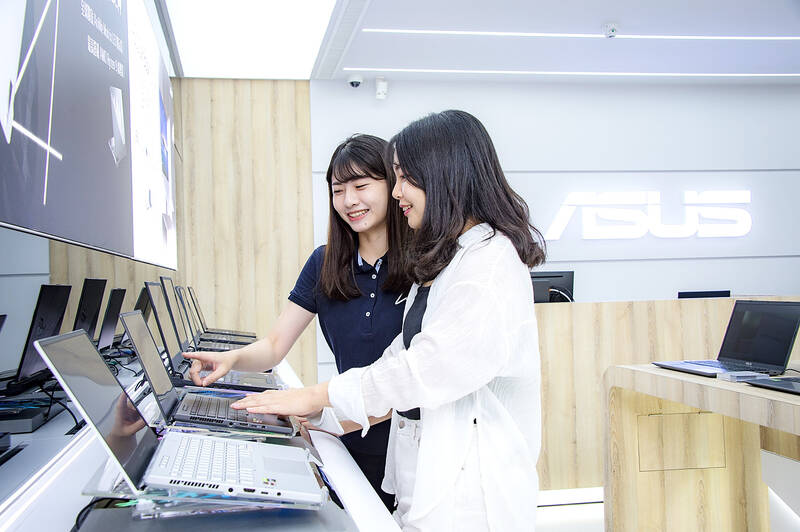
Photo courtesy of Asustek Computer Inc
The expansion was more drastic than the 10 percent increase in 2022, Asustek said.
“Our [AI server] customers include government agencies and major businesses mostly from the Asia-Pacific region with a minority from Europe. They are all eager to build data centers for data training,” Asustek cochief executive officer Samson Hu (胡書賓) told investors in a quarterly conference yesterday.
Given such strong demand, Asustek expects server business to become a bigger revenue contributor this quarter, at about a high-single-digit percentage of the company’s total revenue, it said.
In addition to AI servers, AI PCs would be essential to the company’ growth from the second half of this year, when new models are to be equipped with a neutral processing unit for executing machine learning algorithms and Microsoft Corp’s new chat assistant system, Copilot.
“PC demand remains sluggish in the first half of this year, but generative AI [applications] trigger the so-called ‘fourth industrial revolution,’” Asustek co-CEO S.Y. Hsu (許先越) said. “From the second half, the PC market is to usher in a new growth cycle. It will last for several years.”
The global PC market might grow at a low-single-digit percentage each year in the next few years, after growing 2 to 3 percent year-on-year to 260 million units, reversing a down cycle before the COVID-19 pandemic, Hsu said.
The company expects an expeditious penetration of AI PCs in the next three years, Asustek said.
AI PCs are expected to account for at least half of all PCs worldwide in 2026, it said.
In the near term, Asustek expects its PC revenue to contract 10 percent quarter-on-quarter during the first three months of this year, matching the seasonal pattern, it said.
Component revenue is expected to grow 15 percent to 25 percent sequentially this quarter, thanks to strong growth momentum in AI servers, Asustek said.
The company yesterday reported a quarterly decline of 65 percent in net profit for the fourth quarter of last year at NT$3.93 billion (US$124.4 million), compared with NT$11.1 billion. That was an improvement from losses of NT$3.82 billion in the fourth quarter of the previous year, due to excessive inventory.
Last year as a whole, net profits grew 8 percent to NT$15.93 billion from NT$14.69 billion in 2022. That translated into earnings per share of NT$21.1 last year, up from NT$19.8 in the prior year.
Gross margin improved to 13.6 percent last year from 12.8 percent a year ago. Operating profit margin sank to 1.9 percent last year from 2.1 percent the previous year.
The company said it aims to boost its operating margin to 4 percent in the long term.

HORMUZ ISSUE: The US president said he expected crude prices to drop at the end of the war, which he called a ‘minor excursion’ that could continue ‘for a little while’ The United Arab Emirates (UAE) and Kuwait started reducing oil production, as the near-closure of the crucial Strait of Hormuz ripples through energy markets and affects global supply. Abu Dhabi National Oil Co (ADNOC) is “managing offshore production levels to address storage requirements,” the company said in a statement, without giving details. Kuwait Petroleum Corp said it was lowering production at its oil fields and refineries after “Iranian threats against safe passage of ships through the Strait of Hormuz.” The war in the Middle East has all but closed Hormuz, the narrow waterway linking the Persian Gulf to the open seas,
RATIONING: The proposal would give the Trump administration ample leverage to negotiate investments in the US as it decides how many chips to give each country US officials are debating a new regulatory framework for exporting artificial intelligence (AI) chips and are considering requiring foreign nations to invest in US AI data centers or security guarantees as a condition for granting exports of 200,000 chips or more, according to a document seen by Reuters. The rules are not yet final and could change. They would be the first attempt to regulate the flow of AI chips to US allies and partners since US President Donald Trump’s administration said it rescinded its predecessor’s so-called AI diffusion rules. Those rules sought to keep a significant amount of AI

Apple Inc increased iPhone production in India by about 53 percent last year and now makes a quarter of its marquee devices there, reflecting the US company’s efforts to avoid tariffs on China. The company assembled about 55 million iPhones in India last year, up from 36 million a year earlier, people familiar with the matter said, asking not to be named because the numbers aren’t public. Apple makes about 220 million to 230 million iPhones a year globally, with India’s share of the total increasing rapidly. Apple has accelerated its expansion in the world’s most populous country in recent years, bolstered

HEADWINDS: The company said it expects its computer business, as well as consumer electronics and communications segments to see revenue declines due to seasonality Pegatron Corp (和碩) yesterday said it aims to grow its artificial intelligence (AI) server revenue more than 10-fold this year from last year, driven by orders from neocloud solutions clients and large cloud service providers. The electronics manufacturing service provider said AI server revenue growth would be driven primarily by the Nvidia Corp GB300 server platform. Server shipments are expected to increase each quarter this year, with the second half likely to outperform the first half, it said. The AI server market is expected to broaden this year as more inference applications emerge, which would drive demand for system-on-chip, application-specific integrated circuits


 RSS
RSS