


The consumer price index (CPI) last month soared to a 19-month high of 3.08 percent from a year earlier, as food and services prices grew over the Lunar New Year holiday, the Directorate-General of Budget, Accounting and Statistics (DGBAS) said yesterday.
Stripping out the holiday effect, the inflationary gauge rose 2.43 percent in the first two months, slowing from 2.7 percent in December last year, DGBAS official Tsao Chih-hung (曹志弘) said, predicting that the CPI could lose some momentum this month.
“It is usual for caregivers, barbers and taxi drivers to charge extra fees in keeping with tradition before and through the holiday,” Tsao said, adding that hotels, restaurants, travel agencies and entertainment facilities did the same.

Photo: CNA
That explained why prices for miscellaneous items climbed 4.25 percent, as caregiving costs spiked 25.87 percent, while prices for jewelry and personal accessories advanced 4.46 percent, the DGBAS report showed.
For similar reasons, spending on education and entertainment was 3.72 percent higher year-on-year, it added. Hotels, restaurants and travel agencies raised charges to reflect strong demand and extra personnel compensation during the holiday.
Food costs, the largest chunk with 25 percent of the weighting, rose 4.49 percent, as fruit prices shot up 20.71 percent due to bad weather last year, Tsao said.
Meat prices gained 5.45 percent on the back of more expensive fodder, the report said, adding that dining prices climbed 4 percent.
Vegetable prices fell 8.62 percent as a harvest drove up supply and eased price hikes in overall food costs, Tsao said.
Core CPI, a more reliable long-term price tracker because it excludes volatile items, expanded 2.9 percent last month, the DGBAS said.
The reading in the first two months increased at a more tolerable 2.27 percent, it said.
Upcoming electricity rate hikes could pose uncertainty, but is hopefully controllable, Tsao said.
A 10 percent hike in electricity rates across the board might drive up inflation by 0.12 percentage points annually, he said, adding that it is difficult to measure indirect influences as some firms would pass the extra financial burden onto consumers, while others would absorb the costs themselves.
The Ministry of Economic Affairs yesterday downplayed the impact of higher electricity rates, saying that a 5 percent hike for residential electricity would lead to an increase of NT$9 per month for those consuming less than 120 kilowatts-per-hour (kWh) and an increase of NT$34 a month for those consuming up to 330kWh.
Taiwan’s residential electricity rates are the fifth-lowest in the world and the industrial electricity rates are the third-lowest, Minister of Economic Affairs Wang Mei-hua (王美花) told legislators yesterday.
Meanwhile, the producer price index (PPI), which captures price changes from a seller’s viewpoint, expanded 0.32 percent last month, but fell 0.12 percent in the first two months compared with a year earlier, the DGBAS said.
Tsao attributed the latest PPI movements to cheaper metal, but higher agricultural product prices, in addition to a soft local currency versus the greenback.
additional reporting by Lisa Wang

purpose: Tesla’s CEO sought to meet senior Chinese officials to discuss the rollout of its ‘full self-driving’ software in China and approval to transfer data they had collected Tesla Inc CEO Elon Musk arrived in Beijing yesterday on an unannounced visit, where he is expected to meet senior officials to discuss the rollout of "full self-driving" (FSD) software and permission to transfer data overseas, according to a person with knowledge of the matter. Chinese state media reported that he met Premier Li Qiang (李強) in Beijing, during which Li told Musk that Tesla's development in China could be regarded as a successful example of US-China economic and trade cooperation. Musk confirmed his meeting with the premier yesterday with a post on social media platform X. "Honored to meet with Premier Li
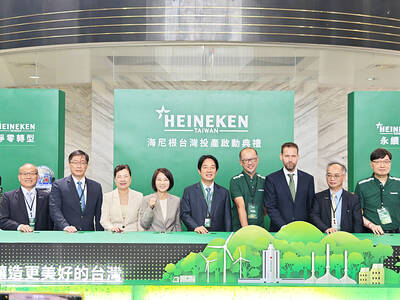
Dutch brewing company Heineken NV on Friday announced an investment of NT$13.5 billion (US$414.62 million) over the next five years in Taiwan. The first multinational brewing company to operate in Taiwan, Heineken made the statement at a ceremony held at its brewery in Pingtung County. It also outlined its efforts to make the brewery “net zero” by 2030. Heineken has been in the Taiwanese market for 20 years, Heineken Taiwan managing director Jeff Wu (吳建甫) said. With strong support from local consumers, the Dutch brewery decided to transition from sales to manufacturing in the country, Wu said. Heineken assumed majority ownership and management rights

coverage expansion: The industrial PC maker has proposed to acquire 3.938 million Aures shares to strengthen its global smart retail presence Leading industrial PC maker Advantech Co (研華) plans to acquire Aures Technologies SA, a French company known for its point-of-sale (POS) and kiosk equipment, to expand its global coverage in smart retail products and services. Advantech proposed to acquire 3.938 million Aures shares from the French firm’s major shareholder and through a public tender offer at up to 6.7 euros per share, the PC maker said in a statement after announcing the deal at the Taiwan Stock Exchange late on Friday. The company aims to acquire up to 100 percent equity of Aures, a well-known brand in the western market with a

Microsoft Corp yesterday said that it would create Thailand’s first data center region to boost cloud and artificial intelligence (AI) infrastructure, promising AI training to more than 100,000 people to develop tech. Bangkok is a key economic player in Southeast Asia, but it has lagged behind Indonesia and Singapore when it comes to the tech industry. Thailand has an “incredible opportunity to build a digital-first, AI-powered future,” Microsoft chairman and chief executive officer Satya Nadella said at an event in Bangkok. Data center regions are physical locations that store computing infrastructure, allowing secure and reliable access to cloud platforms. The global embrace of AI


 RSS
RSS