


The maker of ChatGPT on Thursday unveiled its next leap into generative artificial intelligence with a tool that instantly makes short videos in response to written commands.
San Francisco-based OpenAI’s new text-to-video generator, called Sora, is not the first of its kind. Google, Meta and start-up Runway ML are among the other companies to have demonstrated similar technology.
However, the high quality of videos displayed by OpenAI — some after ChatGPT chief executive officer Sam Altman asked social media users to send in ideas for written prompts — astounded observers while also raising fears about the ethical and societal implications.

Photo: AP
“A instructional cooking session for homemade gnocchi hosted by a grandmother social media influencer set in a rustic Tuscan country kitchen with cinematic lighting,” was a prompt suggested on X by a freelance photographer from New Hampshire.
Altman responded a short time later with a realistic video that depicted what the prompt described.
The tool is not yet publicly available and OpenAI has revealed limited information about how it was built.
The company, which has been sued by some authors and the New York Times over its use of copyrighted written works to train ChatGPT, also has not disclosed what imagery and video sources were used to train Sora. (OpenAI pays an undisclosed fee to The Associated Press to license its text news archive).
OpenAI said in a blog post that it is engaging with artists, policymakers and others before releasing the new tool to the public.
“We are working with red teamers — domain experts in areas like misinformation, hateful content, and bias — who will be adversarially testing the model,” the company said.
“We’re also building tools to help detect misleading content such as a detection classifier that can tell when a video was generated by Sora,” OpenAI said.
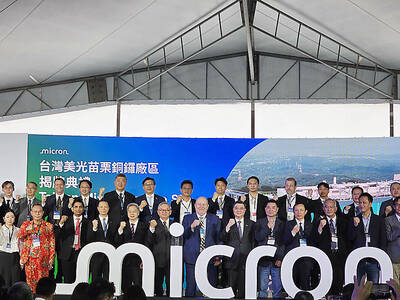
UNPRECEDENTED PACE: Micron Technology has announced plans to expand manufacturing capabilities with the acquisition of a new chip plant in Miaoli Micron Technology Inc unveiled a newly acquired chip plant in Miaoli County yesterday, as the company expands capacity to meet growing demand for advanced DRAM chips, including high-bandwidth memory chips amid the artificial intelligence boom. The plant in Miaoli County’s Tongluo Township (銅鑼), which Micron acquired from Powerchip Semiconductor Manufacturing Corp (力積電) for US$1.8 billion, is expected to make a sizeable capacity contribution to the company from fiscal 2028, the company said in a statement. It would be an extended production site of Micron’s large-scale manufacturing hub in Taichung, the company said. As the global semiconductor industry is racing to reach US$1 trillion

Singapore-based ride-hailing and delivery giant Grab Holdings Ltd has applied for regulatory approval to acquire the Taiwan operations of Germany-based Delivery Hero SE's Foodpanda in a deal valued at about US$600 million. Grab submitted the filing to the Fair Trade Commission on Friday last week, with the transaction subject to regulatory review and approval, the company said in a statement yesterday. Its independent governance structure would help foster a healthy and competitive market in Taiwan if the deal is approved, Grab said. Grab, which is listed on the NASDAQ, said in the filing that US-based Uber Technologies Inc holds about 13 percent of

Taiwan’s food delivery market could undergo a major shift if Singapore-based Grab Holdings Ltd completes its planned acquisition of Delivery Hero SE’s Foodpanda business in Taiwan, industry experts said. Grab on Monday last week announced it would acquire Foodpanda’s Taiwan operations for US$600 million. The deal is expected to be finalized in the second half of this year, with Grab aiming to complete user migration to its platform by the first half of next year. A duopoly between Uber Eats and Foodpanda dominates Taiwan’s delivery market, a structure that has remained intact since the Fair Trade Commission (FTC) blocked Uber Technologies Inc’s

Memory chip stocks extended their losses yesterday after Alphabet Inc’s Google publicized research that could allow more efficient use of the storage needed for artificial intelligence (AI) development. SK Hynix Inc and Samsung Electronics Co, South Korean leaders in the market, fell more than 6 percent and about 5 percent respectively in Seoul. In the US, Micron Technology Inc, Western Digital Corp and Sandisk Corp slid more than 2 percent in pre-market trading, after they all closed lower on Wednesday. Memory companies have been on a tear in recent months as the rapid development of AI infrastructure triggered a spike in chip


 RSS
RSS