


China’s economy last year grew at one of its slowest rates in more than three decades, official figures showed yesterday, as it was battered by a crippling property crisis, sluggish consumption and global turmoil.
The figures were in line with expectations and even beat Beijing’s target, but would likely pile fresh pressure on Chinese officials to unveil more stimulus measures to improve business activity and get the country’s army of consumers spending again.
Chinese National Bureau of Statistics (NBS) revealed that GDP expanded 5.2 percent to 126 trillion yuan (US$17.6 trillion) last year.

Photo: EPA-EFE
The reading is better than the 3 percent recorded in 2022, when strict zero-COVID-19 curbs destroyed activity, but marks the weakest performance since 1990, excluding the pandemic years.
While 5.2 percent would be looked on enviously by other governments such as the US and those in the eurozone — which each expanded about 2 percent in 2022 — it is well down from the levels of about 6 or 7 percent constantly enjoyed in the 2010s.
China’s economy enjoyed an initial post-COVID-19 pandemic rebound early last year, but ran out of steam within months as a lack of confidence among households and businesses hit consumption. Statistics last month showed deflation continued for the third month in a row, likely deepening consumer reluctance to spend.
Tensions with the US and efforts by some Western nations to reduce dependence on China or diversify their supply chains have also hit growth.
NBS official Kang Yi (康義) yesterday told media that the recovery had been an “arduous task” last year, while other data painted a bleak picture of the state of the Chinese economy as the year drew to a close.
Between the third and fourth quarters — figures more reflective of the real-time economic situation — it only grew 1 percent.
And last month saw retail sales — a key indicator of household spending — slow after a rebound the previous month.
Unemployment also increased slightly to 5.1 percent — but the statistics effectively exclude millions of migrant workers from rural areas.
Official statistics also showed China’s population decline accelerated last year, extending a downward streak after more than six decades of growth as the country battles a looming demographic crisis.
“What China saw last year was possibly the most disappointing post-COVID recovery imaginable,” said Shehzad Qazi, managing director of China Beige Book, a consultancy firm that tracks the Chinese economy.
“The economy limped to calendar’s end,” he said. “Any true acceleration [this year] will require either a major global upside surprise or more active government policy.”
Weighed down by a lack of business confidence and sluggish consumption, China has sought to lure back international investors.
Speaking at the annual meeting of global elites in Davos on Tuesday, Chinese Premier Li Qiang (李強) painted a bullish picture of the economy.
“Choosing the Chinese market is not a risk, but an opportunity,” Li said.
However, risks abound, most prominently in the country’s teetering real-estate market, with last month’s new home prices falling at the fastest pace in about nine years, marking the sixth straight month of declines, NBS data showed.
Property sales by floor area fell 8.5 percent last year while new construction starts plunged 20.4 percent.
Also weighing down the Chinese economy is a lack of jobs for the country’s young people.
NBS resumed the publication of youth unemployment data, which it had suspended for five months.
Last month’s survey-based jobless rate for those aged 16 to 24, excluding college students, was at 14.9 percent, compared with a record high of 21.3 percent in June.
Additional reporting by Reuters

purpose: Tesla’s CEO sought to meet senior Chinese officials to discuss the rollout of its ‘full self-driving’ software in China and approval to transfer data they had collected Tesla Inc CEO Elon Musk arrived in Beijing yesterday on an unannounced visit, where he is expected to meet senior officials to discuss the rollout of "full self-driving" (FSD) software and permission to transfer data overseas, according to a person with knowledge of the matter. Chinese state media reported that he met Premier Li Qiang (李強) in Beijing, during which Li told Musk that Tesla's development in China could be regarded as a successful example of US-China economic and trade cooperation. Musk confirmed his meeting with the premier yesterday with a post on social media platform X. "Honored to meet with Premier Li
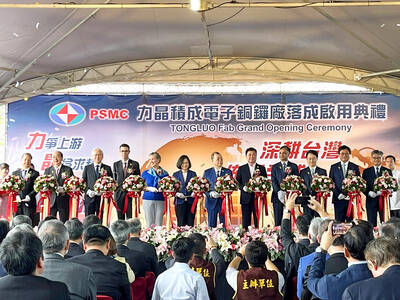
ARTIFICIAL INTELLIGENCE: The chipmaker last month raised its capital spending by 28 percent for this year to NT$32 billion from a previous estimate of NT$25 billion Contract chipmaker Powerchip Semiconductor Manufacturing Corp (力積電子) yesterday launched a new 12-inch fab, tapping into advanced chip-on-wafer-on-substrate (CoWoS) packaging technology to support rising demand for artificial intelligence (AI) devices. Powerchip is to offer interposers, one of three parts in CoWoS packaging technology, with shipments scheduled for the second half of this year, Powerchip chairman Frank Huang (黃崇仁) told reporters on the sidelines of a fab inauguration ceremony in the Tongluo Science Park (銅鑼科學園區) in Miaoli County yesterday. “We are working with customers to supply CoWoS-related business, utilizing part of this new fab’s capacity,” Huang said, adding that Powerchip intended to bridge
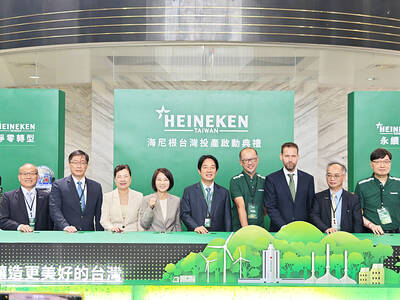
Dutch brewing company Heineken NV on Friday announced an investment of NT$13.5 billion (US$414.62 million) over the next five years in Taiwan. The first multinational brewing company to operate in Taiwan, Heineken made the statement at a ceremony held at its brewery in Pingtung County. It also outlined its efforts to make the brewery “net zero” by 2030. Heineken has been in the Taiwanese market for 20 years, Heineken Taiwan managing director Jeff Wu (吳建甫) said. With strong support from local consumers, the Dutch brewery decided to transition from sales to manufacturing in the country, Wu said. Heineken assumed majority ownership and management rights

Microsoft Corp yesterday said that it would create Thailand’s first data center region to boost cloud and artificial intelligence (AI) infrastructure, promising AI training to more than 100,000 people to develop tech. Bangkok is a key economic player in Southeast Asia, but it has lagged behind Indonesia and Singapore when it comes to the tech industry. Thailand has an “incredible opportunity to build a digital-first, AI-powered future,” Microsoft chairman and chief executive officer Satya Nadella said at an event in Bangkok. Data center regions are physical locations that store computing infrastructure, allowing secure and reliable access to cloud platforms. The global embrace of AI


 RSS
RSS