


Two more major shipping firms, Mediterranean Shipping Co (MSC) and CMA CGM SA, on Saturday said that they were suspending passage through a Red Sea strait vital for global trade after Yemeni rebel attacks.
The announcement by Italian-Swiss giant MSC and France’s CMA CGM follows a similar decision on Friday by two of the world’s largest shipping companies — AP Moller-Maersk A/S and Hapag-Lloyd AG.
The announcements were in response to a warning by the Iran-backed Houthi rebels, who control much of Yemen, but are not recognized internationally.
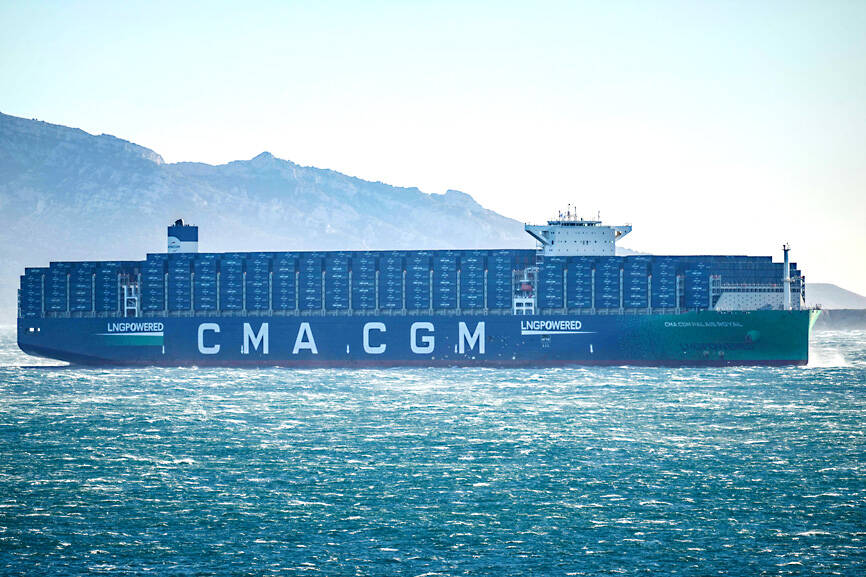
Photo: AFP
The Houthis said they were targeting vessels near the strategic Bab al-Mandeb strait to pressure Israel over its war with Hamas in the Gaza Strip.
Thousands of ships every year transit through the strait, which runs between Yemen on the southwestern tip of the Arabian Peninsula and the African continent.
The tensions have added to fears that the Gaza conflict could spread.
Ships belonging to Israel or heading to its ports “will remain vulnerable to targeting until the aggression stops, the siege on Gaza is lifted and humanitarian aid continues to flow” to Gaza, Houthi spokesperson Mohammed Abdul Salam said on X, formerly Twitter.
Oman was sponsoring discussions “with a number of international parties” regarding operations in the Red and Arabian seas, he added.
A US destroyer on Saturday shot down more than a dozen drones in the Red Sea launched from Houthi-controlled areas of Yemen, the US’ Central Command said.
The British government said one of its destroyers had also brought down a suspected attack drone in the area.
MSC, one of the world’s largest freight shipping lines, said one of its container vessels had been targeted in the Red Sea on Friday and it was halting traffic through the strait until it was safe. Nobody on the MSC Palatium III was wounded, but the ship was damaged by fire, the company said.
CMA CGM said it ordered all its vessels to leave the area until further notice.
“The situation continues to deteriorate and there are increasing concerns about security,” it said.
On Friday, the International Chamber of Shipping condemned the Houthi attacks, which “threaten the lives of innocent seafarers and the safety of merchant shipping.”
The incidents breached international law and states in the region should work to de-escalate the situation, the group said.
Diverting Asia-bound shipping around South Africa’s Cape of Good Hope would increase costs and delays, it said.
Consultancy S&P Global estimated that the detour would increase the distance between Rotterdam in the Netherlands and Singapore by 40 percent.

Elon Musk’s lieutenants have reached out to chip industry suppliers, including Applied Materials Inc, Tokyo Electron Ltd and Lam Research Corp, for his envisioned Terafab, early steps in an audacious and likely arduous attempt to break into the production of cutting-edge chips. Staff working for the joint venture between Tesla Inc and Space Exploration Technologies Corp (SpaceX) have sought price quotes and delivery times for an array of chipmaking gear, people familiar with the matter said. In past weeks, they’ve contacted makers of photomasks, substrates, etchers, depositors, cleaning devices, testers and other tools, according to the people, who asked not to

Taiwan is attracting a growing number of foreign jobseekers as companies increasingly recruit overseas talent to ease labor shortages and expand global reach, recruitment platform 104 Job Bank (104人力銀行) said yesterday. More than 40,000 foreign nationals searched for jobs in Taiwan through the platform last year, a 28 percent increase from a year earlier, the company said. Malaysians accounted for the largest share of overseas jobseekers at 12.2 percent, followed by Indonesians at 11.9 percent and Vietnamese at 10.8 percent. Indonesian applicants surged more than 50 percent year-on-year, while Vietnamese jobseekers rose by more than 30 percent. Applicants from the
NO SHORTCUTS: Asked about Elon Musk’s Terafab initiative, TSMC CEO C.C. Wei said it takes two to three years to build a fab and another one to two to ramp it up Taiwan Semiconductor Manufacturing Co (TSMC, 台積電) yesterday raised its revenue growth forecast for this year to above 30 percent, up from the 25 percent it estimated three months earlier, citing extremely robust artificial intelligence (AI)-related chip demand. “Our customers and customers’ customers, who are mainly cloud service providers, continue to send us very positive signals and outlook,” TSMC chairman and CEO C.C. Wei (魏哲家) said at an earnings conference. The company also hiked its capital expenditure for this year toward the higher end of its forecast, or US$56 billion, as it aims to step up advanced chip capacity expansions, such as

The founder of Chinese property giant Evergrande Group (恆大集團) has pleaded guilty to charges of fraud and bribery, a court said yesterday, the latest blow for what was once the country’s leading developer. Evergrande’s rise was propelled by decades of rapid urbanization and rising living standards, but in 2020, its access to credit dramatically narrowed when the government introduced curbs on excessive borrowing and speculation. The company defaulted in 2021 after struggling to repay creditors. Founder Xu Jiayin (許家印), 67, known as Hui Ka Yan in Cantonese, was reportedly held by police in 2023, with Evergrande saying he had been subjected to


 RSS
RSS