


The industrial production index last month slid 2.32 percent year-on-year to 92.29, the slowest pace of decline in about year, aided by vigorous demand for artificial intelligence (AI) chips, servers and high-performance computing (HPC) devices, the Ministry of Economic Affairs said yesterday.
While the index dipped for a 17th month in a row on an annual basis, it reached its highest level since December last year, the ministry said, attributing the improvement to the nation’s robust AI supply chain and forecasting that the annual decline would soon end.
“There is a good chance that the index would swing back to growth on an annual basis in January next year, given a lower comparison basis in January this year due to the Lunar New Year holiday,” Department of Statistics Deputy Director-General Huang Wei-jie (黃偉傑) said by telephone.
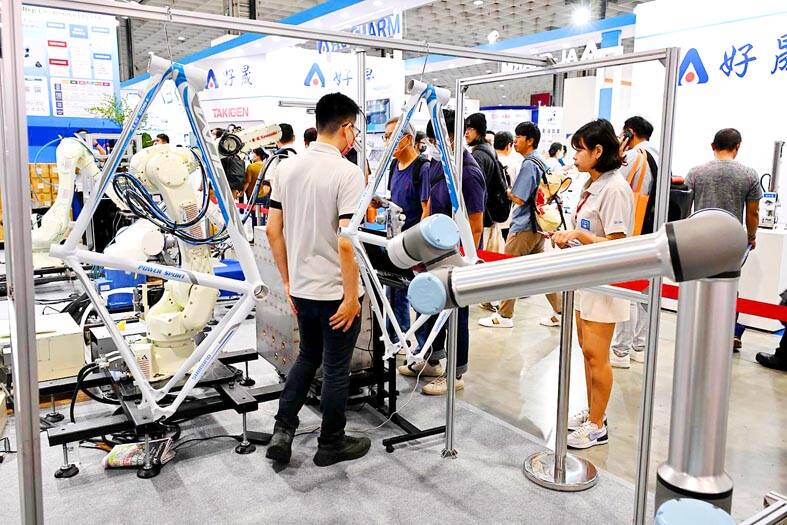
Photo: Tien Yu-hua, Taipei Times
PROMISING SIGNS
“Besides, we have seen a clear trend indicating a significant improvement in industrial production in the past few months, boding well for the index to emerge from inventory-driven negative growth in the first quarter of next year,” Huang said.
A key indicator is that semiconductor output returned to annual growth of 0.37 percent last month, snapping 13 months of declines since September last year, he said.
Demand for 12-inch wafers was the bright spot last month, as chipmakers benefited from strong demand for AI chips and HPC devices, the ministry said.
Rising demand for large TV panels also helped, it said.
The growth in semiconductor output helped bring overall production of electronic components near the breakeven point last month.
The production of electronic components, which mainly comprises semiconductors and flat panels, shrank 0.65 percent annually last month, the mildest reduction in about 12 months, ministry data showed.
Electronic components made up about half of total manufacturing output.
TRADITIONAL INDUSTRIES
Manufacturing production this month is expected to drop between 1.2 percent and 5.5 percent year-on-year to between 93.28 and 89.28, the ministry forecast, based on a survey on local manufacturers.
“With macroeconomic recovery remaining in the doldrums, it would be difficult to see a significant improvement in traditional segments such as machine tools and equipment,” Huang said.
A higher comparison base in November last year would also be a factor, he said.
“Manufacturers produced as many components as they could last year to cope with supply constraints. That resulted in an inventory glut as demand plunged,” he said.
Last month, the production of computers and optical components gained 12.51 percent annually, the fastest rate in more than a year, fueled by increasing demand for servers, cloud-based applications and camera lenses used in smartphones from Apple Inc and Chinese mobile phone brands such as Huawei Technology Co (華為) and Xiaomi Corp (小米).
The production of basic metals, mostly steel, sank 4.6 percent year-on-year last month, as steel mills cut production to cope with weak steel demand.
The petrochemical sector saw production fall 5.18 percent year-on-year last month due to dwindling demand in an inventory-driven down cycle.
Machine tools output plummeted 17.64 percent year-on-year as businesses were reluctant to invest in new manufacturing equipment due to economic uncertainty.
The production of automotive-related products rose 2.37 percent annually last month, attributable to new vehicle launches and improved chip supply, the ministry said.

Cairo’s new monorail slices across the city skyline, running above the familiar chaos of blaring horns and aging buses’ exhaust fumes that mark rush hour below. The US$4.5 billion monorail, opened this month, is among Egypt’s most prominent new transport projects, part of a debt-funded infrastructure drive criticized for sapping state finances while bringing limited benefits to most of the country’s 109 million people. “It feels like you’re in a different country,” said Ramy Sayed, a restaurant manager, aboard a driverless Innovia 300 train. “No noise, no traffic, we’re not used to this.” The eastern line runs 56km from the bustling middle-class

Starlux Airlines Co (星宇航空) today unveiled a long-haul network expansion plan at a shareholders’ meeting in Taipei, including direct flights to Barcelona, Spain, and Zurich, Switzerland, as well as a service connecting Taipei, Sydney and New Zealand. Starlux is to become the first Taiwanese carrier to offer non-stop services to the two European cities, while the inaugural oceanic route is expected to expand transit opportunities within the Australia-New Zealand market, Starlux said. Flight services to Chicago, Dallas, Washington and New York are under evaluation, the airline added. Prior to the shareholders’ meeting, the airline earlier this year announced that it would be

Taiwanese firms have increased investment in the Philippines in recent years as Manila’s ties with Washington deepen and global supply chains continue to shift away from China, an expert at the Chung-Hua Institution for Economic Research (CIER, 中華經濟研究院) said yesterday. The Philippines had not been among Taiwanese investors’ top choices in Southeast Asia, CIER Taiwan ASEAN Studies Center director Kristy Hsu (徐遵慈) said at a seminar in Taipei. However, Taiwan’s investment in the country has grown significantly since the COVID-19 pandemic, reaching US $257 million last year, a high in recent years, she said. Although Taiwan’s total investment in the Philippines still lags

Taiwanese prosecutors suspect that three people successfully smuggled at least one shipment of Nvidia Corp artificial intelligence (AI) chips to China after first exporting them to Japan, people familiar with the matter said. The trio was detained last week by the Keelung District Prosecutors’ Office for allegedly falsifying documents related to exports of Super Micro Computer Inc servers containing advanced Nvidia chips, which the US has barred from sale to China without a license from Washington. The move marked Taiwan’s first public crackdown on AI chip diversion after years of pressure from the US to take a more active role in curtailing


 RSS
RSS