


Shares in troubled Chinese property giant Evergrande Group (恆大集團) yesterday plummeted nearly 80 percent in Hong Kong after the lifting of a 17-month trading suspension.
The resumption of trading came after the company said in a filing on Friday that it had met guidelines set out by the bourse, including belatedly publishing its financial results and complying with other listing rules.
Once China’s largest real-estate firm, Evergrande defaulted in 2021 and is saddled with more than US$300 billion in liabilities, becoming a symbol of the nationwide property crisis that many fear could spill over globally.
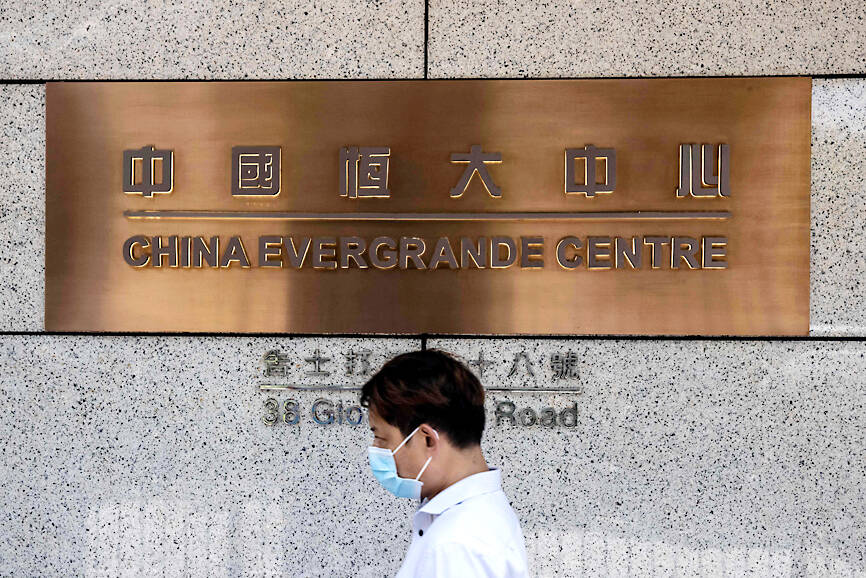
Photo: AFP
Its shares plunged as much as 87 percent during morning trading, slashing its market value from a peak of more than US$50 billion in 2017 to less than US$600 million. It finished the day down 79.4 percent.
The company on Sunday reported fresh losses for the first half of this year amounting to 33 billion yuan (US$4.5 billion) — an improvement on the 66.4 billion yuan in losses reported in the same period last year.
However, its cash assets fell from US$2 billion last year to US$556 million, reflecting its dwindling liquidity.
China’s property market “cooled down significantly” in the first six months of this year and saw new defaults in the sector, “further exacerbating the volatility in the market,” Evergrande said.
“Based on the principles of respecting international restructuring practices and treating the rights and claims of all creditors in a fair and equitable manner, the company steadily pushed forward the work related to the restructuring of its offshore debts,” it said.
In March last year, the Hong Kong stock exchange suspended trading in Evergrande shares after the company failed to publish its 2021 financial results.
Its results for 2021 and last year were published last month, showing a net loss of more than US$113 billion over the two-year period.
Under Hong Kong stock exchange rules, the company risked being delisted if its shares were suspended from trading for 18 months.
Evergrande was supposed to hold creditor meetings yesterday on its offshore debt restructuring proposal, but it announced in the afternoon that the meetings were delayed — just hours before they were set to take place.
The postponement of roughly one month would enable creditors to “consider, understand and evaluate” the plan, the company said in an exchange filing.
The meetings would take place on Sept. 25 or 26, which the developer said was “in line” with the timetable creditors expected.
Evergrande’s plan offers creditors a choice to swap their debt into new notes issued by the company and equities in two subsidiaries, Evergrande Property Services Group Ltd (恒大物業) and Evergrande New Energy Vehicle Group Ltd (恆大新能源汽車).

SECOND-RATE: Models distilled from US products do not perform the same as the original and undo measures that ensure the systems are neutral, the US’ cable said The US Department of State has ordered a global push to bring attention to what it said are widespread efforts by Chinese companies, including artificial intelligence (AI) start-up DeepSeek (深度求索), to steal intellectual property from US AI labs, according to a diplomatic cable. The cable, dated Friday and sent to diplomatic and consular posts around the world, instructs diplomatic staff to speak to their foreign counterparts about “concerns over adversaries’ extraction and distillation of US AI models.” Distillation is the process of training smaller AI models using output from larger, more expensive ones to lower the costs of training a powerful new
Shares of Taiwan Semiconductor Manufacturing Co (TSMC, 台積電) have repeatedly hit new highs, but an equity analyst said the stock’s valuation remains within a reasonable range and any pullback would likely be technical. The contract chipmaker’s historical price-to-earnings (P/E) ratio has ranged between 20 and 30, Cathay Futures Consultant Co (國泰證期) analyst Tsai Ming-han (蔡明翰) told Central News Agency. With market consensus projecting that TSMC would post earnings per share of about NT$100 (US$3.17) this year, supported by strong global demand for artificial intelligence (AI) applications, and the stock currently trading at a P/E ratio of below 25, Tsai said the valuation

The artificial intelligence (AI) boom has triggered a seismic reshuffling of global equity markets, with Taiwan and South Korea muscling past European nations one by one. With its stock market now valued at nearly US$4.3 trillion, Taiwan surpassed the UK, Europe’s biggest market, earlier this month, data compiled by Bloomberg showed. South Korea is about US$140 billion away from doing the same. The tech-heavy Asian markets have shot past Germany and France in the past seven months. The shift is largely down to massive gains in shares of three companies that provide essential hardware for AI: Taiwan Semiconductor Manufacturing Co (TSMC, 台積電),
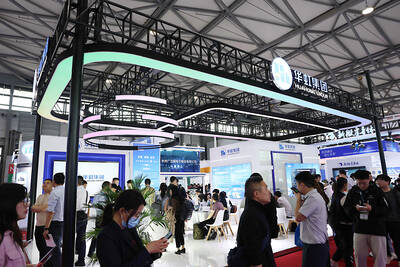
The US Department of Commerce last week ordered multiple chip equipment companies to halt shipments of certain tools to China’s second-largest chipmaker, Hua Hong Semiconductor Ltd (華虹半導體), its latest action to slow the country’s development of advanced chips, two people familiar with the matter said. The department sent letters to at least a handful of companies informing them of restrictions on tools and other materials destined for two Hua Hong facilities US officials believe make China’s most sophisticated chips, the people said. Top US chip equipment companies Lam Research Corp, Applied Materials Inc and KLA Corp, each of which has significant


 RSS
RSS