


Intel Corp yesterday said that it is walking away from its attempt to acquire Tower Semiconductor Ltd, abandoning a US$5.4 billion deal after failing to win regulatory approval in time.
Intel has mutually agreed with Tower Semiconductor to terminate the agreement reached in February last year, it said in a statement.
The purchase of the Israeli company was the keystone of Intel chief executive officer Pat Gelsinger’s plan to get into a faster-growing part of the semiconductor industry, the foundry market dominated by Taiwan Semiconductor Manufacturing Co (TSMC, 台積電).
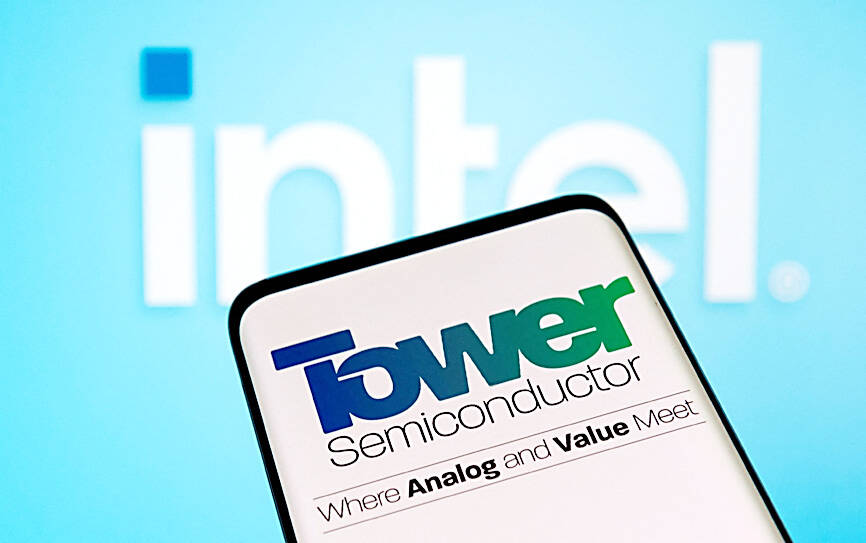
Photo: Reuters
Tower has a relatively small presence in that area — where companies make chips for customers on a contract basis — but has expertise and customers that Intel lacks.
“We will continue to look for opportunities to work together” with Tower in the future, Gelsinger said in the statement.
Intel is to pay Tower a termination fee of US$353 million.
When the transaction was announced, Intel said that it would take “about 12 months.”
The chipmaker had offered US$53 a share to acquire Tower Semiconductor for about US$5.4 billion.
As of October last year, Intel said that it was targeting the first quarter of this year, but then in March warned that the date might slip into the second quarter.
The deadline for completing the transaction was Tuesday at midnight in California.
Increasing tension between China and the US has made securing approval for transactions that require the signoff from regulators in Beijing and Washington increasingly difficult, particularly those involving semiconductors, a key area of friction in the relationship.
While Tower is a fraction of the size of Intel and TSMC in terms of revenue, it is active in older types of production-making chips for big customers such as Broadcom Inc.
Although those chips do not require the state-of-the-art production techniques that an Intel or Nvidia Corp processor demands, many new types of chips for markets such as electric vehicles can be made in older plants.
Sanford C. Bernstein analyst Stacy Rasgon said that the deal’s failure would be a setback for Intel.
“A failed deal does seem modestly disappointing for the prospects of Intel’s foundry efforts,” Rasgon wrote in a research note. “Overall Intel’s foundry efforts were never going to be easy even with Tower, but now may prove to be even more challenging without.”
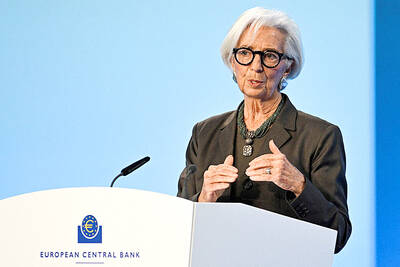
European Central Bank (ECB) President Christine Lagarde is expected to step down from her role before her eight-year term ends in October next year, the Financial Times reported. Lagarde wants to leave before the French presidential election in April next year, which would allow French President Emmanuel Macron and German Chancellor Friedrich Merz to find her replacement together, the report said, citing an unidentified person familiar with her thoughts on the matter. It is not clear yet when she might exit, the report said. “President Lagarde is totally focused on her mission and has not taken any decision regarding the end of
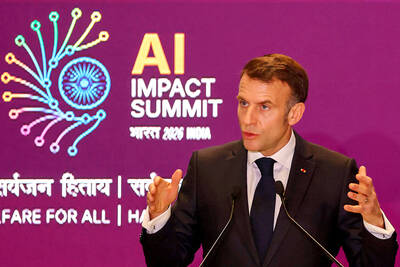
French President Emmanuel Macron told a global artificial intelligence (AI) summit in India yesterday he was determined to ensure safe oversight of the fast-evolving technology. The EU has led the way for global regulation with its Artificial Intelligence Act, which was adopted in 2024 and is coming into force in phases. “We are determined to continue to shape the rules of the game... with our allies such as India,” Macron said in New Delhi. “Europe is not blindly focused on regulation — Europe is a space for innovation and investment, but it is a safe space.” The AI Impact Summit is the fourth

Australian singer Kylie Minogue says “nothing compares” to performing live, but becoming an international wine magnate in under six years has been quite a thrill for the Spinning Around star. Minogue launched her first own-label wine in 2020 in partnership with celebrity drinks expert Paul Schaafsma, starting with a basic rose but quickly expanding to include sparkling, no-alcohol and premium rose offerings. The actress and singer has since wracked up sales of around 25 million bottles, with her carefully branded products pitched at low-to mid-range prices in dozens of countries. Britain, Australia and the United States are the biggest markets. “Nothing compares to performing

AUSPICIOUS TIMING: Ostensibly looking to spike the guns of domestic rivals, ByteDance launched the upgrade to coincide with the Lunar New Year China’s ByteDance Ltd (字節跳動) has rolled out its Doubao 2.0 model, an upgrade of the country’s most widely used artificial-intelligence (AI) app, the company announced on Saturday. ByteDance is one of several Chinese firms hoping to generate overseas and domestic buzz around its new AI models during the Lunar New Year holiday, which began yesterday, when hundreds of millions of Chinese partake in family gatherings in their hometowns. The company, like rival Alibaba Group Holding Ltd (阿里巴巴), was caught off-guard by DeepSeek’s (深度求索) meteoric rise to global fame during last year’s Spring Festival, when Silicon Valley and investors worldwide were


 RSS
RSS