

Global shares dipped yesterday after Wall Street took a step back from its big rally as markets tried to digest a slew of earnings.
Investor optimism was also hurt by Fitch Ratings downgrading the US government’s credit rating, citing a growing federal debt burden and an “erosion of governance” that has manifested in debt limit standoffs.
The rating was cut on Tuesday one notch to “AA+” from “AAA,” the highest possible rating.
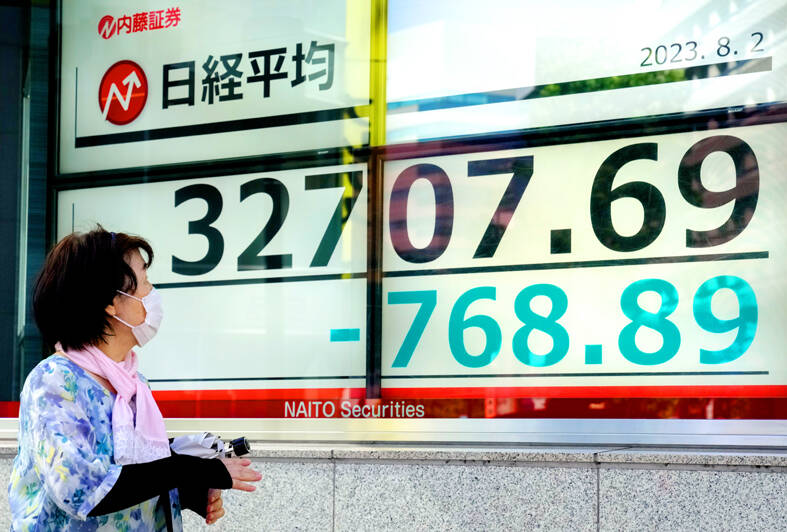
Photo: EPA-EFE
In 2011, ratings agency Standard & Poor’s stripped the US of its prized “AAA” rating.
The move follows a long, drawn-out row between Republicans and Democrats earlier this year over raising the US borrowing ceiling, which had fueled fears of a devastating default by the world’s top economy.
While a deal was eventually struck, the saga rattled markets and reinforced the sense of long-running deadlock on Capitol Hill that has seen the gears of government jammed up.
US Secretary of the Treasury Janet Yellen said the move by Fitch was based on outdated data, adding that the US economy has rapidly recovered from the COVID-19 pandemic recession.
“Some negativity was permeating across Asian equity markets mid-week thanks to Fitch downgrade news. Whilst not a game-changer, news that Fitch downgraded the US credit rating by a notch was enough to put risk appetite on the back foot, as evidenced by the red numbers across the board,” KCM Trade chief market analyst Tim Waterer said.
Shares in Taipei fell 1.85 percent as profit-taking added to the selling of artificial intelligence (AI)-concept stocks, with the TAIEX ending down 319.14 points at 16,893.73.
As investors pocketed recent gains amid the AI frenzy, Wistron Corp (緯創) lost 10 percent, Quanta Computer Inc (廣達) dropped 9.92 percent, Wiwynn Corp (緯穎) declined 9.86 percent and Lite-On Technology Corp (光寶科技) fell 9.74 percent, Taiwan Stock Exchange data showed.
Elsewhere in Asia, Japan’s benchmark Nikkei 225 slumped 2.3 percent to finish at 32,707.69. Australia’s S&P/ASX 200 fell 1.3 percent to 7,354.60. South Korea’s KOSPI slid 1.9 percent to 2,616.47. Hong Kong’s Hang Seng dipped 2.5 percent to 19,517.38, while the Shanghai Composite lost 0.9 percent to 3,261.69.
In Europe, France’s CAC 40 fell 1.3 percent to 7,311.42 in early trading, while Germany’s DAX dipped 1.4 percent to 16,007.22. Britain’s FTSE 100 dropped 1.8 percent to 7,531.78.
Still, SPI Asset Management managing partner Stephen Innes said the outlook was positive.
“While debt downgrades seldom, if ever, have long legs, investors may pause and let the dust settle before re-entering risk markets,” he said in a note.
“However, within this super market-friendly environment of stable growth and a Fed close to the end of its hiking cycle creating fertile ground for stock gains, it’s unlikely risk sentiment will wander too far off the soft landing path,” he wrote, referring to the US Federal Reserve.
Additional reporting by staff writer and AFP

Bankers in Hong Kong skipped the summer break as an artificial intelligence (AI)-fueled rush for capital sent share sales to a record, defying a bruising selloff in the city’s stocks. Initial public offerings (IPOs), placements and block trades raised US$47.5 billion in July to last month, the biggest haul ever for the period, data compiled by Bloomberg showed. That pushed fundraising this year above US$92 billion and within reach of the US$112.5 billion record set in 2021. AI has been at the heart of Hong Kong’s deal revival, but this summer brought a new level of intensity. Chinese companies raised ever-larger sums
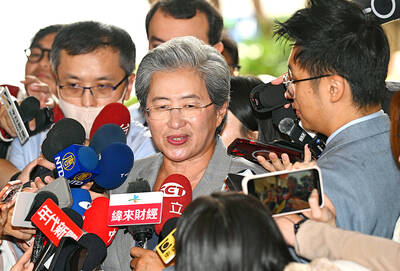
SILICON ISLAND: When asked about geopolitical tensions, Lisa Su said that ‘Taiwan is absolutely critical to the semiconductor supply chain, and very, very critical for AMD’ Advanced Micro Devices Inc (AMD) CEO Lisa Su (蘇姿丰) yesterday said the company plans to “substantially” increase manufacturing capacity next year through its Taiwanese supply chain, particularly with Taiwan Semiconductor Manufacturing Co (TSMC, 台積電), as surging demand for artificial intelligence (AI)-related processors continues to outstrip supply. “It is a very exciting time right now for all kinds of compute, and especially on the CPU [central processing unit] side,” Su said during a visit to Taiwan. “The overall market has increased a lot in 2026, and so we have also increased our own supply and capacity in 2026, but I can
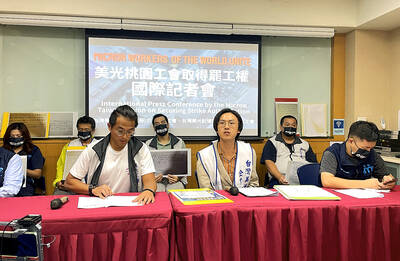
INDUSTRY STANDARD: Most global semiconductor companies have tied employee bonuses directly to corporate profits, the union said, urging Micron to do the same Micron Memory Taiwan Co’s (台灣美光) Taoyuan union secured strike authorization yesterday after a six-day vote, ramping up pressure on management to build a reasonable profit-sharing mechanism. Before the strike, the Taoyuan union “encourages” members to join a protest in Taipei on Oct. 19, union chairman Jerry Lin (林哲瑞) told a news conference in Taipei. The union did not rule out staging a snap strike, Lin said. The union has 2,258 registered members, with 88.3 percent backing the strike, he said. The vote comes as Micron’s board of directors is meeting today and tomorrow in the US. The union expects the board to respond
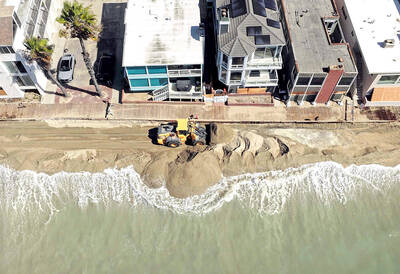
Sea levels in California are set to rise by as much as a foot (30cm) in the coming days as an enormous wave washes up the US West Coast. The huge surge of energy, known as a “coastal trapped wave” or a “Kelvin wave,” is part of El Nino, a months-long phenomenon in the Pacific Ocean that scientists say could generate powerful storms and floods in some parts of the world, while leaving others in drought. The Kelvin wave is not anything like a tsunami; nor does it crash on beaches. Rather it is a sustained bulge of excess water up to


 RSS
RSS