


OpenAI and others in the artificial intelligence (AI) race have committed to making their technology safer with features such as watermarks on fabricated images, the White House said yesterday.
“These commitments, which the companies have chosen to undertake immediately, underscore three principles that must be fundamental to the future of AI — safety, security, and trust — and mark a critical step toward developing responsible AI,” the White House said in a release.
Representatives from Amazon, Anthropic, Google, Inflection, Meta, Microsoft and OpenAI were to join US President Joe Biden later yesterday to announce the commitments, which include developing “robust technical mechanisms” such as watermarking systems to ensure that users know when content is AI-generated, a White House official said.
Photo: AP
Worry that imagery or audio created by artificial intelligence will be used for fraud and misinformation has ramped up as the technology improves and next year’s US presidential election gets closer.
Ways to tell when audio or imagery have been generated artificially are being sought to prevent people from being duped by fakes that look or sound real.
“They’re committing to setting up a broader regime towards making it easier for consumers to know whether content is AI-generated or not,” the White House official said. “There is technical work to be done, but the point here is that it applies to audio and visual content, and it will be part of a broader system.”
The goal is for it to be easy for people to tell when online content is created by AI, the official added.
Commitments by the companies include independent testing of AI systems for risks when it comes to biosecurity, cybersecurity, or “societal effects,” the White House said.
Common Sense Media commended the White House for its “commitment to establishing critical policies to regulate AI technology,” according to the review and ratings organization’s chief executive James Steyer.
“That said, history would indicate that many tech companies do not actually walk the walk on a voluntary pledge to act responsibly and support strong regulations,” Steyer said.
Biden is also working on an executive order intended to ensure that AI is safe and trustworthy, the White House official said.
Watermarks for AI-generated content were among the topics European Commissioner for Internal Market Thierry Breton discussed with OpenAI chief executive Sam Altman during a visit to San Francisco in June.
“Looking forward to pursuing our discussions — notably on watermarking,” Breton wrote in a tweet that included a video snippet of him and Altman.
In the video clip Altman said he “would love to show” what OpenAI is doing with watermarks “very soon.”
The White House said that it will also work with allies to establish an international framework to govern the development and use of AI.
SECOND-RATE: Models distilled from US products do not perform the same as the original and undo measures that ensure the systems are neutral, the US’ cable said The US Department of State has ordered a global push to bring attention to what it said are widespread efforts by Chinese companies, including artificial intelligence (AI) start-up DeepSeek (深度求索), to steal intellectual property from US AI labs, according to a diplomatic cable. The cable, dated Friday and sent to diplomatic and consular posts around the world, instructs diplomatic staff to speak to their foreign counterparts about “concerns over adversaries’ extraction and distillation of US AI models.” Distillation is the process of training smaller AI models using output from larger, more expensive ones to lower the costs of training a powerful new
Shares of Taiwan Semiconductor Manufacturing Co (TSMC, 台積電) have repeatedly hit new highs, but an equity analyst said the stock’s valuation remains within a reasonable range and any pullback would likely be technical. The contract chipmaker’s historical price-to-earnings (P/E) ratio has ranged between 20 and 30, Cathay Futures Consultant Co (國泰證期) analyst Tsai Ming-han (蔡明翰) told Central News Agency. With market consensus projecting that TSMC would post earnings per share of about NT$100 (US$3.17) this year, supported by strong global demand for artificial intelligence (AI) applications, and the stock currently trading at a P/E ratio of below 25, Tsai said the valuation
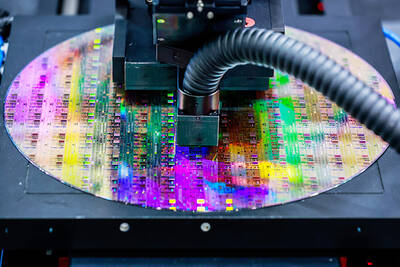
The artificial intelligence (AI) boom has triggered a seismic reshuffling of global equity markets, with Taiwan and South Korea muscling past European nations one by one. With its stock market now valued at nearly US$4.3 trillion, Taiwan surpassed the UK, Europe’s biggest market, earlier this month, data compiled by Bloomberg showed. South Korea is about US$140 billion away from doing the same. The tech-heavy Asian markets have shot past Germany and France in the past seven months. The shift is largely down to massive gains in shares of three companies that provide essential hardware for AI: Taiwan Semiconductor Manufacturing Co (TSMC, 台積電),

The US Department of Commerce last week ordered multiple chip equipment companies to halt shipments of certain tools to China’s second-largest chipmaker, Hua Hong Semiconductor Ltd (華虹半導體), its latest action to slow the country’s development of advanced chips, two people familiar with the matter said. The department sent letters to at least a handful of companies informing them of restrictions on tools and other materials destined for two Hua Hong facilities US officials believe make China’s most sophisticated chips, the people said. Top US chip equipment companies Lam Research Corp, Applied Materials Inc and KLA Corp, each of which has significant


 RSS
RSS