


MediaTek Inc (聯發科) yesterday said it is working with Nvidia Corp — a supplier of chips used to power artificial intelligence (AI) — to deliver in-vehicle cabin solutions for next-generation vehicles as early as 2026.
The announcement came about a month after the Hsinchu-based chip designer launched a new platform, Dimensity Auto, further diversifying its business as it seeks new growth from the rapidly growing auto chip industry.
The Dimensity brand was first used for MediaTek’s 5G mobile chip series.

Photo: CNA
“With this partnership, our collaborative vision is to provide a global one-stop shop for the automotive industry, designing the next generation of intelligent, always-connected vehicles,” MediaTek CEO Rick Tsai (蔡力行) told a media briefing in Taipei.
“Through this special collaboration with Nvidia, we will together be able to offer a truly unique platform for the computer intensive, software-defined vehicle of the future,” he said.
MediaTek expects to create a new product by late 2025 and aims to have automotive solutions available for automakers in 2026 or 2027, Tsai said.
Beyond the auto industry, Tsai said the company plans to collaborate in new areas with Nvidia “as long as it is mutually beneficial.”
There has been speculation that MediaTek was in talks with Nvidia to develop chips for Windows on Arm notebook computers and for its first graphics processing unit (GPU).
“AI and accelerated computing are fueling the transformation of the entire auto industry,” Nvidia founder and CEO Jensen Huang (黃仁勳) said. “The combination of MediaTek’s industry-leading SoC [system on a chip] and Nvidia’s GPU and AI software technologies will enable new user experiences, enhanced safety and new connected services for all vehicle segments, from luxury to mainstream.”
Through this collaboration, MediaTek aims to develop automotive SoCs integrating a new Nvidia GPU chiplet with Nvidia AI and graphics intellectual property. Chiplets are connected with an ultra-fast and coherent chiplet interconnect technology.
MediaTek’s smart cabin solutions are to run Nvidia’s Drive OS, Drive IX, CUDA and TensorRT software technologies — delivering a full range of AI cabin and cockpit functions with cutting-edge graphics, AI, safety and security features.
By tapping Nvidia’s core expertise in AI, cloud, graphics technology and software, and pairing with Nvidia ADAS solutions, MediaTek aims to bolster the capabilities of its comprehensive Dimensity Auto platform, which leverages the company’s expertise in mobile computing, high-speed connectivity and entertainment, and its extensive Android ecosystem, to deliver an all-around smarter in-vehicle experience.
Separately, the Ministry of Economic Affairs yesterday said that Nvidia has launched an AI project, for which the government would offer a NT$6.7 billion subsidy.
As part of the project, Nvidia plans to set up an AI lab in Taiwan and recruit about 1,000 AI researchers to develop cutting-edge technology platforms like the Omniverse technology platform, the ministry said.
The AI lab would collaborate with local universities to foster AI talent, it said.
Nvidia would also be working with Taiwanese companies to develop AI applications based on the its advanced GPU technology, the ministry said.
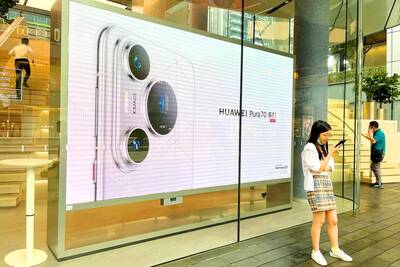
Huawei Technologies Co’s (華為) latest smartphones carry a version of the advanced made-in-China processor it revealed last year, results from an independent analysis showed. This underscored the Chinese company’s ability to sustain production of the controversial chip. The Pura 70 series unveiled last week sports the Kirin 9010 processor, research firm TechInsights found during a teardown of the device. This is a newer version of the Kirin 9000s, made by Semiconductor Manufacturing International Corp (SMIC, 中芯) for the Mate 60 Pro, which had alarmed officials in Washington who thought a 7-nanometer chip was beyond China’s capabilities. Huawei has enjoyed a resurgence since
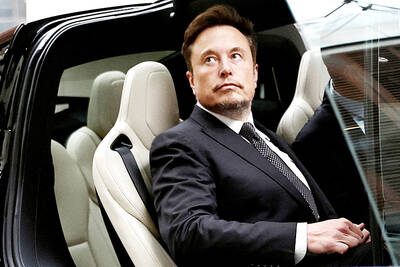
purpose: Tesla’s CEO sought to meet senior Chinese officials to discuss the rollout of its ‘full self-driving’ software in China and approval to transfer data they had collected Tesla Inc CEO Elon Musk arrived in Beijing yesterday on an unannounced visit, where he is expected to meet senior officials to discuss the rollout of "full self-driving" (FSD) software and permission to transfer data overseas, according to a person with knowledge of the matter. Chinese state media reported that he met Premier Li Qiang (李強) in Beijing, during which Li told Musk that Tesla's development in China could be regarded as a successful example of US-China economic and trade cooperation. Musk confirmed his meeting with the premier yesterday with a post on social media platform X. "Honored to meet with Premier Li
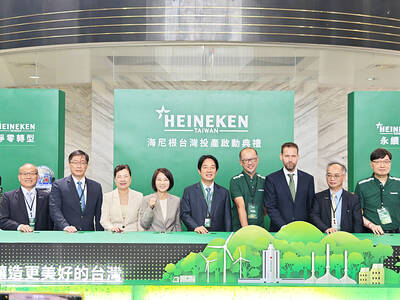
Dutch brewing company Heineken NV on Friday announced an investment of NT$13.5 billion (US$414.62 million) over the next five years in Taiwan. The first multinational brewing company to operate in Taiwan, Heineken made the statement at a ceremony held at its brewery in Pingtung County. It also outlined its efforts to make the brewery “net zero” by 2030. Heineken has been in the Taiwanese market for 20 years, Heineken Taiwan managing director Jeff Wu (吳建甫) said. With strong support from local consumers, the Dutch brewery decided to transition from sales to manufacturing in the country, Wu said. Heineken assumed majority ownership and management rights
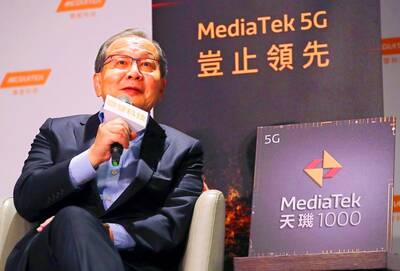
GROWTH DRIVERS: The firm expects to benefit from generative AI applications for smartphones, higher average selling price of flagship chips and market share gains Smartphone chip designer MediaTek Inc (聯發科) yesterday said it estimates that revenue would expand at an annual rate of about 15 percent this year, as a proliferation of generative artificial intelligence (AI) applications for premium smartphones are fueling demand for its flagship smartphone chips. It expects its smartphone chip revenue to outgrow the company’s average growth rate this year, benefiting primarily from the higher average selling price of its flagship smartphone chips and market share gains. The flagship chip revenue is to soar 50 percent year-on-year this year, MediaTek told an investor conference yesterday. As a whole, this year’s gross margin is


 RSS
RSS