


The European Chamber of Commerce Taiwan (ECCT) on Thursday called for concerted efforts by the public and private sectors to create family-friendly workplaces to help reverse Taiwan’s low birthrate and population decline.
The demographic trend, if left unaddressed, would lead to a shortage of workers and talent, boding ill for social and economic health, the foreign trade group said.
Taiwan’s labor and talent shortage has a lot to do with work-life conflicts, low financial security and a lack of daycare, among other issues, it said, citing a survey of 1,236 local employees and employers by human resource consultancy Adecco Taiwan in cooperation with the ECCT.
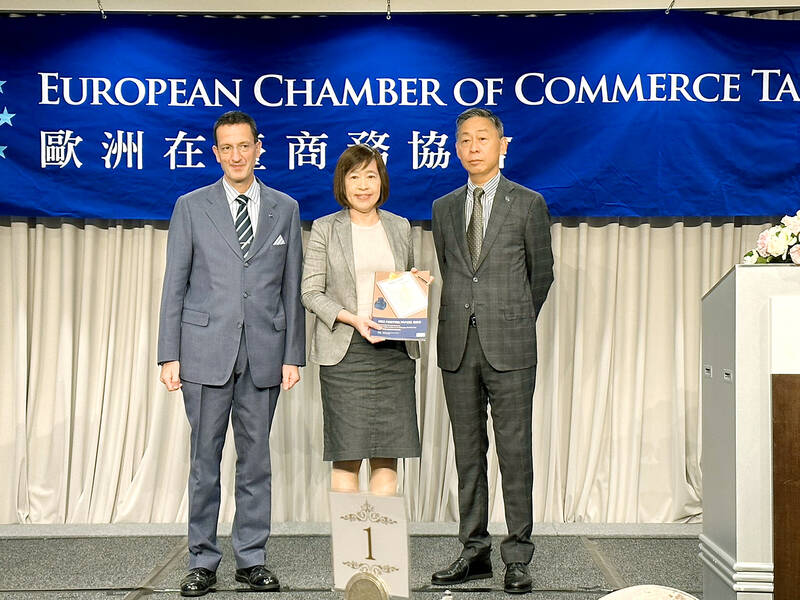
Photo: CNA
Businesses can play a key role in addressing work-life conflicts by creating more family-friendly, diverse and inclusive workplaces, the chamber said.
At present, the family-friendly policies most businesses offer are flexible working hours and remote/hybrid work, it said.
Respondents ranked work-family balance as the third most important factor after salary and job stability, the survey found.
That means parents need more financial support and flexible working options, it said, adding that having flexible working hours and being able to work remotely are considered extremely helpful for people who wish to balance work and family life.
There is also a clear link between childcare subsidies, allowances and paid parental leave offered by companies and their willingness to have children, it said.
Many companies offer subsidies, such as marriage and maternity allowances and parental leave, above the statutory requirement, it said.
The major challenges to work and family balance stem from concerns about performance review results and chances for gaining a promotion when taking family leave, as cited by 39.89 percent of respondents, it found.
Difficulty in finding jobs that can meet employees’ job requirements and family demands ranked second at 39.36 percent, it said.
Long working hours and little private time come as the third obstacle at 37.65 percent, it said.
Most employees rely on daycare facilities or support from relatives for childcare or they are forced to sacrifice working hours or switch to a part-time job to take care of their children, it said.
The most common stress reported by employees with children is a lack of time and energy to take care of their children due to long working hours, followed by worries about the quality of infant and childcare facilities, it said.
As for the low birthrate, 64.46 percent of respondents said having a quality personal life tops their list of concerns, followed by the desire to save money and buy a home or pay a mortgage at 63.37 percent, and financial instability at 57.23 percent, it said.
Nearly 50 percent attributed it to not having the right partner, 41.88 percent reported difficulty arranging childcare and 38.12 percent cited living in an unfavorable social environment due to pollution, a poor education system and a highly competitive society, it said.
When making childbearing decisions, financial stability is considered the most important, followed by having the right partner, possessing good physical and mental health, and other concerns, it said.

Cairo’s new monorail slices across the city skyline, running above the familiar chaos of blaring horns and aging buses’ exhaust fumes that mark rush hour below. The US$4.5 billion monorail, opened this month, is among Egypt’s most prominent new transport projects, part of a debt-funded infrastructure drive criticized for sapping state finances while bringing limited benefits to most of the country’s 109 million people. “It feels like you’re in a different country,” said Ramy Sayed, a restaurant manager, aboard a driverless Innovia 300 train. “No noise, no traffic, we’re not used to this.” The eastern line runs 56km from the bustling middle-class

Taiwanese firms have increased investment in the Philippines in recent years as Manila’s ties with Washington deepen and global supply chains continue to shift away from China, an expert at the Chung-Hua Institution for Economic Research (CIER, 中華經濟研究院) said yesterday. The Philippines had not been among Taiwanese investors’ top choices in Southeast Asia, CIER Taiwan ASEAN Studies Center director Kristy Hsu (徐遵慈) said at a seminar in Taipei. However, Taiwan’s investment in the country has grown significantly since the COVID-19 pandemic, reaching US $257 million last year, a high in recent years, she said. Although Taiwan’s total investment in the Philippines still lags

Intel Corp regards Taiwan Semiconductor Manufacturing Co (TSMC, 台積電) as a longstanding partner, as the US chipmaker would continue outsourcing production of advanced chips to TSMC, Intel chief executive officer Lip-Bu Tan (陳立武) said yesterday. “I don’t look at people as competitors. I look at the collaboration... Nvidia is also, you know, a good friend,” Tan told a news conference following his keynote speech at the Computex trade show in Taipei. “It’s a very trusted partnership for us... We are a big, top customer for them, and we’re going to continue doing that,” he said, referring to TSMC, the world’s largest foundry

Artificial intelligence (AI) agents would supplant smartphones as the center of people’s digital lives, fundamentally reshaping personal devices and driving a major computing upgrade cycle, Qualcomm Inc CEO Cristiano Amon said yesterday. In his keynote speech for this year’s Computex trade show in Taipei, Amon said that the rise of "agentic AI" — AI systems capable of reasoning, planning and carrying out tasks autonomously — would transform how people interact with technology across phones, PCs, vehicles and wearable devices. Describing the technology as the next major evolution in computing, Amon said that "2026 is the year of agents.” For decades, smartphones have sat


 RSS
RSS