

CTBC Bank Co (中信銀行) might record slower growth in its mortgage business this year as central bank rate hikes and selective credit controls affect the local real-estate market, CTBC Financial Holding Co (中信金控) president James Chen (陳佳文) said yesterday.
CTBC Bank's mortgages rose 13.7 percent year-on-year to NT$974 billion (US$31.61 billion) in the first quarter of this year, the second-largest kind within its loan pipeline after foreign currency-denominated lending of NT$1.15 trillion, it told an investors’ conference in Taipei.
Chen said that whole-year mortgage growth is expected to be lower than last year, increasing by a single-digit percentage, as the real-estate market is on a downward trend.
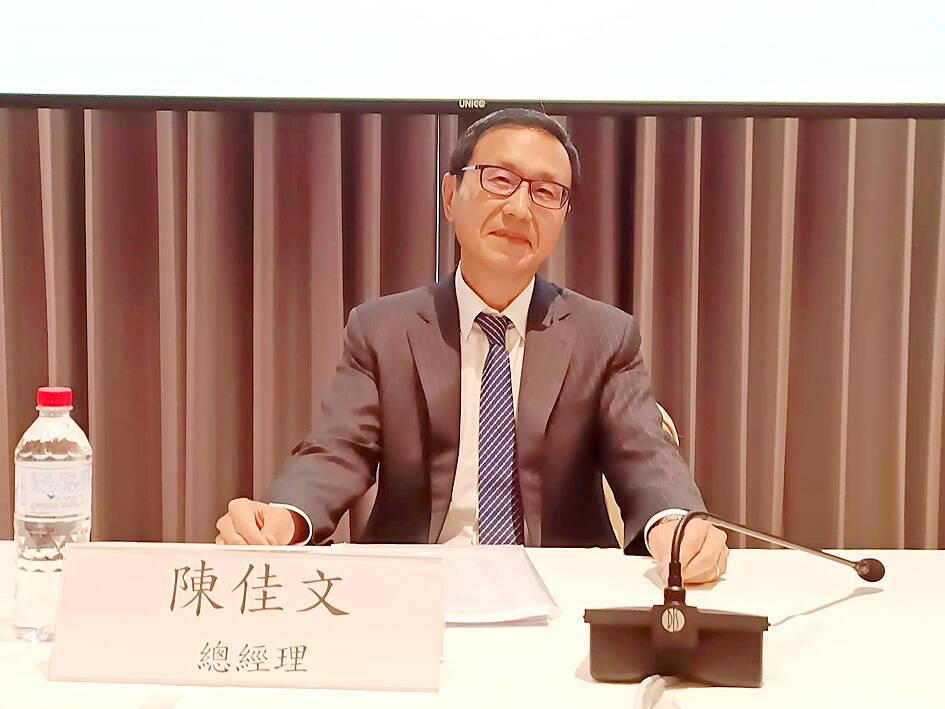
Photo: Lee Ching-hui, Taipei Times
However, as CTBC Bank has concentrated on providing home loans to civil servants and teachers, its mortgage quality remains solid, he said.
CTBC Bank’s net profit rose 52.9 percent from a year earlier to NT$11.36 billion in the first quarter, making up 88 percent of its parent company’s net profit. The bank's net profit grew 37.9 percent from the previous quarter.
Chen said the bank’s overseas branches contributed 35 percent to CTBC Bank’s net profit in the first quarter, supported by strong growth in Hong Kong, Singapore and Thailand.
As the bank has large US dollar deposits, it earned more interest income with the US Federal Reserve hiking rates, while corporate lending in Thailand also showed marked growth as Taiwanese companies continued to shift their operations away from China to Southeast Asia, he said.
In the first quarter, CTBC Financial reported net profit of NT$12.96 billion, down 20.5 percent from a year ago. On a quarterly basis, net profit surged by 1,528.3 percent. Earnings per share were NT$0.66 in the quarter.
The company's life insurance unit, Taiwan Life Insurance Co (台灣人壽), remained in the red in the first quarter with net losses of NT$882 million. But the figure was down 21 percent from a year earlier, CTBC Financial said, adding that the insurer has passed the worst after COVID-19 insurance claims caused greater chaos for the sector last year.
Meanwhile, CTBC Financial plans to expand CTBC Finance Co’s (中國信託資融) business from car loans to “buy now, pay later” and corporate lending operations, to enhance its competitiveness, while CTBC Insurance Co (中國信託產險) plans to raise NT$5 billion later this month to boost its risk-based capital ratio to 200 percent, he said.
Overall, CTBC Financial is expected to report better profit this year than last year, he said.
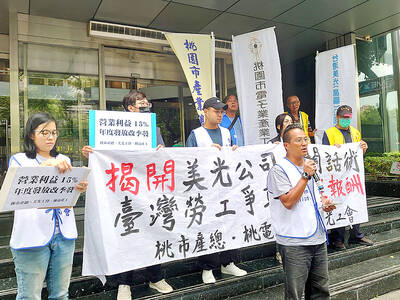
UNION DETERMINATION: Rejecting an offer for a one-time payout as an attempt to influence opinion, the union said a strike at the memory chip manufacturer is possible The Micron Taiwan workers’ union yesterday rejected a one-time payout unveiled by US-based Micron Technology Inc last week, saying it wants a long-term mechanism under which employees would share 15 percent of the company’s operating profits. While the union and the company are still in talks over the dispute, the reward package was proposed unilaterally by the employer without reaching an agreement with the union, union head Jerry Lin (林哲瑞) told reporters. Lin said he suspected the company was seeking to influence public opinion with the move. On Friday last week, Micron announced a reward package under which employees in Taiwan would receive
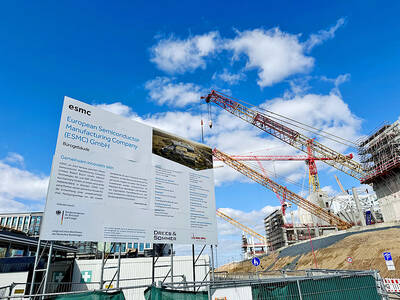
BUILDER’s RITES: The topping out ceremony is held when a project being built has its highest point laid out, a sure sign that TSMC’s European project is making solid progress A “topping out” ceremony was held on Monday at a plant under construction in Germany by Taiwan Semiconductor Manufacturing Co (TSMC, 台積電), indicating that the fab is progressing as planned and within budget, the head of a joint-venture company in charge of the project said. A topping out ceremony is the construction milestone of laying the final beam or structural piece at the highest point of a building, and it honors the construction crew, architects and engineers. European Semiconductor Manufacturing Co (ESMC) president Christian Koitzsch said that about 2,000 workers from 106 countries are working around the clock at the site in
APPEAL: Any agreement to produce advanced memory such as HBM or DRAM could run into opposition from Seoul as those technologies are sensitive, sources said South Korea’s SK Hynix Inc is in talks with Intel Corp about a deal that would see it manufacture memory chips on US soil for the first time, three people familiar with the discussions said. Under one potential scenario, SK Hynix would lease part of Intel’s long-planned chipmaking facility in Ohio, they said. Under another scenario, it could form a venture with Intel and major cloud firms that are keen to lock in memory supplies, two of the people said. A deal would relieve pressure on Intel, which has been struggling, and mark a big win for US President Donald
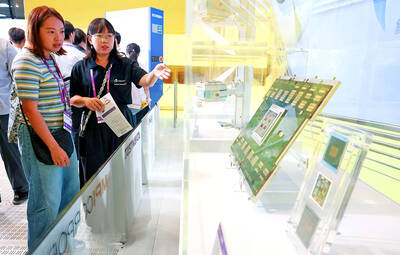
Prices of high-capacity NOR flash memory chips are projected to increase 90 to 110 percent in the second half of this year amid growing demand and slower capacity expansion, after jumping 100 to 120 percent on average in the first half, TrendForce Corp (集邦科技) said yesterday. “Emerging applications such as AI servers and aerospace communications are propelling demand in 2026, aside from existing applications such as advanced driver assistance, digital cockpit systems and industrial devices,” the Taipei-based research group said in a report. Demand from AI servers is exceptionally strong as each AI server requires three to five times more NOR flash


 RSS
RSS