

Samsung Electronics Co’s pledge to cut memorychip production has lifted shares of rival manufacturers because the move could potentially ease a supply glut that has hammered prices across the industry.
Samsung on Friday last week said that it would cut production to a “meaningful level” after reporting its smallest profit in more than a decade.
US chipmaker Micron Technology Inc’s shares rose 8 percent on Monday in New York, their biggest single-day jump in more than a year. Shares of Western Digital Corp also gained 8.7 percent, their best performance in more than two months.

Photo: AFP
ECONOMIC WOES
The post-COVID-19-pandemic slump in demand for consumer electronics, along with broader economic shocks such as rising inflation, have squeezed producers.
International Data Corp on Sunday reported that PC shipments globally tallied 56.9 million in the first quarter of this year, 29 percent less than the same period a year earlier, as the PC market suffered from weak demand, excess inventory and a worsening macroeconomic climate.
Samsung had resisted pulling back on production despite the downturn, in part to take market share from competitors such as Micron.
IMBALANCE
The announcement on Friday last week “adds light to the tunnel,” Stifel, Nicolaus & Co analyst Brian Chin said in a research note.
The move might “help turn around the largest memory supply imbalance in decades.”
Prices of DRAM — a type of memory used to process data — are expected to fall about 10 percent this quarter, Yuanta Securities Co (元大證券) analyst Gilhyun Baik said.
That follows a roughly 20 percent slide in the previous three months and a more than 30 percent drop in the fourth quarter of last year.
Additional reporting by AFP

In China’s hilly Guizhou Province, a cluster of European-style buildings complete with clock tower and multi-arched bridge emits a low, permanent hum — a clue to its unexpected identity as tech giant Huawei’s largest data center. The town-like complex is unique in design, but not in its placement. Dozens of data centers have been constructed in the southwestern province in the past few years. They are part of a government strategy that has seen much of the digital infrastructure for breakneck artificial intelligence (AI) development across China’s eastern seaboard established in the country’s less populated, rural west. The build-out is ongoing. China
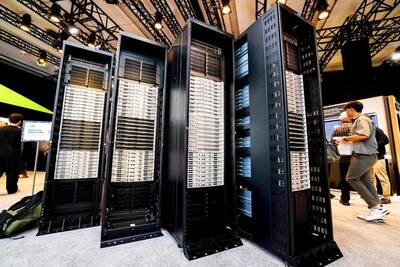
AM Intelligence, an Indian artificial intelligence (AI) infrastructure company, has ordered 9,000 Nvidia Corp Vera Rubin systems, seeking to become one of the first adopters of the advanced computing platform in Asia. Servers equipped with the rack-scale systems are slated to come online next year in southern India, the Hyderabad-based company said in a statement yesterday. Customers include major cloud service providers, AI labs and organizations aiming to develop homegrown Indian AI models, it said. Supplies of high-end Nvidia compute clusters remain tight. Demand from data centers and companies such as Microsoft Corp, Alphabet Inc’s Google and Amazon.com Inc to train AI models

EXPANDING: Firms are accelerating commercialization of the technologies as the industry moves beyond chip-level speeds to upgrading rack-to-rack links, SEMI said Silicon photonics and copackaged optics (CPO), technologies seen as critical to meeting the surging bandwidth demands of artificial intelligence (AI) infrastructure, would be among the main themes at the Semicon Taiwan trade show, which opens on Wednesday, event organizer SEMI said yesterday. The forum runs until Friday at the Taipei Nangang Exhibition Center, with technical forums beginning today. The event is expected to set a record in terms of the number of participants, SEMI said, projecting more than 1,300 exhibitors from 65 countries across 4,300 booths and more than 100,000 attendees. Optical interconnects underpinning AI infrastructure would be one of the highlights, with

Taiwan Semiconductor Manufacturing Co (TSMC, 台積電) has increased its second-quarter employee bonuses by more than 50 percent from a year earlier, as the world’s largest contract chipmaker posted record earnings in the three-month period. TSMC distributed its second-quarter bonuses to employees on Friday. Employee bonuses for the April-to-June period totaled NT$36 billion (US$1.14 billion), the chipmaker’s financial data showed. During the period, TSMC posted NT$706.56 billion in net profit, up 77.4 percent from a year earlier and 23.4 percent from a quarter earlier. Second-quarter earnings per share (EPS) rose to NT$27.25, compared with NT$15.36 a year earlier and NT$22.08 in the first


 RSS
RSS