

Converting the world to entirely clean energy would require US$10 trillion in investment, but continuing to rely on fossil fuels would cost about US$14 trillion, Elon Musk said.
A massive build-out of solar-panel factories and metal refineries are required over the next 20 years to deliver renewable-power generation and electricity-storage capacity needed to power the global economy entirely with carbon-free energy, Tesla Inc said in its Master Plan Part 3 published on Thursday.
The white paper fleshes out the details of Musk’s vision for a world without fossil fuels first outlined during last month’s investor day.
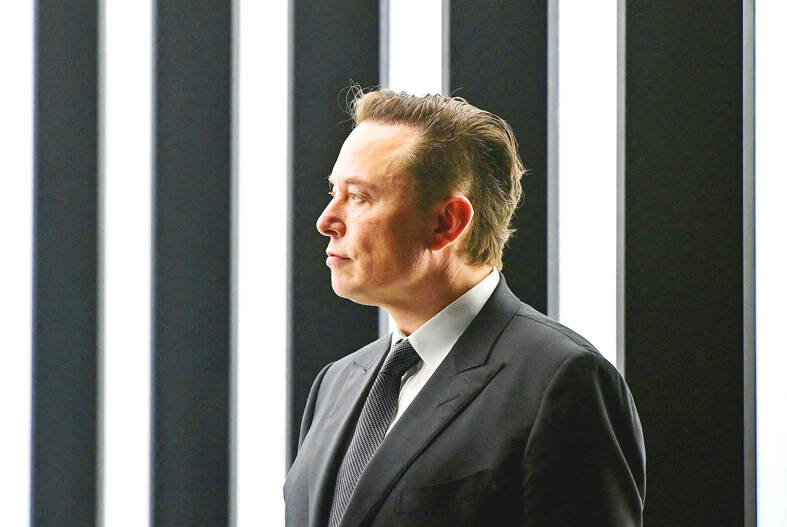
Photo: Reuters
“Earth will move to a sustainable energy economy,” Musk said during the event in Austin, Texas. “And it will happen in your lifetime.”
Tesla sees upgraded grids powered with wind and solar, global arrays of battery farms and underground hydrogen caverns to store energy, a retooling of heavy industries like steel and cement manufacturing, and homes to businesses warmed or cooled with heat pumps.
The cost of the alternative — continuing to produce oil, coal and natural gas — is higher, Tesla said, and at last year’s rates would total about US$14 trillion over the next two decades.
Musk’s envisaged global energy system requires about 30,000 gigawatts of renewable-power capacity and 240,000 gigawatt-hours of storage batteries.
Those figures compare to renewables capacity of 3,214 gigawatts in 2021 and a stationary energy storage sector that is forecast to have 1,432 gigawatt hours of capacity by the end of the 2030, according to BloombergNEF. That would represent a huge boon to clean tech firms like Tesla.
While the US$10 trillion investment cost of a cleaner world is high, Musk argues that is just a fraction of the US$100 trillion global economy and entirely feasible when spread out over two decades.
“Over 20 years, it would be 0.5 percent of the global economy,” he told investors last month. “So this is not a big number.”
The world’s metals sector would be poised for a major demand boom under Musk’s scenario. A total of US$502 billion of mining capital expenditure and US$662 billion of spending on refining would be needed to produce the nickel, lithium, copper and other materials to be used in batteries and clean-energy equipment, Tesla forecasts.
At peak levels, the world would need to dig up 3.3 billion tonnes of earth every year to obtain the necessary metals for the transition to cleaner power sources. Still, that is much less than the 15.5 billion tonnes that are currently extracted for the fossil fuel industries, the company said.
There is also little prospect of the world exhausting supplies of required metals, as only a fraction of current resources are needed and higher demand would encourage explorers to look for new deposits, it said.
Recycling will begin to meaningfully replace new metals supply from 2040, as expired batteries, solar panels and wind turbines are harvested for reuse.
Other materials will be phased out or minimized: using copper instead of silver in solar panels, using artificial graphite in batteries, and eliminating rare earths from wind turbines.
“The electrified and sustainable future is technically feasible and requires less investment and less material extraction than continuing today’s unsustainable energy economy,” Tesla said in the document.

BOOMING BUSINESS: Memory supply constraints would be even more severe in 2027 and 2028, prompting customers to sign long-term supply agreements, Micron said Micron Memory Taiwan Co (台灣美光) yesterday said it is accelerating memorychip capacity expansion amid growing artificial intelligence (AI)-driven demand, with its accumulated investment in Taiwan reaching NT$1.6 trillion (US$50.2 billion) as of June. The company’s investment in Taiwan has surged over the past four years, with recent spending equaling the total invested over the past 25 years, Micron Taiwan chairman Donghui Lu (盧東暉) told a media briefing in Taipei. “The launch of ChatGPT and the outbreak of COVID triggered increasing demand for memory chips. Since then, demand has gathered pace rapidly, with only a brief pause in 2023 when a major downturn”
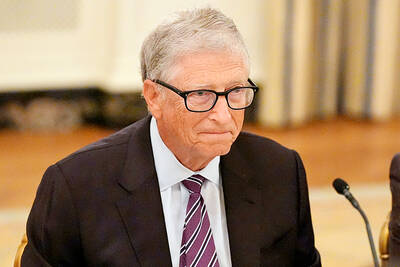
Artificial intelligence (AI) requires safeguards that go beyond self-regulation, Microsoft Corp cofounder Bill Gates said in an interview that aired on Sunday, calling for legislation to be passed in US Congress. “You need law enforcement and the politicians to get into the discussion about what safeguards and monitoring look like,” Gates said in a taped interview on NBC’s Meet the Press program. “And that has to be a required thing.” A sudden groundswell has risen in favor of federal intervention after OpenAI in July said that an autonomous AI agent went rogue during a security test and hacked into another company, subverting

Apple Inc is set to sell about 6 million units of the iPhone Duo this year, Counterpoint Research said, offering the first estimate for how the company’s inaugural foldable device would fare. The figure, more typical of the niche foldable segment than Apple’s usual smartphone sales, is contingent on how well the company ramps up production of the new hardware, Counterpoint senior analyst Ivan Lam (林科宇) said. Priced at US$1,999 and set for a release this month, the iPhone Duo sits atop the Apple lineup and carries industry wide hopes for stoking greater interest and sales of foldables. Market researcher IDC Corp
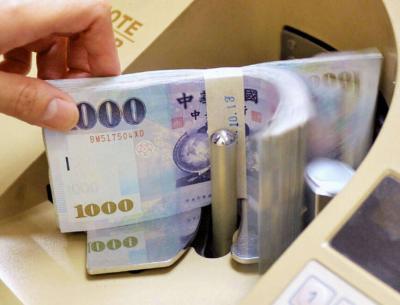
Taiwan ranked fifth worldwide in net financial assets per capita at the end of last year, averaging 164,470 euros (US$186,219), a report released this week by Germany-based Allianz Research said. Taiwan's ranking remained unchanged from the previous year, trailing only the US, Switzerland, Denmark and Singapore, Allianz’s Global Wealth Report said. In the report, Allianz assessed household assets and liabilities in nearly 60 countries, finding that global household wealth reached a record high last year, while the rise of artificial intelligence and market gains made asset ownership increasingly important in determining who benefits from wealth creation. Global financial assets reached a record 268.4


 RSS
RSS