


The official manufacturing purchasing managers’ index (PMI) last month returned to contraction, as the collapses of US regional banks sapped restocking demand and raw material prices, the Chung-Hua Institution for Economic Research (CIER, 中華經濟研究院) said yesterday.
The leading economic indicator, which aims to gauge the health of the manufacturing industry, registered at 47.3 last month, down from 51.4 in February, as rush orders ended amid a lingering global slowdown, the Taipei-based think tank said.
“The earlier rebound was spurred by expectations of a recovery in the second half of this year, rather than reflecting improvement in end-market demand,” CIER president Yeh Chun-hsien (葉俊顯) told a news conference in Taipei.
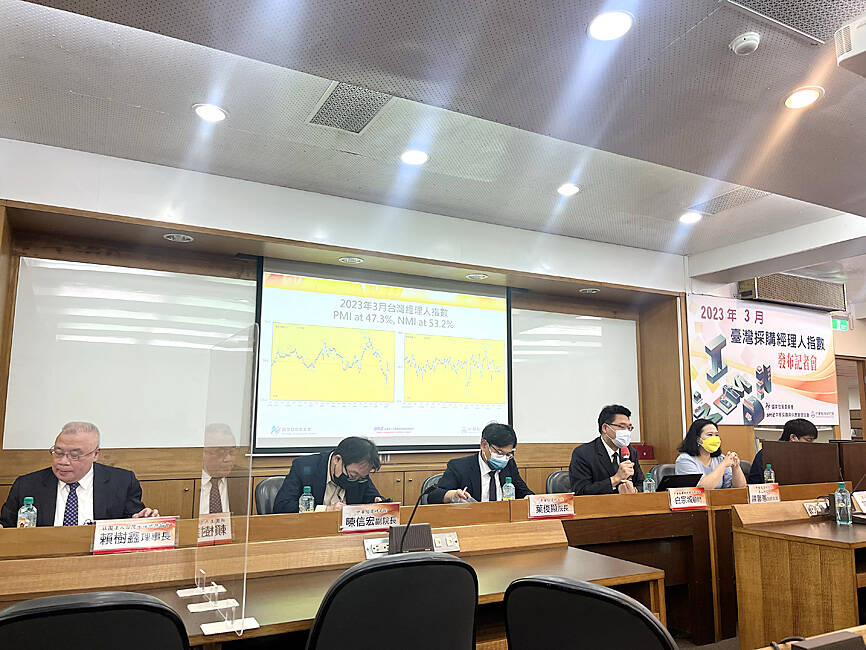
Photo: Hsu Tzu-ling, Taipei Times
PMI data of 50 and higher indicate business expansion, while values below the threshold suggest contraction.
Firms traditionally rebuild inventory after the Lunar New Year holiday, and this year the inventory replenishment occurred in February given the late-January end to this year’s holiday, Yeh said.
Order visibility remains poor, with the subindex of new business shedding 6.6 points to 44.5, the CIER survey showed.
The subindex on industrial output tumbled 10.4 points to 52, while the employment measure lost 3.4 points to 45.5, indicating that firms shrank their capacity and payroll to cut operational costs and support selling prices, it showed.
Liquidity risks linked to the failures of US regional banks negatively affected raw material prices and recovery expectations, Yeh said.
The gauge of raw material prices dropped 6.1 points, but remained relatively high at 56.5, the survey showed.
Firms upstream of supply chains began to build critical raw materials in anticipation of a market turnaround, Yeh said, adding that they have forged close ties with clients and can more easily pass on rising costs.
However, firms downstream have experienced profit pressure, as they grapple with growing overhang amid tepid sales, dimming the chance of cost transfers, Yeh said.
Those firms should increase their long-term cash positions in the face of unfavorable operating conditions, he said.
Manufacturers are slightly more positive about their business prospects, with the six-month outlook gaining 1.5 points to 46.2, the CIER survey showed.
Firms in the chemical and biotechnology sectors are most optimistic when compared with other companies, it showed.
The non-manufacturing index fared well at 53.2, up from 50.2 in February, as almost all non-manufacturing sectors reported business advances, the survey showed.
Financial, hospitality and transportation service providers predict continued business improvement, helped by the continued loosening of COVID-19 restrictions, it said.
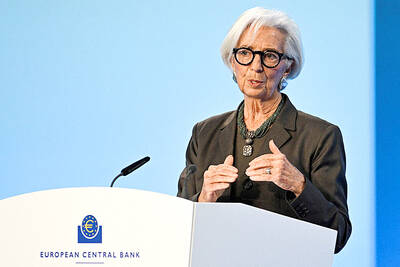
European Central Bank (ECB) President Christine Lagarde is expected to step down from her role before her eight-year term ends in October next year, the Financial Times reported. Lagarde wants to leave before the French presidential election in April next year, which would allow French President Emmanuel Macron and German Chancellor Friedrich Merz to find her replacement together, the report said, citing an unidentified person familiar with her thoughts on the matter. It is not clear yet when she might exit, the report said. “President Lagarde is totally focused on her mission and has not taken any decision regarding the end of

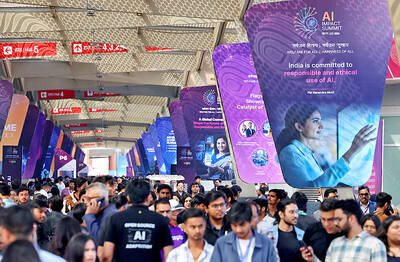
French President Emmanuel Macron told a global artificial intelligence (AI) summit in India yesterday he was determined to ensure safe oversight of the fast-evolving technology. The EU has led the way for global regulation with its Artificial Intelligence Act, which was adopted in 2024 and is coming into force in phases. “We are determined to continue to shape the rules of the game... with our allies such as India,” Macron said in New Delhi. “Europe is not blindly focused on regulation — Europe is a space for innovation and investment, but it is a safe space.” The AI Impact Summit is the fourth

AUSPICIOUS TIMING: Ostensibly looking to spike the guns of domestic rivals, ByteDance launched the upgrade to coincide with the Lunar New Year China’s ByteDance Ltd (字節跳動) has rolled out its Doubao 2.0 model, an upgrade of the country’s most widely used artificial-intelligence (AI) app, the company announced on Saturday. ByteDance is one of several Chinese firms hoping to generate overseas and domestic buzz around its new AI models during the Lunar New Year holiday, which began yesterday, when hundreds of millions of Chinese partake in family gatherings in their hometowns. The company, like rival Alibaba Group Holding Ltd (阿里巴巴), was caught off-guard by DeepSeek’s (深度求索) meteoric rise to global fame during last year’s Spring Festival, when Silicon Valley and investors worldwide were
Advanced Micro Devices Inc (AMD) is partnering with Tata Consultancy Services Ltd (TCS) to deploy the US chipmaker’s latest artificial intelligence (AI) data center technology in India, challenging Nvidia Corp in one of the world’s fastest-growing markets. AMD is to offer its Helios data center blueprint and work with TCS to support up to 200 megawatts of AI infrastructure capacity in India, the companies said in a statement on Monday. “AI adoption is accelerating from pilots to large-scale deployments, and that shift requires a new blueprint for compute infrastructure,” AMD chief executive officer Lisa Su (蘇姿丰) said in the statement. “Together with


 RSS
RSS