


Wan Hai Lines Ltd (萬海航運) yesterday said it expects sea cargo rates to improve in the second and third quarters from the first quarter, and that rates for long-term contracts would be better than spot rates.
The decline in freight rates has slowed since the Lunar New Year holiday and the rates for some Asian markets have even started to rebound, Wan Hai president Tommy Hsieh (謝福隆) told an investors’ conference.
The shipper expects the US market to return to pre-COVID-19 pandemic levels this year. Demand in the US market would start to pick up in the third quarter, as most clients are still digesting inventories, Hsieh said.
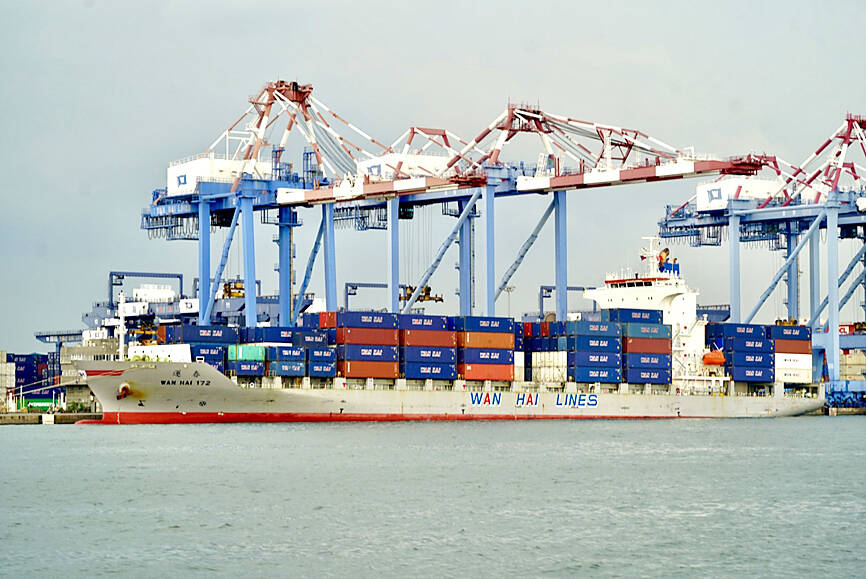
Photo: CNA
To boost demand during the slow season, the container shipper is offering customized services to attract clients, he said.
“The outlook for the North American market would be clearer later this month after we finish negotiating with some of our large retail clients and sign contracts,” he said.
Despite the downtrend, Wan Hai expects rates of newly signed long-term contracts to be higher than spot rates, as clients would be willing to pay more to secure capacity and ensure stable transportation, he said.
The company’s plans to use its larger vessels for its operations on the east and west coasts of the US, while its medium-sized or small vessels would be deployed in the Asian and Middle Eastern markets, the company said.
Wan Hai yesterday reported its freight rates for four markets — the US, South America, Middle East and India — as well as intra-Asian markets in the fourth quarter last year.
FREIGHT RATES
The rates for the US and South America both fell below US$2,000 per twenty-foot equivalent unit (TEU), compared with their peak of above US$6,000 in the first quarter last year and the fourth quarter of 2021 respectively, corporate data showed.
Meanwhile, the rates for the Middle East and India slid from a peak of about US$3,000 per TEU in the fourth quarter of 2021 to about US$1,000 per TEU in the fourth quarter last year, while intra-Asian rates remained comparatively low, the data showed.
Responding to an investor’s question on whether Wan Hai could report net quarterly losses this year following its net loss of NT$40 million (US$1.31 million) in the fourth quarter of last year, Hsieh said that the company would not provide forecasts.
Asked about the company’s plan to distribute a low cash dividend of NT$5 after posting earnings per share of NT$33, Hsieh said that the company plans to buy new vessels to boost its fuel efficiency and reduce its average fleet age.

SECOND-RATE: Models distilled from US products do not perform the same as the original and undo measures that ensure the systems are neutral, the US’ cable said The US Department of State has ordered a global push to bring attention to what it said are widespread efforts by Chinese companies, including artificial intelligence (AI) start-up DeepSeek (深度求索), to steal intellectual property from US AI labs, according to a diplomatic cable. The cable, dated Friday and sent to diplomatic and consular posts around the world, instructs diplomatic staff to speak to their foreign counterparts about “concerns over adversaries’ extraction and distillation of US AI models.” Distillation is the process of training smaller AI models using output from larger, more expensive ones to lower the costs of training a powerful new

Micron Technology Inc is a driving force pushing the US Congress to pass legislation that would put new export restrictions on equipment its Chinese competitors use to make their chips, according to people familiar with the matter. A US House of Representatives panel yesterday was to vote on the “MATCH Act,” a bill designed to close gaps in restrictions on chipmaking equipment. It would also pressure foreign companies that sell equipment to Chinese chipmaking facilities to align with export curbs on US companies like Lam Research Corp and Applied Materials Inc. The bill targets facilities operated by China’s ChangXin Memory Technologies Inc

Singapore-based ride-hailing and delivery giant Grab Holdings’ planned acquisition of Foodpanda’s Taiwan operations has yet to enter the formal review stage, as regulators await supplementary documents, the Fair Trade Commission (FTC) said yesterday. Acting FTC Chairman Chen Chih-min (陳志民) told the legislature’s Economics Committee that although Grab submitted its application on March 27, the case has not been officially accepted because required materials remain incomplete. Once the filing is finalized, the FTC would launch a formal probe into the deal, focusing on issues such as cross-shareholding and potential restrictions on market competition, Chen told lawmakers. Grab last month announced that it would acquire

The artificial intelligence (AI) boom has triggered a seismic reshuffling of global equity markets, with Taiwan and South Korea muscling past European nations one by one. With its stock market now valued at nearly US$4.3 trillion, Taiwan surpassed the UK, Europe’s biggest market, earlier this month, data compiled by Bloomberg showed. South Korea is about US$140 billion away from doing the same. The tech-heavy Asian markets have shot past Germany and France in the past seven months. The shift is largely down to massive gains in shares of three companies that provide essential hardware for AI: Taiwan Semiconductor Manufacturing Co (TSMC, 台積電),


 RSS
RSS