


Some parts of Twitter Inc’s source code — the fundamental computer code on which the social network runs — were leaked online, the social media company said in a legal filing on Sunday that was first reported by the New York Times.
The legal document, filed with the US District Court for the Northern District of California, said that Twitter had asked GitHub, an Internet hosting service for software development, to take down the code where it was posted.
The platform complied and said the content had been disabled, the filing showed.
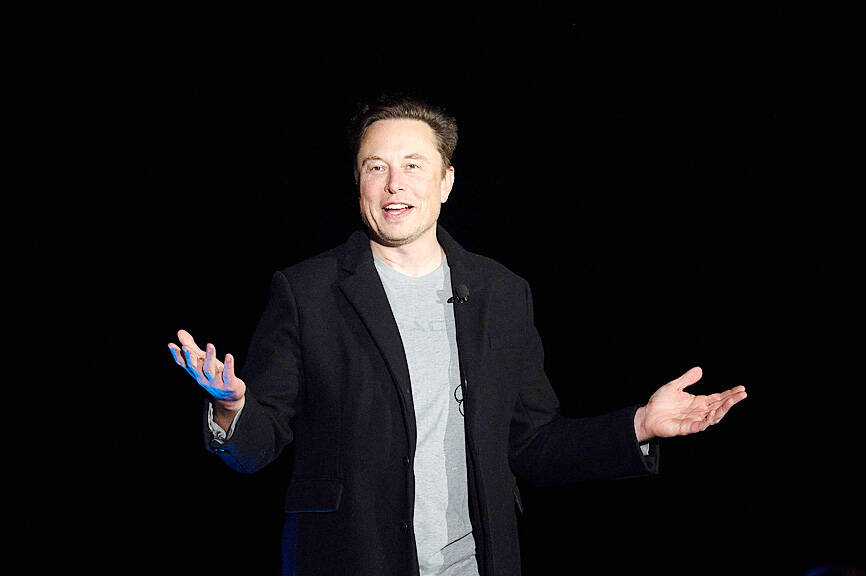
Photo: AFP
Twitter also asked the court to identify the alleged infringer or infringers who posted Twitter’s source code on systems operated by GitHub without Twitter’s authorization.
Twitter, based in San Francisco, said in the filing that the postings infringe copyrights held by Twitter.
CHAOS
The leak creates more challenges for billionaire Elon Musk, who bought Twitter in October last year for US$44 billion and took the company private. Since then, it has been engulfed in chaos, with massive layoffs and advertisers fleeing.
The US Federal Trade Commission is also probing Musk’s mass layoffs at Twitter and trying to obtain his internal communications as part of ongoing oversight into the social media company’s privacy and cybersecurity practices, according to documents described in a congressional report.
LOSING VALUE
Meanwhile, Musk has estimated the value of Twitter at US$20 billion, less than half of what he paid for the social media platform just five months ago, an internal e-mail showed.
The e-mail to employees referred to a new stock compensation program in the San Francisco-based company and the allocation of shares to employees of X Holdings I Inc, Twitter’s umbrella company.
The compensation plan values the platform at US$20 billion, slightly more than Snapchat’s parent company Snap Inc (US$18.2 billion) or Pinterest Inc (US$18.7 billion), both of which are publicly traded, unlike Twitter.
In the internal e-mail, Musk describes the brutal contraction in Twitter’s value, writing that the platform faced such grave financial difficulties that at one point it was on the verge of bankruptcy.
“Twitter was trending to lose ~$3B/year,” Musk wrote in a message posted on Saturday on the platform.
He cited a revenue drop of US$1.5 billion per year and a debt-servicing burden of the same amount — leaving it with “only 4 months of money.”
Musk added simply: “Extremely dire situation.”
Additional reporting by AFP
SECOND-RATE: Models distilled from US products do not perform the same as the original and undo measures that ensure the systems are neutral, the US’ cable said The US Department of State has ordered a global push to bring attention to what it said are widespread efforts by Chinese companies, including artificial intelligence (AI) start-up DeepSeek (深度求索), to steal intellectual property from US AI labs, according to a diplomatic cable. The cable, dated Friday and sent to diplomatic and consular posts around the world, instructs diplomatic staff to speak to their foreign counterparts about “concerns over adversaries’ extraction and distillation of US AI models.” Distillation is the process of training smaller AI models using output from larger, more expensive ones to lower the costs of training a powerful new
Shares of Taiwan Semiconductor Manufacturing Co (TSMC, 台積電) have repeatedly hit new highs, but an equity analyst said the stock’s valuation remains within a reasonable range and any pullback would likely be technical. The contract chipmaker’s historical price-to-earnings (P/E) ratio has ranged between 20 and 30, Cathay Futures Consultant Co (國泰證期) analyst Tsai Ming-han (蔡明翰) told Central News Agency. With market consensus projecting that TSMC would post earnings per share of about NT$100 (US$3.17) this year, supported by strong global demand for artificial intelligence (AI) applications, and the stock currently trading at a P/E ratio of below 25, Tsai said the valuation
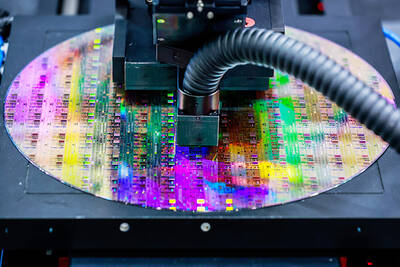
The artificial intelligence (AI) boom has triggered a seismic reshuffling of global equity markets, with Taiwan and South Korea muscling past European nations one by one. With its stock market now valued at nearly US$4.3 trillion, Taiwan surpassed the UK, Europe’s biggest market, earlier this month, data compiled by Bloomberg showed. South Korea is about US$140 billion away from doing the same. The tech-heavy Asian markets have shot past Germany and France in the past seven months. The shift is largely down to massive gains in shares of three companies that provide essential hardware for AI: Taiwan Semiconductor Manufacturing Co (TSMC, 台積電),

The US Department of Commerce last week ordered multiple chip equipment companies to halt shipments of certain tools to China’s second-largest chipmaker, Hua Hong Semiconductor Ltd (華虹半導體), its latest action to slow the country’s development of advanced chips, two people familiar with the matter said. The department sent letters to at least a handful of companies informing them of restrictions on tools and other materials destined for two Hua Hong facilities US officials believe make China’s most sophisticated chips, the people said. Top US chip equipment companies Lam Research Corp, Applied Materials Inc and KLA Corp, each of which has significant


 RSS
RSS