


HSBC Holdings PLC is set to buy the UK arm of Silicon Valley Bank, the culmination of a frantic weekend in which ministers and bankers explored a number of ways to avert the SVB Financial Group unit’s collapse.
The London-listed lender’s “ring-fenced subsidiary, HSBC UK Bank PLC, is acquiring Silicon Valley Bank UK Ltd (SVB UK) for £1 [US$1.21],” HSBC said in a statement yesterday.
“This acquisition makes excellent strategic sense for our business in the UK,” CEO Noel Quinn said in the statement. “SVB UK customers can continue to bank as usual, safe in the knowledge that their deposits are backed by the strength, safety and security of HSBC.”
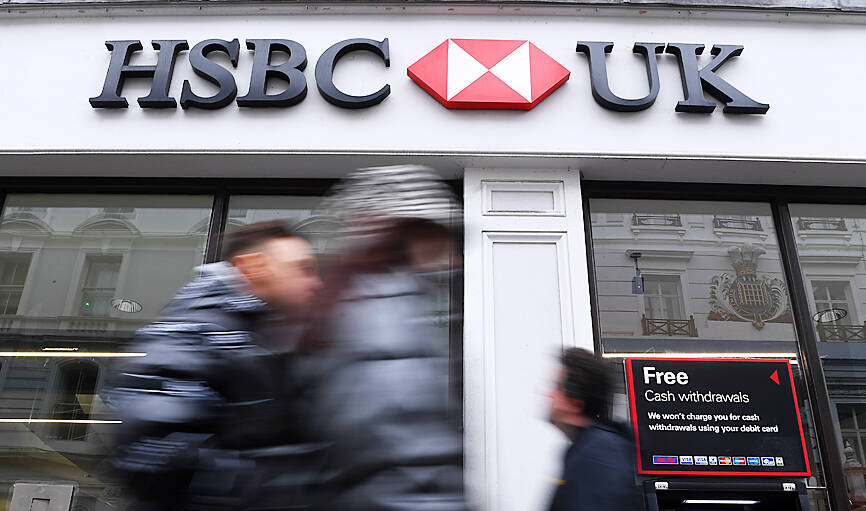
Photo: EPA-EFE
Ministers and officials had spent the weekend drafting plans to ringfence the UK’s technology and life sciences industries, following warnings that they would be crippled without intervention.
Although small compared with the UK’s largest banks, SVB has an outsized role in the world of start-ups, describing itself as “the go-to banking partner for founders, entrepreneurs and investors.”
British Chancellor of the Exchequer Jeremy Hunt yesterday said HSBC’s rescue of SVB’s UK arm was necessary to help protect some of Britain’s most important technology companies.
“We were faced with a situation where we could have seen some of our most important companies — our most strategic companies — wiped out, and that would have been extremely dangerous,” Hunt told reporters.
He said the British Treasury had been neutral as to what the solution for SVB’s UK arm was, and his priority was to avoid using British taxpayer money.
“We were looking at all options and we needed to be sure that if the sale didn’t happen, we had other solutions ready,” Hunt said.
“The UK banking system is extremely secure, it’s well capitalized,” he added.
A host of lenders were mooted as possible buyers.
Nascent clearing institution Bank of London Group Ltd in a statement on Sunday said that it submitted a formal proposal to the British Treasury, the Bank of England and the board of SVB UK.
Royal Group, an investment firm controlled by a top Abu Dhabi royal, and Softbank Group Corp-backed OakNorth Bank Ltd were also among those considering a takeover.
Another plan was for lenders to take on depositors from SVB Financial Group’s British arm. Several big banks would have taken on SVB’s depositors, offering them access to money until their funds were released from the lender.
The leaders of about 180 technology firms had said in an open letter to Hunt that the loss of deposits at SVB would have the potential to cripple the sector and set the ecosystem back 20 years.
“This is an urgent matter. Help is needed by tomorrow,” British Private Equity and Venture Capital Association director-general Michael Moore said before the Treasury’s intervention. “Long-term support will be required to protect the UK’s innovators, entrepreneurs and funders.”
The announcement comes after US financial regulators moved on Sunday to assure all depositors their money is safe following the collapse of Silicon Valley Bank, and established a new lending program offered by the US Federal Reserve with funds from the US Department of the Treasury.

SECOND-RATE: Models distilled from US products do not perform the same as the original and undo measures that ensure the systems are neutral, the US’ cable said The US Department of State has ordered a global push to bring attention to what it said are widespread efforts by Chinese companies, including artificial intelligence (AI) start-up DeepSeek (深度求索), to steal intellectual property from US AI labs, according to a diplomatic cable. The cable, dated Friday and sent to diplomatic and consular posts around the world, instructs diplomatic staff to speak to their foreign counterparts about “concerns over adversaries’ extraction and distillation of US AI models.” Distillation is the process of training smaller AI models using output from larger, more expensive ones to lower the costs of training a powerful new
Shares of Taiwan Semiconductor Manufacturing Co (TSMC, 台積電) have repeatedly hit new highs, but an equity analyst said the stock’s valuation remains within a reasonable range and any pullback would likely be technical. The contract chipmaker’s historical price-to-earnings (P/E) ratio has ranged between 20 and 30, Cathay Futures Consultant Co (國泰證期) analyst Tsai Ming-han (蔡明翰) told Central News Agency. With market consensus projecting that TSMC would post earnings per share of about NT$100 (US$3.17) this year, supported by strong global demand for artificial intelligence (AI) applications, and the stock currently trading at a P/E ratio of below 25, Tsai said the valuation
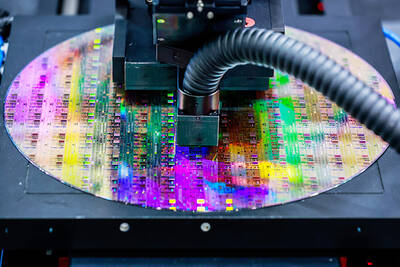
The artificial intelligence (AI) boom has triggered a seismic reshuffling of global equity markets, with Taiwan and South Korea muscling past European nations one by one. With its stock market now valued at nearly US$4.3 trillion, Taiwan surpassed the UK, Europe’s biggest market, earlier this month, data compiled by Bloomberg showed. South Korea is about US$140 billion away from doing the same. The tech-heavy Asian markets have shot past Germany and France in the past seven months. The shift is largely down to massive gains in shares of three companies that provide essential hardware for AI: Taiwan Semiconductor Manufacturing Co (TSMC, 台積電),

The US Department of Commerce last week ordered multiple chip equipment companies to halt shipments of certain tools to China’s second-largest chipmaker, Hua Hong Semiconductor Ltd (華虹半導體), its latest action to slow the country’s development of advanced chips, two people familiar with the matter said. The department sent letters to at least a handful of companies informing them of restrictions on tools and other materials destined for two Hua Hong facilities US officials believe make China’s most sophisticated chips, the people said. Top US chip equipment companies Lam Research Corp, Applied Materials Inc and KLA Corp, each of which has significant


 RSS
RSS