


Japan’s Softbank Group Corp yesterday reported a surprise US$5.9 billion net loss in the fiscal third quarter, as a slump in the tech sector continued to hit the investment behemoth’s bottom line.
The loss compared with the net profit of ¥29 billion (US$220 million) the firm reported in the same three-month period last year.
Its two Vision Fund investment vehicles alone lost ¥660 billion in the October-to-December quarter, “reflecting declines in the share prices of a wide range of portfolio companies,” Softbank said.
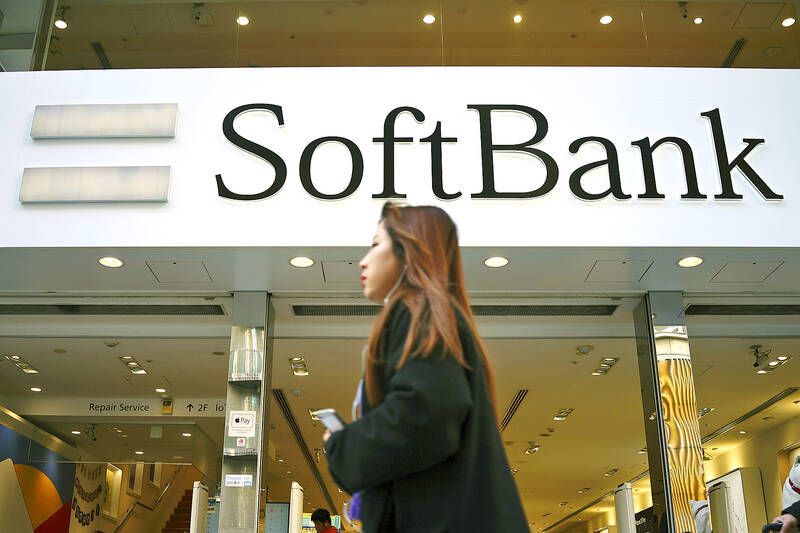
Photo: AP
The firm has made huge bets to find and grow hot new tech ventures around the world, but that has left its earnings vulnerable to fickle market forces, and its Vision Funds have reported losses for four straight quarters.
Interest rate hikes by the US Federal Reserve and other central banks to tackle inflation have weighed on global tech shares, putting pressure on Softbank.
“Weakness in global equity markets remains the main risk to the Softbank story,” said Kirk Boodry, an analyst at Redex Research who publishes on Smartkarma.
Softbank chief executive officer Masayoshi Son has regularly defended his strategy of making major bets on high-tech firms and start-ups, saying that the approach would lead to a handful of significant wins that outweigh losses.
However, his tactics have come under increasing scrutiny given the firm’s successive losses, and Son is not delivering the company’s results presentation. Softbank chief financial officer Yoshimitsu Goto was expected to do the talking instead yesterday.
Last quarter, Goto said that the company was “very pessimistic.”
Analysts said there was good reason to be cautious.
“The overall investment environment is very tough including on US shares,” Toyo Securities Co analyst Hideki Yasuda said before the results.
However, he and other observers say the firm might start to see the benefits of an improving situation in China.
“We are generally somewhat negative on Softbank’s positioning heading into 2023 with concerns on tech valuation at the forefront,” Broody wrote.
“But a recovery in China ... provides some support,” he said, adding that Beijing’s crackdown on tech firms and its COVID-19 policies “both appear to be leveling out.”

Among the rows of vibrators, rubber torsos and leather harnesses at a Chinese sex toys exhibition in Shanghai this weekend, the beginnings of an artificial intelligence (AI)-driven shift in the industry quietly pulsed. China manufactures about 70 percent of the world’s sex toys, most of it the “hardware” on display at the fair — whether that be technicolor tentacled dildos or hyper-realistic personalized silicone dolls. Yet smart toys have been rising in popularity for some time. Many major European and US brands already offer tech-enhanced products that can enable long-distance love, monitor well-being and even bring people one step closer to

TRANSFORMATION: Taiwan is now home to the largest Google hardware research and development center outside of the US, thanks to the nation’s economic policies President Tsai Ing-wen (蔡英文) yesterday attended an event marking the opening of Google’s second hardware research and development (R&D) office in Taiwan, which was held at New Taipei City’s Banciao District (板橋). This signals Taiwan’s transformation into the world’s largest Google hardware research and development center outside of the US, validating the nation’s economic policy in the past eight years, she said. The “five plus two” innovative industries policy, “six core strategic industries” initiative and infrastructure projects have grown the national industry and established resilient supply chains that withstood the COVID-19 pandemic, Tsai said. Taiwan has improved investment conditions of the domestic economy

Malaysia’s leader yesterday announced plans to build a massive semiconductor design park, aiming to boost the Southeast Asian nation’s role in the global chip industry. A prominent player in the semiconductor industry for decades, Malaysia accounts for an estimated 13 percent of global back-end manufacturing, according to German tech giant Bosch. Now it wants to go beyond production and emerge as a chip design powerhouse too, Malaysian Prime Minister Anwar Ibrahim said. “I am pleased to announce the largest IC (integrated circuit) Design Park in Southeast Asia, that will house world-class anchor tenants and collaborate with global companies such as Arm [Holdings PLC],”

MAJOR BENEFICIARY: The company benefits from TSMC’s advanced packaging scarcity, given robust demand for Nvidia AI chips, analysts said ASE Technology Holding Co (ASE, 日月光投控), the world’s biggest chip packaging and testing service provider, yesterday said it is raising its equipment capital expenditure budget by 10 percent this year to expand leading-edge and advanced packing and testing capacity amid strong artificial intelligence (AI) and high-performance computing chip demand. This is on top of the 40 to 50 percent annual increase in its capital spending budget to more than the US$1.7 billion to announced in February. About half of the equipment capital expenditure would be spent on leading-edge and advanced packaging and testing technology, the company said. ASE is considered by analysts


 RSS
RSS