


As the British government’s hopes for homegrown chip giant Arm Ltd to list in London dim, local investors might still be able to own a slice of the Cambridge, England-based firm.
Even if Arm picks the US for an initial public offering (IPO), the British public could buy shares in the chip designer through a retail offer, according to PrimaryBid Ltd, a firm that specializes in such offers.
PrimaryBid has presented the idea to government ministers, having previously organized a similar arrangement alongside the US listing of the owner of luxury members’ clubs Soho House Ltd in 2021.
Photo: AFP
“UK retail investors want and deserve access to Arm’s IPO,” PrimaryBid chief executive officer Anand Sambasivan said. “A London listing would be ideal, but there’s no reason the British public should miss out.”
Arm and the British Treasury declined to comment.
A representative for Softbank Group Corp did not respond to a request for comment.
Arm owner Softbank — which is also PrimaryBid’s largest shareholder — intends to put the unit back on the market and was in March last year targeting a valuation of at least US$60 billion.
Arm is central to the chip industry with its processor designs powering about 95 percent of mobile devices, its Web site said.
British Prime Minister Rishi Sunak, who last month spoke with Arm CEO Rene Haas and Softbank founder Masayoshi Son, has been lobbying for an Arm listing in London and the US, the Financial Times reported.
That effort has focused on making the case for a dual primary listing — a boost for the City of London’s post-Brexit ambitions.
That would give Arm access to London Stock Exchange indices, boosting liquidity in its shares, but Son has said his focus is to take Arm public in the US because of its deep investor base and attractive valuations.
The process has been delayed due to uncertainty in global markets.
The PrimaryBid proposal could leave the UK with the consolation prize of a retail offer alongside a US listing. It could also help promote a government push to attract people’s savings into tech companies with an aim of boosting their returns and helping growth sectors.
A full UK listing of Arm would be a “major coup,” said Steven Fine, chief executive officer of City of London broker Peel Hunt.
Whatever the final plan, “we also believe there would be significant retail demand,” he said.
PrimaryBid estimates there could be £3 billion (US$3.7 billion) of demand from ordinary investors in Arm, which had a substantial following among private investors when it was previously listed in the UK.
Even if PrimaryBid’s pitch comes off, there remains plenty to do to repair the UK’s international reputation as open for business after Brexit, former Confederation of British Industry president Paul Drechsler said.
“Everyone used to want to come in from students to old people,” he said. “Now where are we?”

SECOND-RATE: Models distilled from US products do not perform the same as the original and undo measures that ensure the systems are neutral, the US’ cable said The US Department of State has ordered a global push to bring attention to what it said are widespread efforts by Chinese companies, including artificial intelligence (AI) start-up DeepSeek (深度求索), to steal intellectual property from US AI labs, according to a diplomatic cable. The cable, dated Friday and sent to diplomatic and consular posts around the world, instructs diplomatic staff to speak to their foreign counterparts about “concerns over adversaries’ extraction and distillation of US AI models.” Distillation is the process of training smaller AI models using output from larger, more expensive ones to lower the costs of training a powerful new
Shares of Taiwan Semiconductor Manufacturing Co (TSMC, 台積電) have repeatedly hit new highs, but an equity analyst said the stock’s valuation remains within a reasonable range and any pullback would likely be technical. The contract chipmaker’s historical price-to-earnings (P/E) ratio has ranged between 20 and 30, Cathay Futures Consultant Co (國泰證期) analyst Tsai Ming-han (蔡明翰) told Central News Agency. With market consensus projecting that TSMC would post earnings per share of about NT$100 (US$3.17) this year, supported by strong global demand for artificial intelligence (AI) applications, and the stock currently trading at a P/E ratio of below 25, Tsai said the valuation
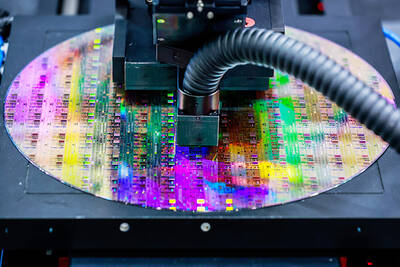
The artificial intelligence (AI) boom has triggered a seismic reshuffling of global equity markets, with Taiwan and South Korea muscling past European nations one by one. With its stock market now valued at nearly US$4.3 trillion, Taiwan surpassed the UK, Europe’s biggest market, earlier this month, data compiled by Bloomberg showed. South Korea is about US$140 billion away from doing the same. The tech-heavy Asian markets have shot past Germany and France in the past seven months. The shift is largely down to massive gains in shares of three companies that provide essential hardware for AI: Taiwan Semiconductor Manufacturing Co (TSMC, 台積電),

The US Department of Commerce last week ordered multiple chip equipment companies to halt shipments of certain tools to China’s second-largest chipmaker, Hua Hong Semiconductor Ltd (華虹半導體), its latest action to slow the country’s development of advanced chips, two people familiar with the matter said. The department sent letters to at least a handful of companies informing them of restrictions on tools and other materials destined for two Hua Hong facilities US officials believe make China’s most sophisticated chips, the people said. Top US chip equipment companies Lam Research Corp, Applied Materials Inc and KLA Corp, each of which has significant


 RSS
RSS