


Vietnam’s economy grew at the fastest pace in Asia this year, signaling momentum before risks from a global slowdown began to materialize.
GDP rose 8.02 percent in the year through this month, official data reported yesterday showed.
Growth was faster than the Vietnamese government’s initial target of 6 percent to 6.5 percent growth, and was aided by a quicker-than-expected 5.92 percent expansion in the final quarter.
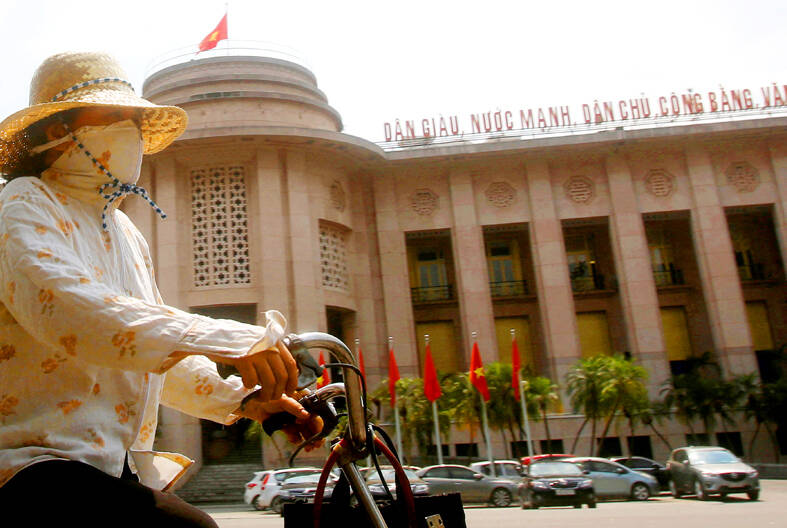
Photo: Reuters
Manufacturing, which grew 8.1 percent during the year, was the main driver of economic growth, Vietnamese General Statistics Office head Nguyen Thi Huong said.
Strong improvement in services also supported growth.
The better-than-expected showing gives the State Bank of Vietnam the space to wait and watch before deciding to pivot monetary policy away from tightening.
Although the central bank has raised the benchmark rate by 200 basis points in two moves this year to 6 percent, looming fears of debt default in Vietnam’s property sector has raised concern about a “China-style” growth hit.
Although Vietnam “is performing well amid uncertainties in the global economy, risks to the economic outlook have become elevated,” the Asian Development Bank (ADB) said in a statement on Dec. 14.
“Though trade continues to expand, signs show weakening global demand for the country’s exports,” it said.
ADB forecasts Vietnam’s growth to be 6.3 percent next year, as major trade partners see a slowdown.
The weakness was already evident in the headline trade data. Exports this month declined 14 percent from a year earlier, the second straight month of decline.
Retail sales during the month rose 17.1 percent, while credit growth improved 12.9 percent.
That was accompanied by consumer price growth of 4.55 percent from a year ago this month. Core inflation, which excludes prices of food, fuel, healthcare and education services, climbed at a faster rate of 4.99 percent.
Vietnam is likely to struggle to keep inflation in check next year, said Bui Thuy Hang, the central bank’s monetary policy department deputy head.
The country would face consumer price increases, with inflation forecast at about 5 percent early next year, higher than the government’s full-year target of 4.5 percent, Hang told an economic forum in Hanoi on Dec. 17.


Taiwanese firms have increased investment in the Philippines in recent years as Manila’s ties with Washington deepen and global supply chains continue to shift away from China, an expert at the Chung-Hua Institution for Economic Research (CIER, 中華經濟研究院) said yesterday. The Philippines had not been among Taiwanese investors’ top choices in Southeast Asia, CIER Taiwan ASEAN Studies Center director Kristy Hsu (徐遵慈) said at a seminar in Taipei. However, Taiwan’s investment in the country has grown significantly since the COVID-19 pandemic, reaching US $257 million last year, a high in recent years, she said. Although Taiwan’s total investment in the Philippines still lags

Intel Corp regards Taiwan Semiconductor Manufacturing Co (TSMC, 台積電) as a longstanding partner, as the US chipmaker would continue outsourcing production of advanced chips to TSMC, Intel chief executive officer Lip-Bu Tan (陳立武) said yesterday. “I don’t look at people as competitors. I look at the collaboration... Nvidia is also, you know, a good friend,” Tan told a news conference following his keynote speech at the Computex trade show in Taipei. “It’s a very trusted partnership for us... We are a big, top customer for them, and we’re going to continue doing that,” he said, referring to TSMC, the world’s largest foundry

Hon Hai Precision Industry Co (鴻海精密) yesterday said it would work with US chipmaker Intel Corp to jointly develop and deploy next-generation artificial intelligence (AI) infrastructure and intelligent computing platforms in a move to capture booming demand for AI computing systems. Hon Hai, also known as Foxconn Technology Group (富士康), said in a statement that the partnership would combine its global manufacturing scale, system integration expertise and AI data center deployment capabilities with Intel’s strengths in processor architecture, silicon technologies and software ecosystem. The companies said they plan to work on equipment used in AI data centers, including server racks powered by

Artificial intelligence (AI) agents would supplant smartphones as the center of people’s digital lives, fundamentally reshaping personal devices and driving a major computing upgrade cycle, Qualcomm Inc CEO Cristiano Amon said yesterday. In his keynote speech for this year’s Computex trade show in Taipei, Amon said that the rise of "agentic AI" — AI systems capable of reasoning, planning and carrying out tasks autonomously — would transform how people interact with technology across phones, PCs, vehicles and wearable devices. Describing the technology as the next major evolution in computing, Amon said that "2026 is the year of agents.” For decades, smartphones have sat


 RSS
RSS