


Airline EasyJet PLC and aircraft engine maker Rolls-Royce Holdings PLC on Monday said that they had successfully tested a hydrogen-powered aircraft engine, in what the British companies described as a world first for aviation.
Green hydrogen is widely seen as better for the environment than jet fuel.
In a joint statement, the companies said they had “set a new aviation milestone with the world’s first run of a modern aero engine on hydrogen,” in a test carried out on land this month.
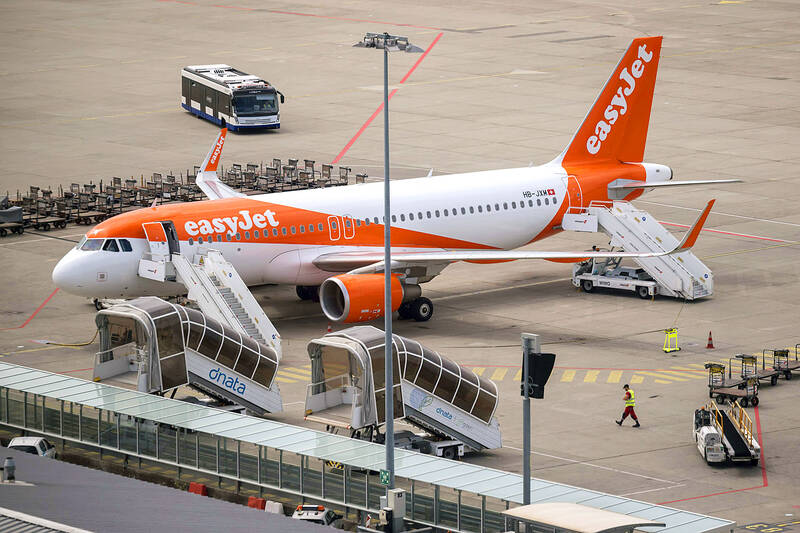
Photo: AFP
The companies tested a turboprop fan engine that is used in aircraft for small regional flights. Green hydrogen for the tests had been generated using tidal and wind energy from Scotland’s Orkney Islands.
Rolls-Royce hopes to eventually conduct a full-scale ground test of a Pearl 15 jet engine.
British Secretary of State for Business, Energy and Industrial Strategy Grant Shapps lauded Monday’s news as “a true British success story,” adding that it was “a prime example of how we can work together to make aviation cleaner while driving jobs across the country.”
“We are pushing the boundaries to discover the zero carbon possibilities of hydrogen, which could help reshape the future of flight,” Rolls-Royce chief technology officer Grazia Vittadini said.
The UK earlier this year identified the need for major investment to help unlock green hydrogen from water using renewable energy. Blue hydrogen, which is far more available than its greener alternative, is opposed by environmentalists, as it is produced from natural gas in a process releasing carbon dioxide into the atmosphere.
In related news, Shell PLC is to buy Nature Energy Biogas A/S from hedge fund Davidson Kempner Capital Management for nearly US$2 billion as the oil major expands its transition from fossil fuels.
The deal would make Shell the largest producer in Europe of what is known as renewable natural gas, known as RNG, a statement said.
It taps into Shell’s plan to leverage its existing expertise producing and marketing gas for a lower-carbon economy.
Biogas is chemically the same as conventional natural gas, but is made from decomposing organic material such as agricultural waste. It is a platform primed for growth, with the US, through the Inflation Reduction Act, and the EU identifying the renewable fuel as a way to boost energy supplies and cut emissions in the coming years.
“Acquiring Nature Energy will add a European production platform and growth pipeline to Shell’s existing RNG projects in the United States,” Shell’s downstream director Huibert Vigeveno said. “We will use this acquisition to build an integrated RNG value chain at global scale, at a time when energy transition policies and customer preferences are signaling strong growth in demand in the years ahead.”
The deal, which is expected to close in the first quarter of next year, follows a similar move by competitor BP PLC earlier this year, which bought Archaea Energy Inc for about US$4.1 billion including debt.
Additional reporting by Bloomberg

The domestic unit of the Chinese-owned, Dutch-headquartered chipmaker Nexperia BV will soon be able to produce semiconductors locally within China, according to two company sources. Nexperia is at the center of a global tug-of-war over critical semiconductor technology, with a Dutch court in February ordering a probe into alleged mismanagement at the company. The geopolitical tussle has disrupted supply chains, with some carmakers reportedly forced to cut production due to chip shortages. Local production would allow Nexperia’s domestic arm, Nexperia Semiconductors (China) Ltd (安世半導體中國), to bypass restrictions in place since October on the supply of silicon wafers — etched with tiny components to

Singapore-based ride-hailing and delivery giant Grab Holdings Ltd has applied for regulatory approval to acquire the Taiwan operations of Germany-based Delivery Hero SE's Foodpanda in a deal valued at about US$600 million. Grab submitted the filing to the Fair Trade Commission on Friday last week, with the transaction subject to regulatory review and approval, the company said in a statement yesterday. Its independent governance structure would help foster a healthy and competitive market in Taiwan if the deal is approved, Grab said. Grab, which is listed on the NASDAQ, said in the filing that US-based Uber Technologies Inc holds about 13 percent of
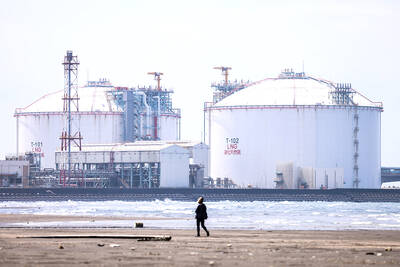
Taiwan is open to joining a global liquefied natural gas (LNG) program if one is created, but on the condition that countries provide delivery even in a scenario where there is a conflict with China, an energy department official said yesterday. While Taiwan’s priority is to have enough LNG at home, the nation is open to exploring potential strategic reserves in other countries such as Japan or South Korea, Energy Administration Deputy Director-General Chen Chung-hsien (陳崇憲) said. While the LNG market does not have a global reserve for emergencies like that of oil, the concept has been raised a few times —

Taiwan Semiconductor Manufacturing Co (TSMC, 台積電) yesterday received government approval to deploy its advanced 3-nanometer (3nm) process at its second fab currently under construction in Japan, the Ministry of Economic Affairs said in a news release. The ministry green-lit the plan for the facility in Kumamoto, which is scheduled to start installing equipment and come online in 2028 with a monthly production capacity of 15,000 12-inch wafers, the ministry said. The Department of Investment Review in June 2024 authorized a US$5.26 billion investment for the facility, slated to manufacture 6- to 12nm chips, significantly less advanced than 3nm process. At a meeting with


 RSS
RSS