


The executive hired to steer FTX Group through bankruptcy on Thursday offered his first findings of improper fund transfers and poor accounting at the collapsed cryptocurrency exchange, describing it as a “complete failure” of controls.
John Ray, who was named FTX’s chief executive officer after the company filed for bankruptcy on Friday last week, said in a court filing that the lapses in oversight, security and corporate governance he identified were greater than in any other process he has managed in his 40 years as a bankruptcy specialist, including at Enron Corp.
“Never in my career have I seen such a complete failure of corporate controls and such a complete absence of trustworthy financial information as occurred here,” Ray said in the filing with a bankruptcy court in Delaware.
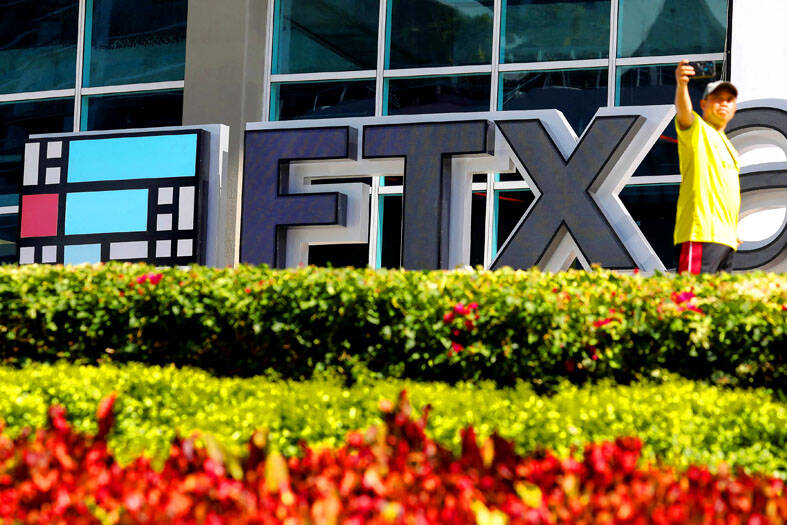
Photo: REUTERS
FTX collapsed after one of its cofounders, Sam Bankman-Fried, used US$10 billion in client funds to prop up his hedge fund Alameda Research, which had suffered losses when its bets on cryptocurrency ventures soured. That left FTX with insufficient funds to cover withdrawals when a plunge in the value of one of its currencies, FTT, triggered a bank run.
While Ray’s filing does not provide a full account of FTX’s demise, it details several lapses that contributed to the downfall.
An Alameda entity had lent US$2.3 billion to an FTX entity, while Bankman-Fried, and FTX cofounders and top executives Nishad Singh and Ryan Salame had collectively borrowed US$1.6 billion from Alameda, the filing said. More such “related party” transactions are listed in the filing, although details are not offered.
Bankman-Fried, Singh and Salame did not respond to requests for comment.
FTX funds were also used to buy homes and other personal items for employees and advisers, Ray wrote.
Some of the money transfers were not documented as company loans, while the homes were registered under the names of the employees, Ray added.
Proper checks and balances were absent, the filing said.
Employees submitted payment requests through an online “chat” platform and supervisors approved them with personalized emojis, the filing said.
Bankman-Fried often communicated through applications that were set to auto-delete after a short time and encouraged employees to do the same, Ray wrote.
Most of the financial statements Ray reviewed were not audited.
He said he harbored “substantial concerns” for statements he found that were audited because they relied on Prager Metis, an accounting firm operating on the metaverse platform Decentraland.
Ray wrote that his predecessor had made “erratic and misleading public statements,” citing an exchange with a reporter on Twitter.
Vox on Wednesday published an interview with Bankman-Fried in which he said he regretted his decision to file for bankruptcy protection and criticized regulators.
He later attempted to backtrack, saying he was “venting” and thought his exchange of messages with the reporter that made the basis of the interview were private.
FTX had 1 million users in the US and many more across the world, the filing said.
It is unclear how many will be able to recover their funds through the bankruptcy.
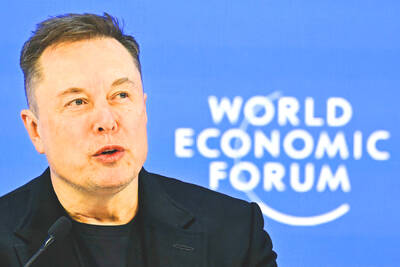
Elon Musk’s lieutenants have reached out to chip industry suppliers, including Applied Materials Inc, Tokyo Electron Ltd and Lam Research Corp, for his envisioned Terafab, early steps in an audacious and likely arduous attempt to break into the production of cutting-edge chips. Staff working for the joint venture between Tesla Inc and Space Exploration Technologies Corp (SpaceX) have sought price quotes and delivery times for an array of chipmaking gear, people familiar with the matter said. In past weeks, they’ve contacted makers of photomasks, substrates, etchers, depositors, cleaning devices, testers and other tools, according to the people, who asked not to

The EU and US are nearing an agreement to coordinate on producing and securing critical minerals, part of a push to break reliance on Chinese supplies. The potential deal would create incentives, such as minimum prices, that could advantage non-Chinese suppliers, according to a draft of an “action plan” seen by Bloomberg. The EU and US would also cooperate on standards, investments and joint projects, as well as coordinate on any supply disruptions by countries like China. The two sides are additionally seeking other “like-minded partners” to join a multicountry accord to help create these new critical mineral supply chains, which feed into

Japan approved ¥631.5 billion (US$3.97 billion) in additional subsidies to hasten Rapidus Corp’s entry into the high-stakes artificial intelligence (AI) chipmaking arena, ramping up support for a project widely regarded as a long shot. The capital is intended to bankroll Rapidus’ work for information technology firm Fujitsu Ltd, one of the initial customers that Tokyo hopes would get the signature endeavor off the ground. The new money raises the fees and investments that the government is injecting into the start-up to ¥2.6 trillion by the end of the current fiscal year to March next year, the Japanese Ministry of Economy, Trade and

The founder of Chinese property giant Evergrande Group (恆大集團) has pleaded guilty to charges of fraud and bribery, a court said yesterday, the latest blow for what was once the country’s leading developer. Evergrande’s rise was propelled by decades of rapid urbanization and rising living standards, but in 2020, its access to credit dramatically narrowed when the government introduced curbs on excessive borrowing and speculation. The company defaulted in 2021 after struggling to repay creditors. Founder Xu Jiayin (許家印), 67, known as Hui Ka Yan in Cantonese, was reportedly held by police in 2023, with Evergrande saying he had been subjected to


 RSS
RSS