


Chinese planemaker Commercial Aircraft Corp of China (COMAC, 中國商用飛機) yesterday said it had secured 330 orders for its homegrown C919 narrow-body and ARJ21 regional jets, and raised its 20-year aircraft demand forecast at the country’s biggest air show.
China Development Bank Financial Leasing Co (國銀金融租賃), ICBC Financial Leasing Co (工銀租賃), CMB Financial Leasing Co (招銀金融租賃), Bank of Communications Financial Leasing Co (交銀金融租賃), CCB Financial Leasing Corp (建信金融租賃), SPDB Financial Leasing Co (浦銀金融租賃) and Jiangsu Financial Leasing Co (江蘇金融租賃) on Tuesday signed orders for a combined 300 C919s and 30 ARJ21s at Airshow China in Zhuhai, COMAC said in a statement.
As with previous announcements, it was not immediately clear how many were firm orders or expressions of interest, and no delivery dates were provided.
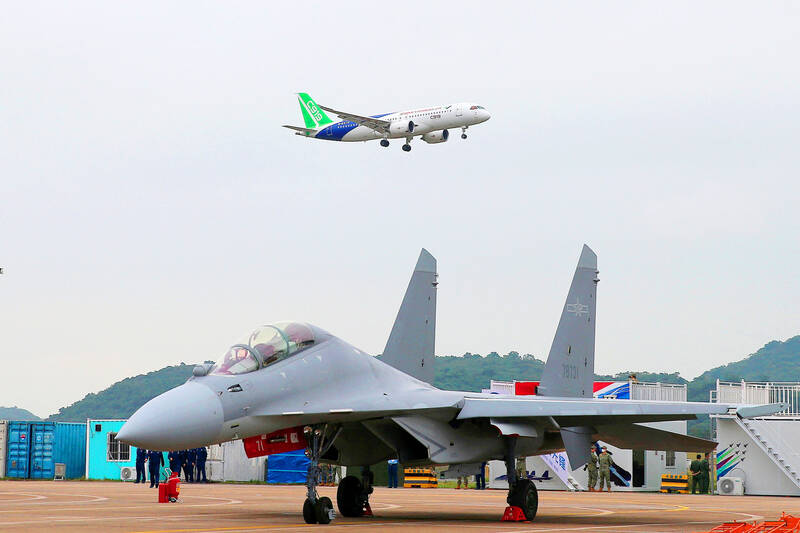
Photo: Reuters
Before the latest deals, there had been 815 orders for the C919 from 28 customers, COMAC said on its Web site.
China Eastern Airlines Corp (中國東方航空) is the only customer that has announced a firm delivery schedule. It expects to receive its first plane next month and another four next year.
The C919 is China’s rival to the popular Airbus SE A320neo and Boeing Co 737 MAX narrow-body jet families, as China looks to become more self-sufficient.
COMAC on Tuesday said that China would need 9,284 new aircraft over the next 20 years to meet market demand, 200 more than in its forecast last year.
The Chinese planemaker’s forecast is higher than Boeing’s, which last month predicted that China would require 8,485 new planes in the next 20 years.
The US manufacturer forecast China would need 6,370 single-aisle airplanes to support its growing network of international and domestic routes, while COMAC said that 6,896 such planes would be needed.
Boeing has been shut out of orders in the world’s biggest market for new aircraft since 2017 amid US-China trade tensions, although Chinese airlines this year agreed to buy more than 300 Airbus narrow-body planes.
POWERING UP: PSUs for AI servers made up about 50% of Delta’s total server PSU revenue during the first three quarters of last year, the company said Power supply and electronic components maker Delta Electronics Inc (台達電) reported record-high revenue of NT$161.61 billion (US$5.11 billion) for last quarter and said it remains positive about this quarter. Last quarter’s figure was up 7.6 percent from the previous quarter and 41.51 percent higher than a year earlier, and largely in line with Yuanta Securities Investment Consulting Co’s (元大投顧) forecast of NT$160 billion. Delta’s annual revenue last year rose 31.76 percent year-on-year to NT$554.89 billion, also a record high for the company. Its strong performance reflected continued demand for high-performance power solutions and advanced liquid-cooling products used in artificial intelligence (AI) data centers,
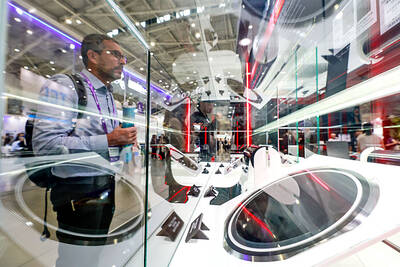
SIZE MATTERS: TSMC started phasing out 8-inch wafer production last year, while Samsung is more aggressively retiring 8-inch capacity, TrendForce said Chipmakers are expected to raise prices of 8-inch wafers by up to 20 percent this year on concern over supply constraints as major contract chipmakers Taiwan Semiconductor Manufacturing Co (TSMC, 台積電) and Samsung Electronics Co gradually retire less advanced wafer capacity, TrendForce Corp (集邦科技) said yesterday. It is the first significant across-the-board price hike since a global semiconductor correction in 2023, the Taipei-based market researcher said in a report. Global 8-inch wafer capacity slid 0.3 percent year-on-year last year, although 8-inch wafer prices still hovered at relatively stable levels throughout the year, TrendForce said. The downward trend is expected to continue this year,

A proposed billionaires’ tax in California has ignited a political uproar in Silicon Valley, with tech titans threatening to leave the state while California Governor Gavin Newsom of the Democratic Party maneuvers to defeat a levy that he fears would lead to an exodus of wealth. A technology mecca, California has more billionaires than any other US state — a few hundred, by some estimates. About half its personal income tax revenue, a financial backbone in the nearly US$350 billion budget, comes from the top 1 percent of earners. A large healthcare union is attempting to place a proposal before
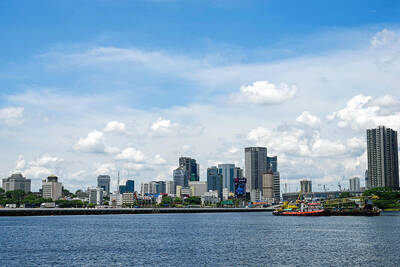
Vincent Wei led fellow Singaporean farmers around an empty Malaysian plot, laying out plans for a greenhouse and rows of leafy vegetables. What he pitched was not just space for crops, but a lifeline for growers struggling to make ends meet in a city-state with high prices and little vacant land. The future agriculture hub is part of a joint special economic zone launched last year by the two neighbors, expected to cost US$123 million and produce 10,000 tonnes of fresh produce annually. It is attracting Singaporean farmers with promises of cheaper land, labor and energy just over the border.


 RSS
RSS