


Hon Hai Precision Industry Co (鴻海精密), the main assembler of Apple Inc’s iPhones, yesterday said it plans to lower its business outlook for this quarter as the COVID-19 pandemic reduced factory utilization at its largest iPhone manufacturing site, in Zhengzhou, China.
“The company’s visibility for the fourth quarter is cautiously optimistic, but due to the pandemic affecting some of our operations in Zhengzhou, the company will revise the outlook downward for the fourth quarter,” Hon Hai said in a statement yesterday.
Hon Hai, also known as Foxconn Technology Group (富士康科技集團) internationally, said it is now “working with the [Chinese] government in a concerted effort to stamp out the pandemic and resume production to its full capacity as quickly as possible.”
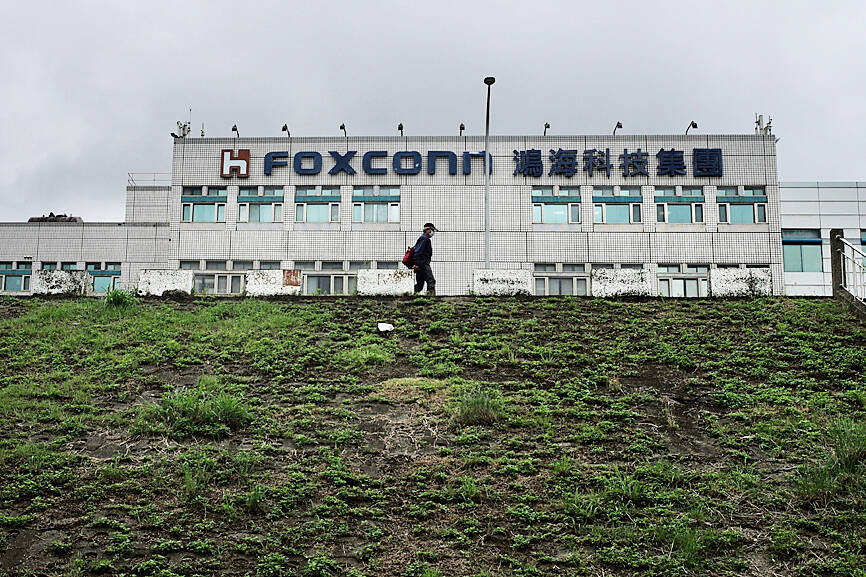
Photo: Sam Yeh, AFP
Hon Hai in August told investors that revenue in the second half of this year would be flat compared with NT$2.7 trillion (US$84.16 billion) earned in the corresponding period last year.
Gross margin in the third and fourth quarters would be higher than the 5.92 percent delivered in the first two quarters of this year, it said.
Before the latest COVID-19 outbreak in Zhengzhou, Hon Hai had been reporting resilient revenue growth. The company yesterday posted NT$776.58 billion in revenue last month, marking the strongest October revenue in its history.
Last month’s revenue surged 40.39 percent from a year earlier, benefiting from its customers’ product launches and strong server demand, but declined 5.56 percent from September, it said.
Hon Hai said computing products, smart consumer electronics, and networking products all delivered double-digit percentage sales growth last month.
From January to the end of last month, revenue expanded 16.89 percent to NT$5.44 trillion from NT$4.65 trillion a year earlier.
Hon Hai has recovered the Zhengzhou factory’s utilization, and has launched a recruitment drive at the site, the company said yesterday.
The company said that with the “closed-loop” management system imposed by Zhengzhou authorities set to end tomorrow, it would increase hiring to boost production.
Hon Hai also said workers who had left during the outbreak would receive a bonus of 500 yuan (US$69.20) if they returned to the Zhengzhou facility.
Hon Hai has scheduled an investors’ conference for Thursday, with analysts suggesting that the effects of lockdowns on iPhone 14 production in Zhengzhou would be high on the agenda.
“We believe it would be difficult for Hon Hai to return capacity utilization to normal in Zhengzhou within a short period,” Taiwan Rating Co (中華信評) said in a report yesterday.
The ratings agency expects Hon Hai’s revenue growth to be weaker than expected at 11 to 13 percent this year from last year, and said that more downside risks are expected next year due to Apple’s efforts to manage risk by spreading its iPhone assembly among other contractors.
As trade and technology tensions heighten between the US and China, Hon Hai is expected to boost its production presence in Vietnam and India, given improving infrastructure in those countries, Taiwan Ratings said.
Hon Hai assembles most of its networking and communications products outside of China, such as in Taiwan and Mexico.
However, China remains its most important manufacturing hub, retaining about 75 percent of its overall capacity, particularly iPhone manufacturing.
Additional reporting by CNA
Taiwan’s foreign exchange reserves fell below the US$600 billion mark at the end of last month, with the central bank reporting a total of US$596.89 billion — a decline of US$8.6 billion from February — ending a three-month streak of increases. The central bank attributed the drop to a combination of factors such as outflows by foreign institutional investors, currency fluctuations and its own market interventions. “The large-scale outflows disrupted the balance of supply and demand in the foreign exchange market, prompting the central bank to intervene repeatedly by selling US dollars to stabilize the local currency,” Department of Foreign

ENERGY ISSUES: The TSIA urged the government to increase natural gas and helium reserves to reduce the impact of the Middle East war on semiconductor supply stability Chip testing and packaging service provider ASE Technology Holding Co (日月光投控) yesterday said it planned to invest more than NT$100 billion (US$3.15 billion) in building a new advanced chip testing facility in Kaohsiung to keep up with customer demand driven by the artificial intelligence (AI) boom. That would be included in the company’s capital expenditure budget next year, ASE said. There is also room to raise this year’s capital spending budget from a record-high US$7 billion estimated three months ago, it added. ASE would have six factories under construction this year, another record-breaking number, ASE chief operating officer Tien Wu

The EU and US are nearing an agreement to coordinate on producing and securing critical minerals, part of a push to break reliance on Chinese supplies. The potential deal would create incentives, such as minimum prices, that could advantage non-Chinese suppliers, according to a draft of an “action plan” seen by Bloomberg. The EU and US would also cooperate on standards, investments and joint projects, as well as coordinate on any supply disruptions by countries like China. The two sides are additionally seeking other “like-minded partners” to join a multicountry accord to help create these new critical mineral supply chains, which feed into

For weeks now, the global tech industry has been waiting for a major artificial intelligence (AI) launch from DeepSeek (深度求索), seen as a benchmark for China’s progress in the fast-moving field. More than a year has passed since the start-up put Chinese AI on the map in early last year with a low-cost chatbot that performed at a similar level to US rivals. However, despite reports and rumors about its imminent release, DeepSeek’s next-generation “V4” model is nowhere in sight. Speculation is also swirling over the geopolitical implications of which computer chips were chosen to train and power the new


 RSS
RSS