


Qualcomm Inc, the biggest maker of smartphone processors, on Wednesday offered a far weaker forecast than expected due to an economic slowdown and COVID-19 lockdowns in China.
Revenue would be US$9.2 billion to US$10 billion in the fiscal first quarter, Qualcomm said.
That compares with an average estimate by analysts of US$12 billion.

Photo: Reuters
Excluding certain items, earnings per share would be US$2.45 at best, the company said.
The average projection was US$3.40.
Qualcomm is coping with the slowdown in part by freezing hiring, executives told a conference call.
The buildup of extra inventory might take two quarters to clear, the company said.
“The further deterioration of the macroeconomic environment and sustained COVID restrictions in China have led to broad-based demand weakening across tiers and regions,” Qualcomm said in a presentation to investors.
Qualcomm chief executive officer Cristiano Amon has said that his tenure would be defined by how successful he is in pushing the chipmaker’s technology into new areas, including automotive equipment, networking and computers.
While Qualcomm is getting more revenue from those newer efforts, the bulk of its sales still comes from phones, limiting the company’s overall growth.
Qualcomm’s main product is the processors that run many of the world’s smartphones. It also sells the modem chips that connect Apple Inc’s iPhone to high-speed data networks.
The phone market is predicted to contract in the low-double-digit percent range, and excess inventory would continue to be a drag on orders throughout the fiscal first quarter, Qualcomm said.
There is a silver lining, though.
The company would continue to provide the modem chips for the “vast majority” of iPhones next year, a turnabout for a company that had expected to lose the business to Apple’s homegrown components, comments that accompanied its earnings report said.
The statement said that Apple would not be moving to its own in-house modem design for next year’s models.
Qualcomm’s fiscal fourth-quarter revenue was US$11.4 billion, in line with estimates.
Profit in the period, which ended on Sept. 25, was US$3.13 per share, excluding some items. That also matched projections.
“While our financial outlook has been temporarily impacted by elevated channel inventory, our diversification strategy and long-term opportunities remain unchanged,” Amon said in a prepared statement.

Apple Inc increased iPhone production in India by about 53 percent last year and now makes a quarter of its marquee devices there, reflecting the US company’s efforts to avoid tariffs on China. The company assembled about 55 million iPhones in India last year, up from 36 million a year earlier, people familiar with the matter said, asking not to be named because the numbers aren’t public. Apple makes about 220 million to 230 million iPhones a year globally, with India’s share of the total increasing rapidly. Apple has accelerated its expansion in the world’s most populous country in recent years, bolstered

Taiwan Semiconductor Manufacturing Co’s (TSMC, 台積電) share of the global foundry market rose to almost 70 percent last year amid booming demand for artificial intelligence (AI), market information advisory firm TrendForce Corp (集邦科技) said on Thursday. The contract chipmaker posted US$122.54 billion in revenue, up 36.1 percent from a year earlier, accounting for 69.9 percent of the global market, TrendForce said. Its share was up from 64.4 percent in 2024, it said. TSMC’s closest rival, Samsung Electronics, was a distant second, posting US$12.63 billion in sales, down 3.9 percent from a year earlier, for a 7.2 percent share of the global market. In the

HEADWINDS: The company said it expects its computer business, as well as consumer electronics and communications segments to see revenue declines due to seasonality Pegatron Corp (和碩) yesterday said it aims to grow its artificial intelligence (AI) server revenue more than 10-fold this year from last year, driven by orders from neocloud solutions clients and large cloud service providers. The electronics manufacturing service provider said AI server revenue growth would be driven primarily by the Nvidia Corp GB300 server platform. Server shipments are expected to increase each quarter this year, with the second half likely to outperform the first half, it said. The AI server market is expected to broaden this year as more inference applications emerge, which would drive demand for system-on-chip, application-specific integrated circuits
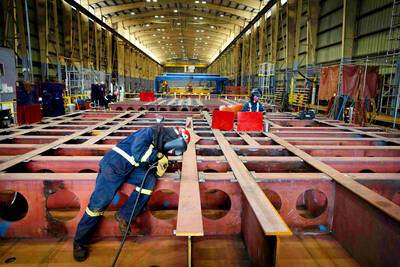
At a massive shipyard in North Vancouver, Canadian workers grind metal beams for a powerful new icebreaker crucial to cementing the country’s presence in the increasingly contested arctic. Icebreakers are specialized, expensive vessels able to navigate in the frozen far north. And “this is the crown jewel,” said Eddie Schehr, vice president of production at the Seaspan shipyard. For Canadian Prime Minister Mark Carney, who heads to Norway next Friday to observe arctic defense drills involving troops from 14 NATO states, Canada’s extreme north has emerged as a strategic priority. “Canada is and forever will be an Arctic nation,” he said ahead of


 RSS
RSS