


Autonomous vehicle companies and suppliers have collectively spent about US$75 billion developing self-driving technology, with scant sign of meaningful revenue emerging from robo-car services after all that cash incineration.
This has spelled disaster for Aurora Innovation Inc, TuSimple Holdings Inc and Embark Technology inc, whose shares have each plunged at least 80 percent this year.
It is no wonder that Intel Corp just slashed the targeted valuation for its autonomous-driving business Mobileye to about US$16 billion, a fraction of the more than US$50 billion it reportedly had in mind 10 months ago.

Photo: Reuters
Cruise LLC, owned by General Motors Co (GM), raised money at a roughly US$30 billion valuation early last year. In March, GM bought out SoftBank Vision Fund at a price implying the venture was worth about US$19 billion.
This is what happens when long-gestating new technology meets the short patience of public markets and harsh reality of rising interest rates. Many of these companies raised tens of billions of dollars long before their technology was proven or their businesses came close to being self-sustaining.
The hype of the past decade or so and crash of late is calling into question whether self-driving vehicles will ever work.
Anthony Levandowski, one of Google’s early autonomy pioneers, who left for Uber Technologies Inc and was later convicted of stealing trade secrets, is the cofounder and chief executive of Pronto, a start-up developing autonomous trucks for industrial sites.
In a Businessweek cover story this month, he said that less-complex use cases would be the way forward for the foreseeable future.
Adam Jonas, head of global auto and shared mobility research at Morgan Stanley, seven years ago ascribed massive value to a Tesla Inc mobility service that is still nowhere to be found.
He said in recent a note that autonomy could be a 10 or 20-year proposition.
Companies in the space are now being forced to contemplate drastic measures. Aurora chief executive Chris Urmson last month sent out an internal memo raising the prospect of cost cuts, taking the company private, spinning off assets or even trying to sell the company to Apple Inc or Microsoft Corp.
Others have seen high-level turnover. GM chief executive Mary Barra dismissed Cruise counterpart Dan Ammann late last year. TuSimple replaced founder and chief executive Lu Cheng (呂程) in March, and its general counsel James Mullen resigned last month. Alphabet-owned Waymo LLC lost its chief product officer Dan Chu last month to 23andMe Holding Co.
While executives and investors alike are in some cases heading for the exits, well-capitalized companies in the space are plowing ahead into new markets and projects. Cruise plans to replicate its San Francisco robo-taxi service in Phoenix and Austin, Texas. Waymo is to start offering rides in Los Angeles and also has been hauling beer between Dallas and Houston.
Start-up Kodiak Robotics raised US$30 million in private capital this week and ran its freight trucks 12,875km from Texas to Florida.
While there was a test driver at the wheel, the human ceded to the robot 94 percent of the time, Kodiak chief executive and founder Don Burnette said. The company is starting to haul furniture for Ikea.
Asked if Kodiak would be ready to ditch the safety driver anytime soon, Burnette said: “We’re pretty close. It seems like we always say this. It’s a couple years out.”
It might take even longer, but the market getting the timing of autonomy wrong does not mean it will never work. The lesson is that technology as radical as robotic driving was always better off in the incubators of daring venture capitalists, not the portfolios of trigger-happy stock traders.
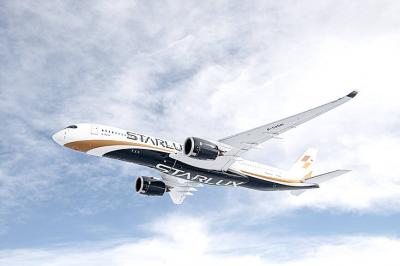
Starlux Airlines Co (星宇航空) today unveiled a long-haul network expansion plan at a shareholders’ meeting in Taipei, including direct flights to Barcelona, Spain, and Zurich, Switzerland, as well as a service connecting Taipei, Sydney and New Zealand. Starlux is to become the first Taiwanese carrier to offer non-stop services to the two European cities, while the inaugural oceanic route is expected to expand transit opportunities within the Australia-New Zealand market, Starlux said. Flight services to Chicago, Dallas, Washington and New York are under evaluation, the airline added. Prior to the shareholders’ meeting, the airline earlier this year announced that it would be
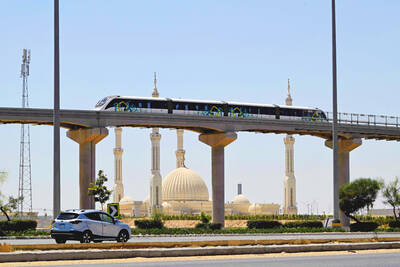
Cairo’s new monorail slices across the city skyline, running above the familiar chaos of blaring horns and aging buses’ exhaust fumes that mark rush hour below. The US$4.5 billion monorail, opened this month, is among Egypt’s most prominent new transport projects, part of a debt-funded infrastructure drive criticized for sapping state finances while bringing limited benefits to most of the country’s 109 million people. “It feels like you’re in a different country,” said Ramy Sayed, a restaurant manager, aboard a driverless Innovia 300 train. “No noise, no traffic, we’re not used to this.” The eastern line runs 56km from the bustling middle-class
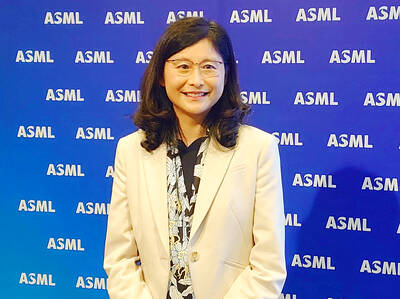
Netherlands-based semiconductor equipment supplier ASML Holding NV yesterday said that it is planning to hire an additional 1,000 people in Taiwan this year in response to growing demand from clients. ASML had previously planned to recruit 600 people this year, but that the plan has been adjusted upward, ASML vice president and ASML Taiwan general manager Grace Wang (汪佳慧) told reporters. ASML has a workforce of more than 4,500 in Taiwan, accounting for about 10 percent of its global total, Wang said. This year’s recruitment campaign would focus on adding people in the customer support, manufacturing and supply chain domains to assist ASML
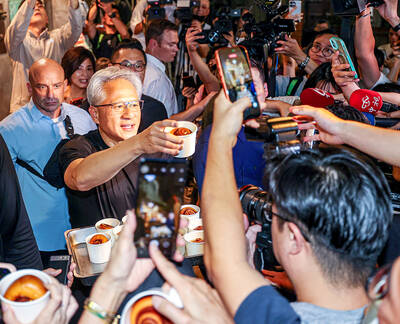
Nvidia Corp yesterday announced that CEO Jensen Huang (黃仁勳) would attend an employee meeting in Taipei tomorrow to celebrate the launch of the company’s Taiwan headquarters project. Huang would attend a gathering at the site of Nvidia’s planned headquarters in Beitou Shilin Technology Park (北投士林科技園區), the company said in a statement. After arriving in Taiwan on Saturday last week, Huang told reporters that he plans to meet with Quanta Computer Inc (廣達) chairman Barry Lam (林百里) and Taiwan Semiconductor Manufacturing Co (TSMC, 台積電) chairman C.C. Wei (魏哲家), and would attend the groundbreaking ceremony for Nvidia’s Taiwan headquarters tomorrow. Nvidia has not yet applied


 RSS
RSS