


US Senate Intelligence Committee Chairman Mark Warner said he was “disappointed” that companies such as Apple Inc and Tesla Inc tout their environmental, social and governance (ESG) bona fides, but neglect glaring environmental or human rights issues when relying on China for supply chains and sales.
Multinationals might highlight their commitment to ESG goals, but also reason that “the Chinese markets, it’s so big, we’ve got to turn a blind eye” to abuses, Warner said in an interview with Bloomberg in New York. “Whether it’s oppression of the people in Hong Kong or whether it’s the Uighurs or whether it’s using electrical power coming out of Xinjiang to build the batteries that go in your Tesla.”
China has been accused of widespread human rights abuses against mostly Muslim Uighurs in China’s Xinjiang region.
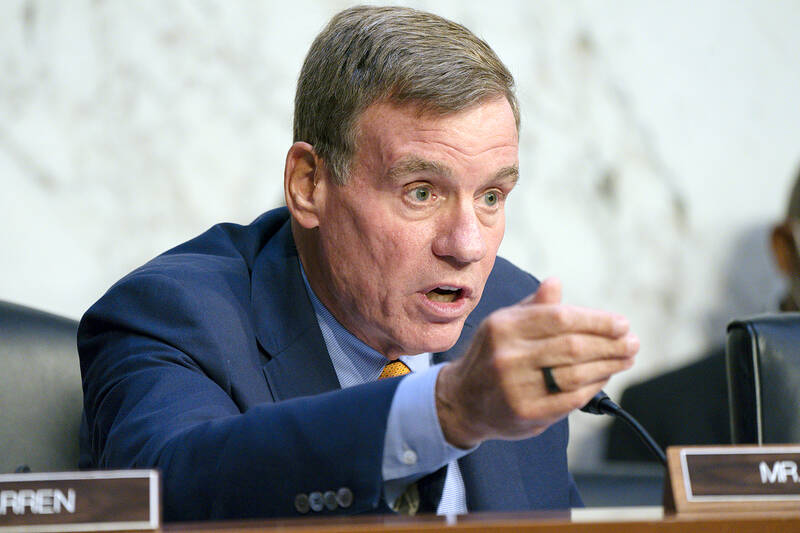
Photo: AP
Warner said that he was “disappointed with our friends at Apple” and has been “really frustrated with not just American companies, but other multinationals.”
Spokespeople for Apple and Tesla did not immediately return e-mails seeking comment on Tuesday.
Sales in China accounted for about one-quarter of Tesla’s automotive revenue in the third quarter, while about one-fifth of Apple’s revenue comes from China.
Warner reiterated his past calls to get the US off an over-reliance on Chinese supply chains and other initiatives.
He said that a blockade of Taiwan by China would be “an economic catastrophe” and hostilities with China would be “exponentially different” than with Russia.
“If China dominates a series of the technology domains, they could run the table,” he said.
Warner said that there would probably be additional legislative action on the issue, including on synthetic biology, advanced energy, quantum computing and other emerging technologies.
Warner said he is also concerned about Elon Musk’s reliance on China amid the Tesla chief executive’s recent statements about Taiwan and his potential purchase of Twitter Inc.
“I don’t think there is another American more dependent upon the largess of the [Chinese] Communist Party [CCP] than Elon Musk,” Warner said in an interview in New York.
Musk told the Financial Times that Taiwan should agree to become a special administrative zone of China to resolve tensions with Beijing.
Musk also said Beijing has sought assurances that he will not offer SpaceX’s Starlink Internet service in China.
Warner, of Virginia, said he is concerned that if Musk’s US$44 billion bid to buy Twitter goes through, he would face additional pressure from China to moderate posts critical of Chinese President Xi Jinping (習近平) or the CCP.
“That to me is much more troubling, or potentially troubling, than whether [former US president] Donald Trump’s on Twitter,” he said, referring to Musk’s criticism of Twitter’s ban on Trump.

Apple Inc increased iPhone production in India by about 53 percent last year and now makes a quarter of its marquee devices there, reflecting the US company’s efforts to avoid tariffs on China. The company assembled about 55 million iPhones in India last year, up from 36 million a year earlier, people familiar with the matter said, asking not to be named because the numbers aren’t public. Apple makes about 220 million to 230 million iPhones a year globally, with India’s share of the total increasing rapidly. Apple has accelerated its expansion in the world’s most populous country in recent years, bolstered
HEADWINDS: The company said it expects its computer business, as well as consumer electronics and communications segments to see revenue declines due to seasonality Pegatron Corp (和碩) yesterday said it aims to grow its artificial intelligence (AI) server revenue more than 10-fold this year from last year, driven by orders from neocloud solutions clients and large cloud service providers. The electronics manufacturing service provider said AI server revenue growth would be driven primarily by the Nvidia Corp GB300 server platform. Server shipments are expected to increase each quarter this year, with the second half likely to outperform the first half, it said. The AI server market is expected to broaden this year as more inference applications emerge, which would drive demand for system-on-chip, application-specific integrated circuits
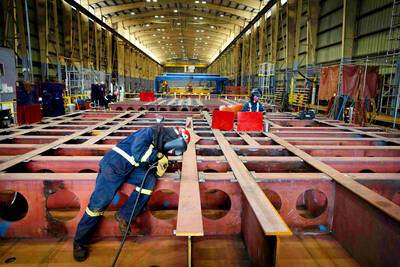
At a massive shipyard in North Vancouver, Canadian workers grind metal beams for a powerful new icebreaker crucial to cementing the country’s presence in the increasingly contested arctic. Icebreakers are specialized, expensive vessels able to navigate in the frozen far north. And “this is the crown jewel,” said Eddie Schehr, vice president of production at the Seaspan shipyard. For Canadian Prime Minister Mark Carney, who heads to Norway next Friday to observe arctic defense drills involving troops from 14 NATO states, Canada’s extreme north has emerged as a strategic priority. “Canada is and forever will be an Arctic nation,” he said ahead of
Taiwan Semiconductor Manufacturing Co’s (TSMC, 台積電) share of the global foundry market rose to almost 70 percent last year amid booming demand for artificial intelligence (AI), market information advisory firm TrendForce Corp (集邦科技) said on Thursday. The contract chipmaker posted US$122.54 billion in revenue, up 36.1 percent from a year earlier, accounting for 69.9 percent of the global market, TrendForce said. Its share was up from 64.4 percent in 2024, it said. TSMC’s closest rival, Samsung Electronics, was a distant second, posting US$12.63 billion in sales, down 3.9 percent from a year earlier, for a 7.2 percent share of the global market. In the


 RSS
RSS