


Foreign brokerages gave mixed reactions after Taiwan Semiconductor Manufacturing Co (TSMC, 台積電) cut its capital expenditure budget for this year by about 10 to 18 percent, due to short-term market uncertainty.
TSMC during an investors’ conference on Thursday reduced its capital expenditure forecast to US$36 billion from an earlier estimate of US$40 billion to US$44 billion.
A European brokerage said it expects the figure to fall further to US$34 billion next year.
Photo: Chiang Ying-ying, AP
The chipmaker’s announcement came as the sector tackles weak global demand due to ongoing inventory adjustments and central banks raising key interest rates to fight fast-growing inflation.
TSMC said it expects capacity utilization for its 6-nanometer and 7-nanometer processes to slow down in the fourth quarter of this year.
The weakness is likely to extend into the first half of next year, due to falling demand for smartphones and PCs, and delayed product launches by customers, it said.
The European securities house said that Washington’s ban on US chip exports to China would drag down TSMC’s sales by 1 to 2 percent next year.
A US securities firm said the chipmaker’s reduction of capital expenditure confirms the presence of significant uncertainties ahead.
Another US brokerage said that it agrees with TSMC’s assessments on the possible effects of the export ban and that ongoing inventory adjustments in the global semiconductor industry would continue until the first half of next year.
TSMC has said it expects inventory levels to return to normal in the second half of next year.
A Japanese brokerage said that it was impressed by TSMC’s third-quarter results after the chipmaker posted NT$280.87 billion (US$8.8 billion) in net profit, or earnings per share of NT$10.83.
Although weakening demand is expected to reduce the company’s capacity utilization in the first half of next year, it is still likely to outperform its peers, the Japanese brokerage said.
Separately, the US International Trade Commission on Friday said that it would investigate TSMC over accusations that it infringed on patents held by New York-based Daedalus Prime LLC.
The commission would also investigate South Korea’s Samsung Electronics Co and US-based IC designer Qualcomm Inc on two separate complaints filed with the agency by Daedalus Prime on Sept. 13.
Daedalus Prime has accused the three companies of contravening Section 337 of the US Tariff Act of 1930 by importing and selling in the US integrated circuits and mobile devices covered by its patent, the agency said.
The probe would cover Samsung’s Galaxy S20 FE and Galaxy A71 5G smartphones, tablet computers and smart watches, as well as components including chips produced by TSMC for Qualcomm, US media have reported.
Intel Corp developed the patents in question, which Daedalus Prime then obtained, the reports said.
The agency is also investigating patent infringement claims made by Daedalus Prime against Mercedes-Benz USA LLC, NXP USA Inc and Avnet Inc.


Taiwan’s foreign exchange reserves fell below the US$600 billion mark at the end of last month, with the central bank reporting a total of US$596.89 billion — a decline of US$8.6 billion from February — ending a three-month streak of increases. The central bank attributed the drop to a combination of factors such as outflows by foreign institutional investors, currency fluctuations and its own market interventions. “The large-scale outflows disrupted the balance of supply and demand in the foreign exchange market, prompting the central bank to intervene repeatedly by selling US dollars to stabilize the local currency,” Department of Foreign

Intel Corp is joining Elon Musk’s long-shot effort to develop semiconductors for Tesla Inc, Space Exploration Technologies Corp and xAI, marking a surprising twist in the chipmaker’s comeback bid. Intel would help the Terafab project “refactor” the technology in a chip factory, the company said on Tuesday in a post on X, Musk’s social media platform. That is a stage in the development process that typically helps make chips more powerful or reliable. The chipmaker’s shares jumped 4.2 percent to US$52.91 in New York trading on Tuesday. The Terafab project is a grand plan by Musk to eventually manufacture his own chips for
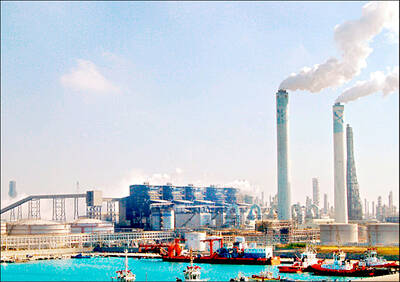
Taiwan Power Co (Taipower, 台電) yesterday said it plans to resume operations at two coal-fired power generators for three months to boost security of electricity supply as liquefied natural gas (LNG) supply risks are running high due to the Middle East conflict. The two coal-fired power generators are at Mailiao Power Plant in Yunlin County’s Mailiao Township (麥寮). The plant, operated by Formosa Plastics Group (台塑集團), supplied electricity to Taipower’s power grid until the end of last year. Taipower’s decision came about one month after Minister of Economic Affairs Kung Ming-hsin (龔明鑫) on March 10 said that the nation had no imminent

Some robotaxi passengers were left stranded in the middle of fast-moving traffic in a major Chinese city after their driverless vehicles stopped running, according to police and media reports on Wednesday. A preliminary investigation indicates more than 100 robotaxis came to a halt because of a “system malfunction,” police in the city of Wuhan said in a statement, without elaborating. No injuries were reported. One passenger told Chinese media that their robotaxi stopped after turning a corner. An instruction on a screen read: “Driving system malfunction. Staff are expected to arrive in 5 minutes.” After no one showed up, the passenger pushed


 RSS
RSS