


US stocks on Friday dropped as worsening inflation expectations kept intact worries that the US Federal Reserve’s aggressive rate hike path could trigger a recession, while investors digested the early stages of earnings season.
In the last session of a volatile week, equities opened higher, then reversed course after data from the University of Michigan showed that consumer sentiment improved this month, but inflation expectations worsened as gasoline prices moved higher. Retail sales data also indicated resilience among consumers.
“The main thrust for the market right now is higher interest rates, higher inflation and the Fed is going to continue to move its fed funds target higher,” said Anthony Saglimbene, chief market strategist at Ameriprise Financial Inc in Troy, Michigan. “The narrative that we’ve seen peak inflation is not evident yet and that’s depressing the market.”

On Thursday, a reading on the consumer prices index (CPI) showed that inflation remained stubbornly high.
Fed officials have been largely in sync when commenting on the need to raise rates and US Federal Reserve Bank of St Louis President President James Bullard said in an interview that the recent CPI data warrants a continued “frontloading” through larger three-quarter-percentage point steps, although that does not necessarily mean rates need to be raised above the central bank’s most recent projections.
The Dow Jones Industrial Average on Friday fell 403.89 points, or 1.34 percent, to 29,634.83, the S&P 500 lost 86.84 points, or 2.37 percent, to 3,583.07, and the NASDAQ Composite Index dropped 327.76 points, or 3.08 percent, to 10,321.39.
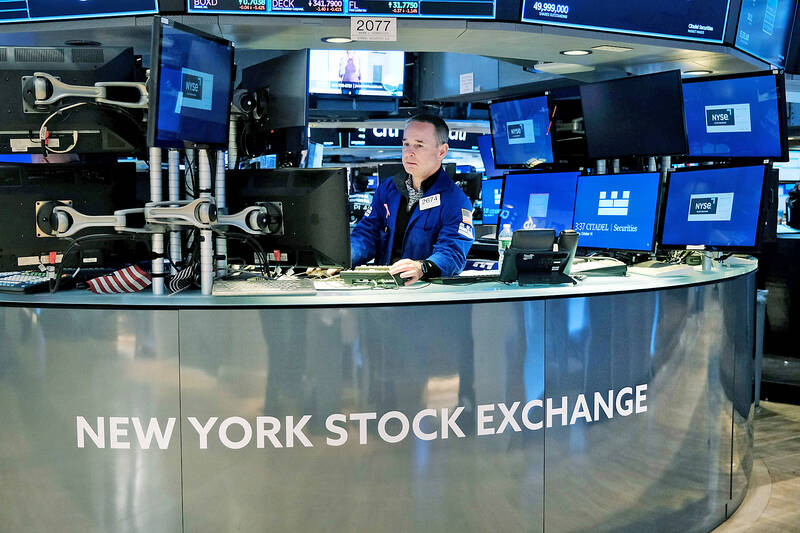
Photo: AFP
Friday’s decline marked the 37th time the S&P 500 recorded a gain or loss of at least 2 percent compared with only seven such sessions in all of last year. For the week, the Dow gained 1.15 percent, the S&P 500 lost 1.56 percent and the NASDAQ fell 3.11 percent.
Corporate earnings season started to pick up steam and helped the bank index, which posted a narrow 0.03 percent gain after quarterly results from JPMorgan Chase & Co, up 1.66 percent, Citigroup Inc, up 0.65 percent, and Wells Fargo & Co, up 1.86 percent, boosted the shares of each.
“The message I got from them is things are looking pretty good from an economic perspective despite the challenges, but they increased loan-loss reserves just in anticipation that you are going to see some more slowing,” said Brian Jacobsen, senior investment strategist at Allspring Global Investments in Menomonee Falls, Wisconsin.
UnitedHealth gained 0.63 percent as one of only three Dow firms to move higher on the day after the health insurer posted better-than-expected quarterly results, while raising its annual forecast.
Analysts expect third-quarter profits for S&P 500 companies to rise just 3.6 percent from a year earlier, much lower than an 11.1 percent increase expected at the start of July, Refinitiv data showed.
Volume on US exchanges was 10.88 billion shares, compared with the 11.48 billion average for the full session over the past 20 trading days.
The S&P 500 posted five new 52-week highs and seven new lows; the NASDAQ Composite recorded 71 new highs and 235 new lows.

HORMUZ ISSUE: The US president said he expected crude prices to drop at the end of the war, which he called a ‘minor excursion’ that could continue ‘for a little while’ The United Arab Emirates (UAE) and Kuwait started reducing oil production, as the near-closure of the crucial Strait of Hormuz ripples through energy markets and affects global supply. Abu Dhabi National Oil Co (ADNOC) is “managing offshore production levels to address storage requirements,” the company said in a statement, without giving details. Kuwait Petroleum Corp said it was lowering production at its oil fields and refineries after “Iranian threats against safe passage of ships through the Strait of Hormuz.” The war in the Middle East has all but closed Hormuz, the narrow waterway linking the Persian Gulf to the open seas,

Apple Inc increased iPhone production in India by about 53 percent last year and now makes a quarter of its marquee devices there, reflecting the US company’s efforts to avoid tariffs on China. The company assembled about 55 million iPhones in India last year, up from 36 million a year earlier, people familiar with the matter said, asking not to be named because the numbers aren’t public. Apple makes about 220 million to 230 million iPhones a year globally, with India’s share of the total increasing rapidly. Apple has accelerated its expansion in the world’s most populous country in recent years, bolstered

HEADWINDS: The company said it expects its computer business, as well as consumer electronics and communications segments to see revenue declines due to seasonality Pegatron Corp (和碩) yesterday said it aims to grow its artificial intelligence (AI) server revenue more than 10-fold this year from last year, driven by orders from neocloud solutions clients and large cloud service providers. The electronics manufacturing service provider said AI server revenue growth would be driven primarily by the Nvidia Corp GB300 server platform. Server shipments are expected to increase each quarter this year, with the second half likely to outperform the first half, it said. The AI server market is expected to broaden this year as more inference applications emerge, which would drive demand for system-on-chip, application-specific integrated circuits

PROJECTION: TSMC said it expects strong growth this year, with revenue in US dollars projected to grow by about 30 percent, outperforming the industry Taiwan Semiconductor Manufacturing Co (TSMC, 台積電) yesterday reported consolidated sales last month reached NT$317.66 billion (US$9.98 billion), the highest ever for the month of February, driven by robust demand for chips built using the company’s advanced 3-nanometer (3nm) process. Last month’s figure was up 22.2 percent from a year earlier, but fell 20.8 percent from January, the world’s largest contract chipmaker said in a statement. For the first two months of the year, TSMC posted cumulative sales of NT$718.91 billion, up 29.9 percent from a year earlier. Analysts attributed the growth to sustained global demand for artificial intelligence (AI) products


 RSS
RSS