


Foxsemicon Integrated Technology Inc (京鼎) yesterday said its new factory had entered operation and would generate NT$3 billion (US$95.15 million) in production value at full utilization.
The semiconductor equipment component manufacturing arm of Foxconn Technology Group (富士康科技集團) in January invested NT$2.4 billion to build the fab in Miaoli County’s Jhunan Township (竹南) amid a thriving semiconductor industry worldwide.
The new factory is expected to create 400 new jobs, Foxsemicon said in a statement.
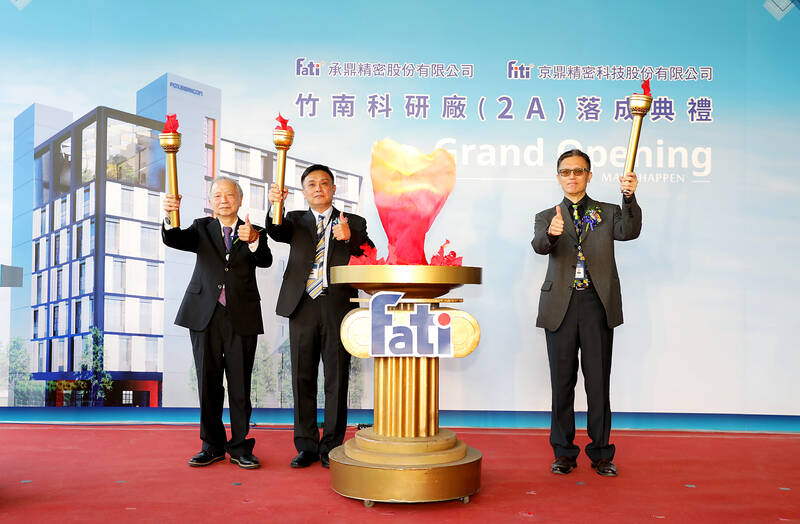
Photo courtesy of Foxsemicon Integrated Technology Inc
Although the world’s memorychip industry in the past few months started showing some weakness amid sagging demands for PCs and smartphones, Foxsemicon expects the semiconductor equipment sector’s growth not to be dented by the trend.
Demands for semiconductors used in artificial intelligence, 5G devices, high-performing computing applications and electric vehicles remain robust, company spokesman Frank Chen (陳鎮福) told the Taipei Times by telephone.
The world’s major chipmakers, including memorychip makers, are still building new factories and expanding capacity to capture future growth, he said.
“The semiconductor equipment supply chain has not felt the chill of winter yet,” Chen said.
The world’s major semiconductor equipment suppliers, such as Applied Materials Inc and Lam Research Corp, are unable to keep pace with customers’ demand, as the COVID-19 pandemic and other factors weighing on logistics lengthen lead times, he said.
Foxsemicon counts Applied Materials as one of its customers, the company’s annual report said.
The world’s fab equipment spending is expected to grow about 9 percent annually to an all-time high of US$99 billion this year, with Taiwanese firms topping the equipment spending list, international trade group SEMI said last week.
SEMI also forecast that global spending on semiconductor equipment next year would remain in high gear at about US$97 billion.
“We retain our forecast of double-digit percentage [revenue] growth in the full year. So far we have performed better than that,” Chen said.
The Miaoli-based company saw revenue soar 18.9 percent to NT$9.26 billion in the first eight months of this year, compared with NT$7.79 billion in the same period last year.
Foxsemicon said that its local fabs and capacity help it boost supply resilience amid global geopolitical tensions and pandemic restrictions.
The stock price of Foxsemicon rallied 1.57 percent to NT$193.5 yesterday, outperforming the TAIEX, which gained 0.66 percent, Taiwan Stock Exchange data showed.

Netherlands-based semiconductor equipment supplier ASML Holding NV yesterday said that it is planning to hire an additional 1,000 people in Taiwan this year in response to growing demand from clients. ASML had previously planned to recruit 600 people this year, but that the plan has been adjusted upward, ASML vice president and ASML Taiwan general manager Grace Wang (汪佳慧) told reporters. ASML has a workforce of more than 4,500 in Taiwan, accounting for about 10 percent of its global total, Wang said. This year’s recruitment campaign would focus on adding people in the customer support, manufacturing and supply chain domains to assist ASML

UNDER MICROSCOPE: Taiwan detained three people who allegedly conspired to buy servers in Taiwan and export them using fraudulent documentation, prosecutors said Nvidia Corp chief executive officer Jensen Huang (黃仁勳) on Saturday urged Super Micro Computer Inc to tighten up on compliance after Taiwan detained three people this week for allegedly making fraudulent declarations about artificial intelligence (AI) servers made by its US partner. The development marked the nation’s first crackdown on semiconductor smuggling, which grew after the US slapped restrictions on exports of high-end chips such as Nvidia AI accelerators to China. Nvidia is “rigorous” in explaining regulations to all of its partners, Huang told reporters after arriving in Taipei. “Ultimately Super Micro has to run their own company,” he said in response to

Nvidia Corp yesterday announced that CEO Jensen Huang (黃仁勳) would attend an employee meeting in Taipei tomorrow to celebrate the launch of the company’s Taiwan headquarters project. Huang would attend a gathering at the site of Nvidia’s planned headquarters in Beitou Shilin Technology Park (北投士林科技園區), the company said in a statement. After arriving in Taiwan on Saturday last week, Huang told reporters that he plans to meet with Quanta Computer Inc (廣達) chairman Barry Lam (林百里) and Taiwan Semiconductor Manufacturing Co (TSMC, 台積電) chairman C.C. Wei (魏哲家), and would attend the groundbreaking ceremony for Nvidia’s Taiwan headquarters tomorrow. Nvidia has not yet applied

Huawei Technologies Co (華為) said it has come up with a new pathway to shorten its gap with industry leader Taiwan Semiconductor Manufacturing Co (TSMC, 台積電), potentially achieving a breakthrough in making advanced semiconductors without cutting-edge equipment. Right now there is about a five-year gap between what TSMC is capable of and what Huawei, together with its manufacturing partner Semiconductor Manufacturing International Corp (中芯), can produce. Huawei is to start making 1.4-nanometer chips by 2031 with its own “LogicFolding” technology, Huawei semiconductor chief He Tingbo (何庭波) said in a rare public appearance during a chip conference yesterday, while TSMC has


 RSS
RSS