


Mohamed El-Erian has a cautionary word for anyone anticipating an end to interest-rate increases from the US Federal Reserve and other central banks.
“All of you who are looking for a pivot, be careful what you wish for,” the Allianz SE chief economic adviser and Gramercy Funds chairman said on Friday.
“This pivot only happens if you have an economic accident or a financial accident, and the journey to an economic accident or a financial accident is a very painful journey,” he said.
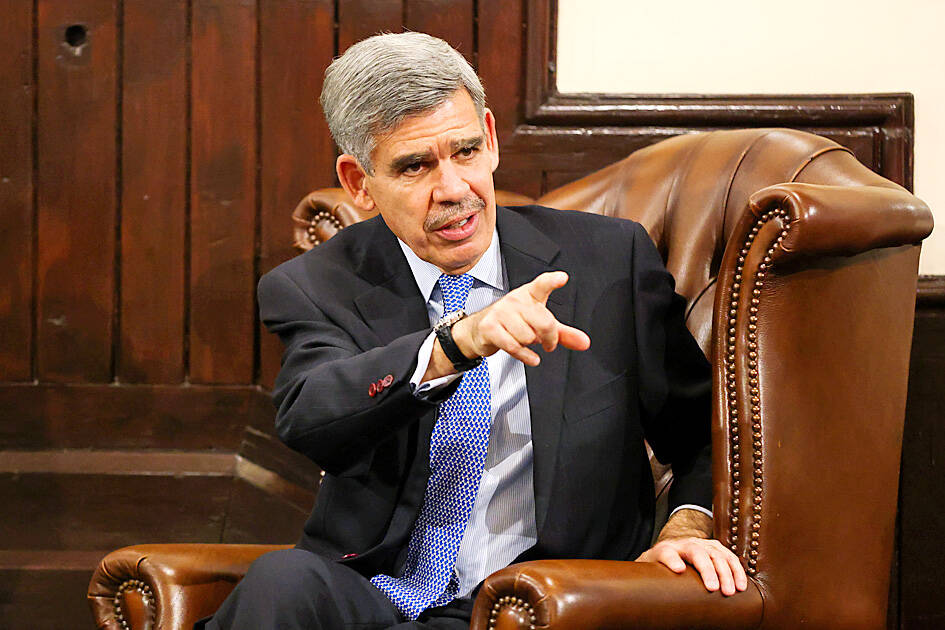
Photo: Bloomberg
The closely followed investor and strategist points to an upheaval in markets this past week, highlighted by the Bank of England intervening to stop a meltdown in gilts after a UK tax cut proposal, as a sign of economic fragility.
“This week has told us a lot about the transitions going on,” said El-Erian, who is also president of Queens’ College, Cambridge, and a Bloomberg Opinion columnist. “The next few weeks are going to be pretty volatile.”
More than a year ago, El-Erian said the Fed was lagging in its fight against the fastest inflation in decades, which appears to be prescient as the central bank began a rate-hike regime this year that shows no sign of stopping.
Financial markets from stocks to bonds to credit have dropped in value this year, and liquidity is shrinking to the point where the riskiest deals are now getting hung up.
“How do you reconcile the need to tighten monetary policy with the need to maintain financial stability?” El-Erian said. “That tension is playing out not just at the domestic level but the international level.”
The Bank of England was not the only central bank that has intervened in markets recently, as the Bank of Japan moved to shore up its currency against a soaring US dollar.
“These interventions, to be clear, are temporary,” El-Erian said. “It tells you that the global economy is not clearing on its own. If it is allowed to clear on its own, there’s going to be a lot of collateral damage.”
However, with global inflation proving to be persistent, the Fed and its peers likely have no choice but to stick with plans for rate increases, at least for now.
“There has to be more pain before we get to a world where central banks say we are changing our inflation target,” El-Erian said. “There is a justification for changing the inflation target, [but] the credibility blow would be significant.”
Meanwhile, Bank of America Corp strategists said that the Fed needs to slow the pace of rate hikes to prevent credit market dysfunction.
Distress, dispersion and debt-to-enterprise-value ratios were all above June highs, pushing the bank’s measure of credit stress to a “borderline critical zone” this week, strategists Oleg Melentyev and Eric Yu said.
A Fed slowdown and possible pause would “allow the economy to fully adjust to all the extreme tightening already implemented, but still working its way through the financial system’s plumbing,” they wrote in a note on Friday.
Failure to do so risks dysfunction that “would be difficult to contain and fix,” they added.
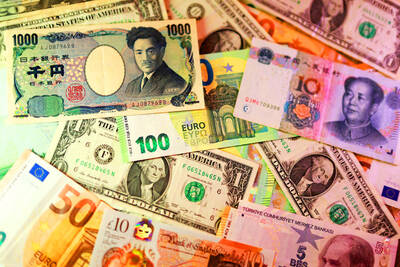
Taiwan’s foreign exchange reserves fell below the US$600 billion mark at the end of last month, with the central bank reporting a total of US$596.89 billion — a decline of US$8.6 billion from February — ending a three-month streak of increases. The central bank attributed the drop to a combination of factors such as outflows by foreign institutional investors, currency fluctuations and its own market interventions. “The large-scale outflows disrupted the balance of supply and demand in the foreign exchange market, prompting the central bank to intervene repeatedly by selling US dollars to stabilize the local currency,” Department of Foreign

ENERGY ISSUES: The TSIA urged the government to increase natural gas and helium reserves to reduce the impact of the Middle East war on semiconductor supply stability Chip testing and packaging service provider ASE Technology Holding Co (日月光投控) yesterday said it planned to invest more than NT$100 billion (US$3.15 billion) in building a new advanced chip testing facility in Kaohsiung to keep up with customer demand driven by the artificial intelligence (AI) boom. That would be included in the company’s capital expenditure budget next year, ASE said. There is also room to raise this year’s capital spending budget from a record-high US$7 billion estimated three months ago, it added. ASE would have six factories under construction this year, another record-breaking number, ASE chief operating officer Tien Wu

The EU and US are nearing an agreement to coordinate on producing and securing critical minerals, part of a push to break reliance on Chinese supplies. The potential deal would create incentives, such as minimum prices, that could advantage non-Chinese suppliers, according to a draft of an “action plan” seen by Bloomberg. The EU and US would also cooperate on standards, investments and joint projects, as well as coordinate on any supply disruptions by countries like China. The two sides are additionally seeking other “like-minded partners” to join a multicountry accord to help create these new critical mineral supply chains, which feed into

For weeks now, the global tech industry has been waiting for a major artificial intelligence (AI) launch from DeepSeek (深度求索), seen as a benchmark for China’s progress in the fast-moving field. More than a year has passed since the start-up put Chinese AI on the map in early last year with a low-cost chatbot that performed at a similar level to US rivals. However, despite reports and rumors about its imminent release, DeepSeek’s next-generation “V4” model is nowhere in sight. Speculation is also swirling over the geopolitical implications of which computer chips were chosen to train and power the new


 RSS
RSS