


Unilever PLC chief executive officer Alan Jope plans to retire at the end of next year following a tumultuous period where the company botched a potential £50 billion (US$53 billion) deal and irked investors with lackluster growth.
Jope, a long-term veteran of the consumer goods company, is to leave after only five years in the role, with no named successor in place.
The move comes after Jope tried unsuccessfully to buy GSK PLC’s consumer health unit earlier this year and less than three months after activist investor Nelson Peltz was granted a board position after building a stake in the British maker of Magnum ice cream and Dove soap.
Photo: REUTERS
Unilever would be seeking a new CEO at a time when the company, which is lagging its bigger rival Nestle SA, has to contend with the global surge in inflation, continued supply chain disruption and a record fall in the pound.
The board would start a search for his successor, considering both internal and external candidates, the company said yesterday.
Jope would have spent more than 35 years working for Unilever. He inherited a tough operating margin target of 20 percent and a focus on the “purpose” of his brands from predecessor Paul Polman. The former led to tight cost control and sales growth lagging behind that of archrival Procter & Gamble Co. The latter invited ridicule from investor Terry Smith, who questioned why products such as mayonnaise had to have purpose.
Jope’s resignation leaves Unilever plenty of time to find a successor, but such a long period of uncertainty amid high levels of inflation could unnerve investors. With no long-term boss in charge, Unilever is less likely to make bold decisions like selling significant parts of its food portfolio, for example.
Through last week, shares of Unilever had a total return of 12 percent since Jope became CEO in 2019.
Meanwhile, Nestle shares have returned 36 percent as chief executive officer Mark Schneider revamped the Swiss food company’s portfolio to focus on higher-growth businesses.
Earlier this year, one of Unilever’s top investors, Nick Train of Lindsell Train Investment Trust PLC, said the company has contracted a case of “long COVID,” with “pedestrian” results that did not compare with better performances from rivals.
Smith, the founder of Fundsmith and a large shareholder of Unilever, has been the most vocal critic, accusing the consumer giant of having “lost the plot” with its focus on social purpose.
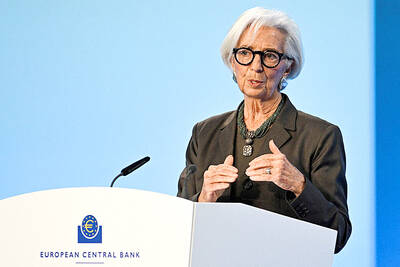
European Central Bank (ECB) President Christine Lagarde is expected to step down from her role before her eight-year term ends in October next year, the Financial Times reported. Lagarde wants to leave before the French presidential election in April next year, which would allow French President Emmanuel Macron and German Chancellor Friedrich Merz to find her replacement together, the report said, citing an unidentified person familiar with her thoughts on the matter. It is not clear yet when she might exit, the report said. “President Lagarde is totally focused on her mission and has not taken any decision regarding the end of
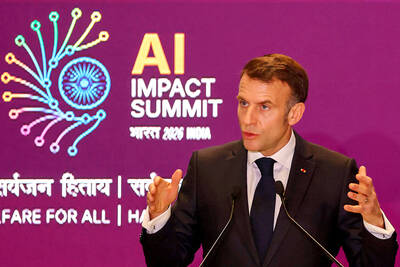
French President Emmanuel Macron told a global artificial intelligence (AI) summit in India yesterday he was determined to ensure safe oversight of the fast-evolving technology. The EU has led the way for global regulation with its Artificial Intelligence Act, which was adopted in 2024 and is coming into force in phases. “We are determined to continue to shape the rules of the game... with our allies such as India,” Macron said in New Delhi. “Europe is not blindly focused on regulation — Europe is a space for innovation and investment, but it is a safe space.” The AI Impact Summit is the fourth

AUSPICIOUS TIMING: Ostensibly looking to spike the guns of domestic rivals, ByteDance launched the upgrade to coincide with the Lunar New Year China’s ByteDance Ltd (字節跳動) has rolled out its Doubao 2.0 model, an upgrade of the country’s most widely used artificial-intelligence (AI) app, the company announced on Saturday. ByteDance is one of several Chinese firms hoping to generate overseas and domestic buzz around its new AI models during the Lunar New Year holiday, which began yesterday, when hundreds of millions of Chinese partake in family gatherings in their hometowns. The company, like rival Alibaba Group Holding Ltd (阿里巴巴), was caught off-guard by DeepSeek’s (深度求索) meteoric rise to global fame during last year’s Spring Festival, when Silicon Valley and investors worldwide were

Advanced Micro Devices Inc (AMD) is partnering with Tata Consultancy Services Ltd (TCS) to deploy the US chipmaker’s latest artificial intelligence (AI) data center technology in India, challenging Nvidia Corp in one of the world’s fastest-growing markets. AMD is to offer its Helios data center blueprint and work with TCS to support up to 200 megawatts of AI infrastructure capacity in India, the companies said in a statement on Monday. “AI adoption is accelerating from pilots to large-scale deployments, and that shift requires a new blueprint for compute infrastructure,” AMD chief executive officer Lisa Su (蘇姿丰) said in the statement. “Together with


 RSS
RSS